
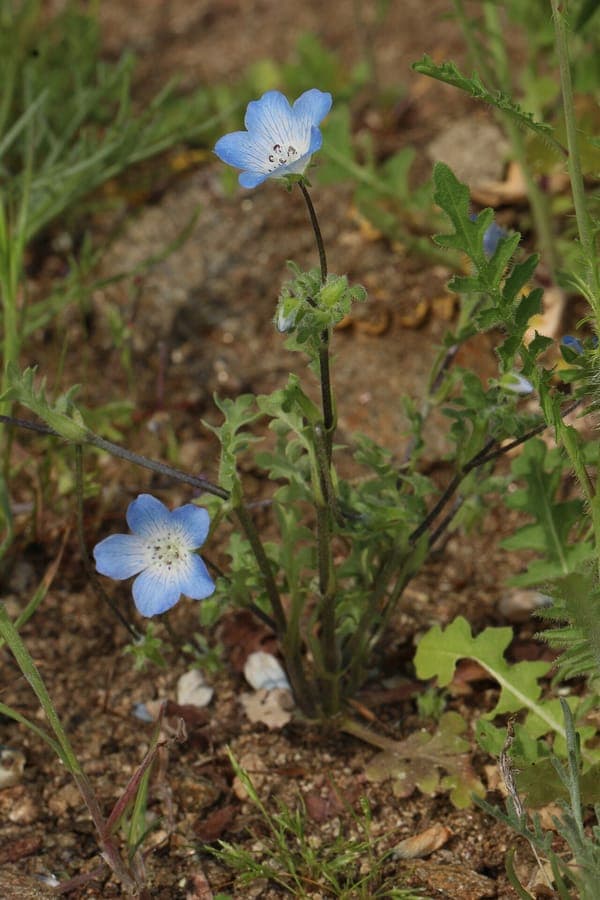
Walter Siegmund (talk) / CC BY-SA 4.0, via Wikimedia Commons
Nemophila menziesii: complete guide
Nemophila menziesii
¿Quieres ver Nemophila menziesii: complete guide en tu jardín?
1 minuto, sin tarjeta de crédito
Overview
Nemophila menziesii, commonly known as Baby's-blue-eyes or California bluebell, is a delicate small annual plant native to the western United States, particularly California. This diminutive plant in the Boraginaceae family is celebrated for its tender, finely divided foliage and especially its enchanting tiny sky-blue flowers with white centers. This charming plant reaches only 15-30 cm tall and is perfect for borders, between stonework, and in hanging baskets.
Appearance and Bloom
Nemophila menziesii forms compact, low-growing mounds approximately 15-30 centimeters high. The foliage is fine, silky, and lightly hairy. The flowers are small, about 2-3 centimeters across, with characteristic sky-blue coloring and white eyes with dark spots around the center. They appear in great profusion April to June, creating a sea of blue. The flowers are highly attractive to bees and butterflies.
Ideal Location
Baby's-blue-eyes thrives best in sunny to partially shaded locations. The plant tolerates full sun but in very hot climates some protection from intense afternoon sun is appreciated. At least three to four hours of direct sunlight is needed for optimal blooming. Partial shade reduces flowering somewhat but provides more tolerance in extreme heat.
Soil
Nemophila is not very particular about soil. It thrives in average to fertile, well-draining soil. A sandy or light loam is ideal. Heavy, clay-based soils should be improved with sand or grit. The plant also grows in poor soil. Avoid wet or boggy conditions. pH is not critical, slightly acidic to neutral is fine.
Watering
Once planted, Baby's-blue-eyes needs regular water until well-established. Keep soil moist but not waterlogged. In dry periods provide regular watering. This annual is more moisture-sensitive than other wildflowers. Mulching helps retain moisture. In containers water frequently, especially in warm seasons. Avoid waterlogging though.
Diseño gratis
¿Quieres ver Nemophila menziesii: complete guide en tu jardín? Crea un diseño gratis ahora.
Pruning
Pruning is minimal. Regularly deadhead spent flowers to encourage blooming and prolong flowering. This leads to more continuous flowers throughout the season. If the plant declines in very hot periods, you can pinch it back to encourage new growth and reblooming.
Maintenance Calendar
Spring (March-April): Sow seeds directly into garden or in trays indoors four weeks before last frost. Keep soil moist. Summer (May-June): Regularly deadhead spent flowers. Water regularly. Avoid excessive heat. Autumn (July-September): Plant will decline in very hot months. Possible reblooming as temps cool. Winter (October-February): Plant dies back after frost as it is annual.
Winter Hardiness
Nemophila menziesii is an annual plant that is not frost-hardy. It grows as a winter or spring annual in mild climates or as a summer annual in cold regions. In temperate zones above 0 degrees, seeds can be sown early in the season. Seed can be sown in autumn for winter growth in zones 8-10.
Companion Plants
Baby's-blue-eyes pairs beautifully with other spring and early summer flowers. Plant combinations including poppies, linaria, alyssum, and snapdragons are charming. Silvery foliage like senecio and dusty miller creates nice contrast. In wildflower mixes it combines well with California poppy, tidytips, and lupine.
Summary
Nemophila menziesii is an enchanting little flower that adds great charm to any garden. With its sky-blue petals marked with white eyes and compact growth habit, it's perfect for borders, rock gardens, and hanging planters. Easy to grow from seed, this plant promises months of cheerful blooms. For a small but impactful accent in the spring garden, Baby's-blue-eyes is unbeatable.
Find seeds at local nurseries and garden centers. Visit gardenworld.app/en for more garden inspiration. Check gardenworld.app/en for plant advice.
¿Quieres ver Nemophila menziesii: complete guide en tu jardín? Crea un diseño gratis ahora.
Sube una foto, elige un estilo y obtén un diseño fotorrealista con lista de plantas en menos de un minuto.
Más de 10.000 jardines diseñados
Sin tarjeta de crédito


Plantas similares
Western waterleaf: complete guide
Hydrophyllum occidentale
Full growing guide for western waterleaf (Hydrophyllum occidentale): shade tolerance, soil needs, watering, winter hardiness and naturalistic garden use.
Limestone phacelia (Phacelia affinis): complete guide
Phacelia affinis
Full guide to Phacelia affinis, the limestone phacelia: sowing tips, purple-blue bee flowers, drought tolerance and uses in dry or wildlife gardens.
Pyrenean viper's bugloss: complete guide
Echium asperrimum
Echium asperrimum is a striking biennial from the western Mediterranean with rough bristly stems and vivid blue flowers. A magnet for bees and a bold border plant.