
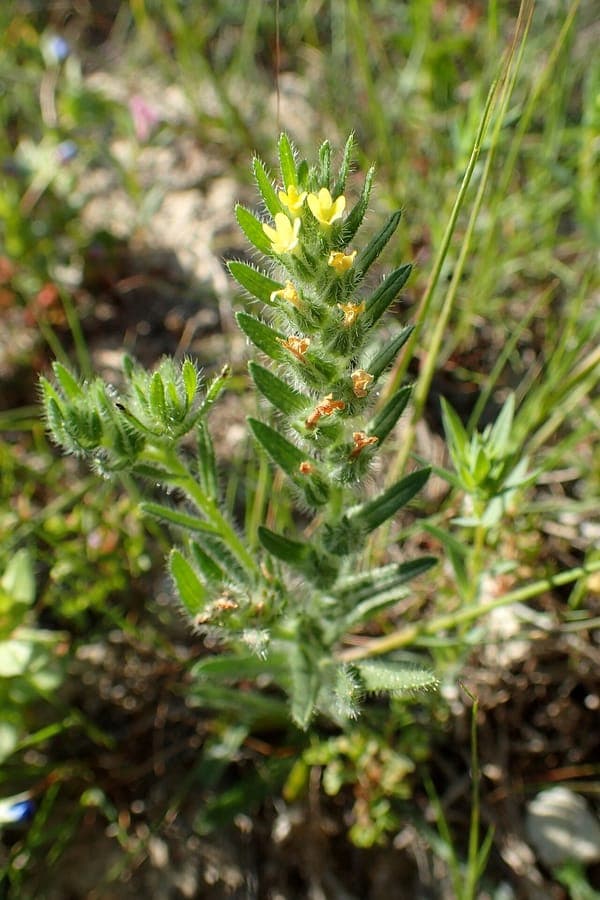
Krzysztof Ziarnek, Kenraiz / CC BY-SA 4.0, via Wikimedia Commons
Neatostema apulum: complete guide
Neatostema apulum
¿Quieres ver Neatostema apulum: complete guide en tu jardín?
1 minuto, sin tarjeta de crédito
Overview
Neatostema apulum, also known as Yellow Gromwell or Hairy Sheepweed, is an interesting Mediterranean herb from the Boraginaceae family. This plant grows naturally in the Mediterranean region, from the Canary Islands to the Arabian Peninsula.
The plant is known for its bright yellow flowers and hairy foliage. With its compact growth and attractive appearance, Neatostema apulum is suitable for dry gardens, rock gardens, and Mediterranean plantings. The plant is very drought-loving and requires minimal watering.
Appearance and Bloom
Neatostema apulum is an annual or winter-annual plant growing 20 to 50 centimeters tall. The plant has lance-shaped, hairy leaves with a gray, silky appearance.
The flowers are yellow to orange-yellow in color, approximately 5 to 10 millimeters wide. They appear from April to June in dense, branched clusters at the top of stems. The flowering period is relatively short, typically two to three months.
Ideal Location
Neatostema apulum grows best in full sun locations. The plant needs at least six to eight hours of direct sunlight daily.
Complete shade leads to poor flowering and weak growth. The plant is very heat-tolerant and grows well against warm walls or in hot garden spots.
Good air circulation is preferable, especially in humid climates, to prevent fungal diseases.
Soil
Neatostema apulum requires well-drained, dry soil. The plant grows best in calcareous, sandy to gravel soil.
Heavy, moist soils are not suitable. To improve growth, add sand, gravel, or pebbles to the soil to reduce water retention. The ideal pH value is between 7.0 and 8.0.
The plant is very drought-loving and requires minimal fertilization.
Diseño gratis
¿Quieres ver Neatostema apulum: complete guide en tu jardín? Crea un diseño gratis ahora.
Watering
Neatostema apulum is very drought-loving and tolerates drought very well. Regular watering is not necessary.
During the growing period (spring), occasional watering can be given, but this is usually not needed unless extreme drought occurs. After flowering stops, watering can be greatly reduced.
Excessive water can lead to root rot. Better too little water than too much.
Pruning
Neatostema apulum requires minimal pruning. Remove faded flowers and dead plant material as needed.
The plant does not need formative pruning. Let the plant grow in its natural shape.
Maintenance Calendar
January to March: Minimal watering. Plant preparation for growth.
April to June: Flowering period. Water as needed. Remove faded flowers.
July to September: Blooming declining. Stop watering. Plant enters summer rest.
October to December: Winter rest. Minimal care.
Winter Hardiness
Neatostema apulum is sensitive to frost. The plant tolerates only light frost, down to about minus 5 degrees Celsius.
In cold climates, the plant is best grown as an annual. Collect seed for next year for replanting.
Companion Planting
Neatostema apulum works well with other Mediterranean drought-tolerant plants:
- Cistus species for white and pink flowers
- Phlomis species for yellow flowers
- Lavender for purple flowers and fragrance
- Santolina for silver foliage
Conclusion
Neatostema apulum is an excellent choice for xeriscape and Mediterranean gardens. Its yellow flowers, drought tolerance, and minimal maintenance requirements make it valuable in garden design.
With attention to dry soil and full sun, this plant will grow into an attractive specimen. For warm, dry gardens, it is absolutely recommended.
Visit gardenworld.app for more Mediterranean garden design inspiration.
¿Quieres ver Neatostema apulum: complete guide en tu jardín? Crea un diseño gratis ahora.
Sube una foto, elige un estilo y obtén un diseño fotorrealista con lista de plantas en menos de un minuto.
Más de 10.000 jardines diseñados
Sin tarjeta de crédito


Plantas similares
Western waterleaf: complete guide
Hydrophyllum occidentale
Full growing guide for western waterleaf (Hydrophyllum occidentale): shade tolerance, soil needs, watering, winter hardiness and naturalistic garden use.
Limestone phacelia (Phacelia affinis): complete guide
Phacelia affinis
Full guide to Phacelia affinis, the limestone phacelia: sowing tips, purple-blue bee flowers, drought tolerance and uses in dry or wildlife gardens.
Pyrenean viper's bugloss: complete guide
Echium asperrimum
Echium asperrimum is a striking biennial from the western Mediterranean with rough bristly stems and vivid blue flowers. A magnet for bees and a bold border plant.