
Wikimedia Commons / CC BY-SA 3.0, via Wikimedia Commons
Bog-asphodel: complete guide
Narthecium ossifragum
¿Quieres ver Bog-asphodel: complete guide en tu jardín?
1 minuto, sin tarjeta de crédito
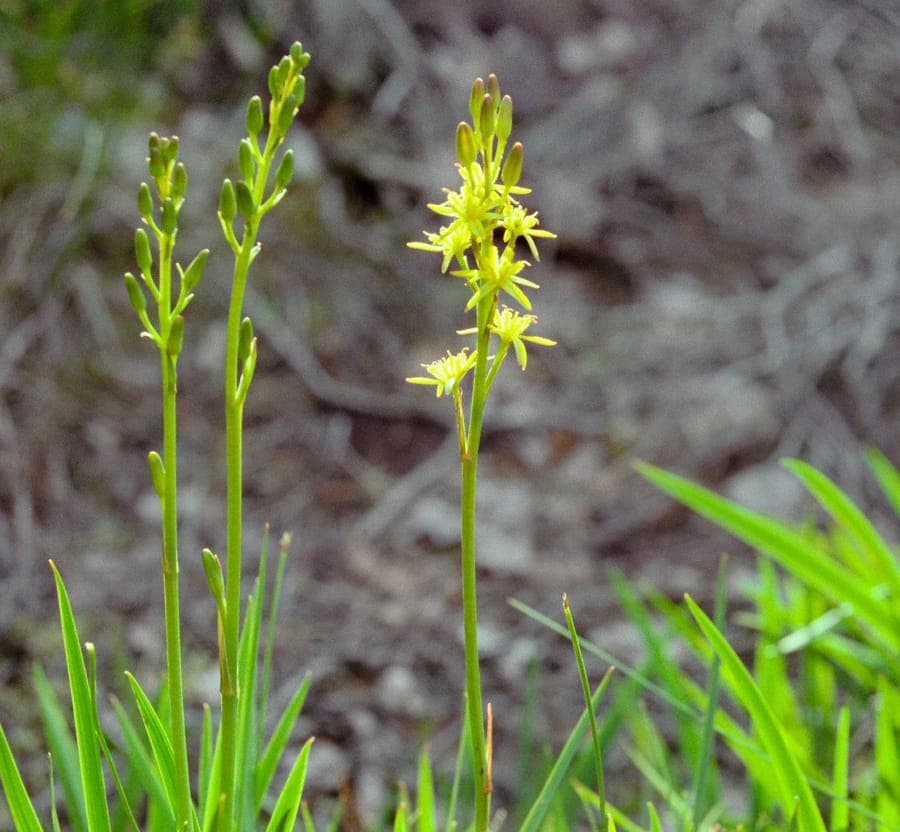
Bog-asphodel, scientifically designated Narthecium ossifragum, is a distinctive, frost-hardy plant from the Nartheciaceae family that specializes in life in extremely acidic, peaty soils. This native European plant is valuable for wetland designs, peat gardens and other challenging water-holding environments with low nutrient status. The plant is characterized by narrow, grass-like leaves growing in dense rosettes and elegant spikes that bear bright yellow flowers in summer. The overall height reaches approximately 20-40 cm, depending on growing conditions.
Appearance and bloom
Bog-asphodel presents itself as a compact, dense cluster of grass-like leaves with a striking yellow-orange tint in certain seasons. The leaves are very narrow, 2-4 mm wide, and remain close to the ground. From June through August, characteristic flower spikes appear bearing small, star-shaped flowers approximately 8 mm in diameter. The flowers are pure yellow with six petals and form an attractive pyramidal flower head. After flowering, small seed capsules develop, turning red-orange and highly decorative. Seeds are dispersed by wind and water.
Ideal location
Bog-asphodel thrives exclusively in very wet locations, especially peatland and low fen wetlands with water levels at or above soil surface. The plant grows best in locations where soil remains moisture-saturated at least 70% of the year. Sunlight is important - at least 4-5 hours direct daily sunlight is needed for good flowering. In deep shade or partial shade the plant grows but flowers much less profusely. Windy locations are acceptable but not ideal.
Soil and planting hole
Soil for Bog-asphodel must be extremely acidic, preferably with pH between 3.5 and 4.5. The plant grows in naturally peaty soils or soils with very high organic matter content. If you wish to cultivate this plant in regular garden soil, prepare an extremely acidic potting soil by mixing white sand and fine peat in a ratio of 40% peat, 40% white sand and 20% water-retention granules. Plant in containers at least 25 cm diameter to maintain regular moisture supply.
Water management
Water is critical for Bog-asphodel - this plant must never dry out. In gardens with natural water-tolerant conditions, it grows without supplemental care. In drier climates or in containers, ensure constantly wet feet, but not outright waterlogging. Water-retention granules in potting soil help considerably. In very warm periods, daily misting can be beneficial. Non-chlorinated water is strongly recommended.
Diseño gratis
¿Quieres ver Bog-asphodel: complete guide en tu jardín? Crea un diseño gratis ahora.
Pruning and maintenance
Bog-asphodel requires minimal pruning. Remove only dead leaves carefully in early spring. After flowering, flower stems can be removed if you wish to prevent seed formation, but this is not strictly necessary. Avoid all chemical fertilizers - this plant is adapted to very nutrient-poor soils and chemical inputs can be harmful.
Maintenance calendar
March to April: check water levels and carefully remove dead foliage. May through August: flowering period, minimal intervention. September to October: seed plumes can remain for decoration. November to February: quiet period, monitor moisture.
Winter hardiness
Bog-asphodel is fully hardy and grows naturally in Great Britain, Ireland, the Netherlands, France, Germany and Scandinavia to the north. The plant survives temperatures to minus 15 Celsius without protective measures. However, because it is a moisture-loving plant, frost damage from waterlogging in winter must be prevented. Ensure no ice forms around roots in overly wet soils.
Planting dimensions
Bog-asphodel grows slowly and spreads via underground rhizomes. Plant 40-50 cm apart for complete coverage over 2-3 years. In container culture, place multiple plants in a larger pot for faster full effect.
Companion plants
Bog-asphodel grows well with other peat-loving plants such as pitcher plants (Sarracenia), sphagnum moss (Sphagnum), sundew species, and small peat-associated grasses. Combinations with small cranberries and peat-dwelling shrubs are also possible. The plant works well in peat gardens where other plants fail due to acidification.
Availability
Bog-asphodel is not widely available in regular garden centers. It is found particularly among specialized peat plant suppliers and some botanical gardens. Online ordering through Intratuin or Gamma may be possible, but plant material is rarely in regular stock. Expect higher prices (10-20 euros per plant) due to specialization.
Closing remarks
Bog-asphodel is ideal for gardeners with wet, peaty soils who wish to maintain or restore this unique flora. The plant is ecologically valuable because it is host plant for diverse insect species and seed-eaters. For gardenworld.app users wishing to recreate peatland landscapes or increase biodiversity, Bog-asphodel offers an attractive native option. It requires special attention to growing conditions, but the effort is worthwhile.
¿Quieres ver Bog-asphodel: complete guide en tu jardín? Crea un diseño gratis ahora.
Sube una foto, elige un estilo y obtén un diseño fotorrealista con lista de plantas en menos de un minuto.
Más de 10.000 jardines diseñados
Sin tarjeta de crédito


Plantas similares
Acer pycnanthum: complete guide
Acer pycnanthum
Acer pycnanthum, the Japanese swamp maple, is a fast-growing tree with early red flowers and brilliant autumn color, ideal for damp garden settings.
Freeman maple: complete guide
Acer × freemanii
Everything about the Freeman maple (Acer x freemanii): a fast-growing shade tree with spectacular autumn colour for large gardens.
Silver vine: complete guide
Actinidia polygama
Discover silver vine (Actinidia polygama): a hardy climbing plant with silvery foliage, loved by gardeners and cats alike.