
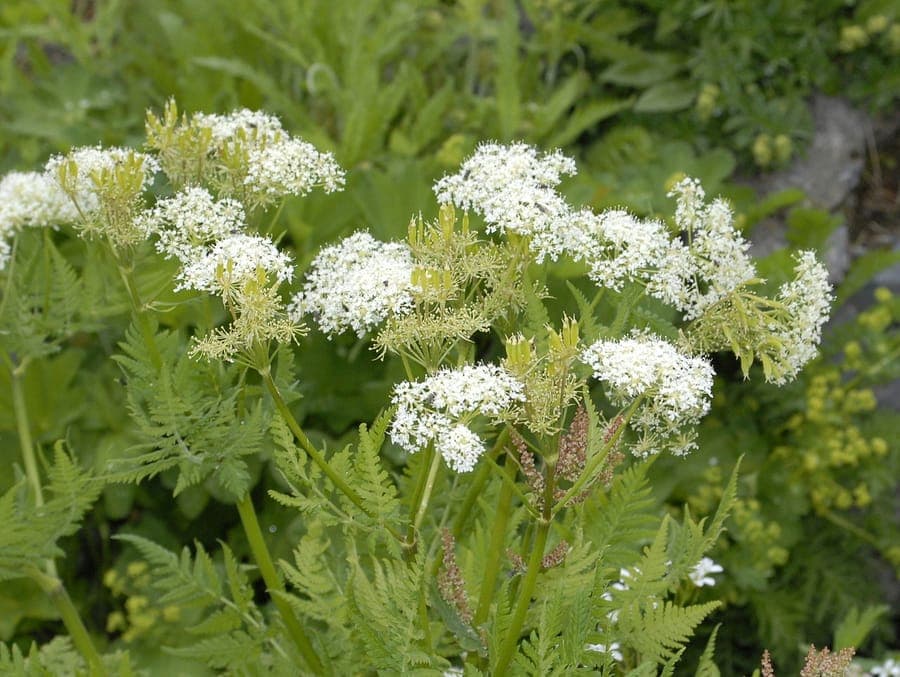
Hectonichus / CC BY-SA 3.0, via Wikimedia Commons
Garden myrrh: complete guide
Myrrhis odorata
¿Quieres ver Garden myrrh: complete guide en tu jardín?
1 minuto, sin tarjeta de crédito
Overview
Garden myrrh (Myrrhis odorata) is a remarkable ornamental plant from the carrot family (Apiaceae) that distinguishes itself through its characteristic anise-scented foliage and delicate flowers. This plant originates from southern and central Europe, where it naturally occurs in mountain meadows and woodland edges. Garden myrrh is a mid-height perennial reaching 60-100 cm tall and readily spreads through self-seeding. What makes this plant particularly special is the refined aniseed fragrance released when brushing past the foliage, which always surprises garden visitors. The plant grows best in partial shade with adequate moisture, making it ideal for underplanting beneath deciduous trees or positioning against a north-facing wall.
This plant is invaluable in an ecological garden because it attracts honey and pollen bees and harbors many beneficial insects. With its airy growth pattern and cheerful flowers from May to June, garden myrrh adds romantic, unforced beauty to any carefully maintained garden space.
Appearance and bloom cycle
Garden myrrh grows to a height of 60-100 cm and forms a broadly spread, open silhouette that is never showy but always elegant. The leaves are very characteristic: twice to thrice pinnately divided with fine, triangular leaflets closely packed along the side veins. Lower leaves can reach 30 cm long and have soft, almost feathery texture. The stem is green to reddish, smooth, and erect growing. Flowers appear from May through early July in dense, flat umbels 3-5 cm across, where each individual flower is tiny but collectively very attractive. The flowers are white to very pale pink, sometimes with a green tint at center.
After flowering, interesting elongated fruits develop that remain green until ripening against September, becoming dark brown. These fruits are of interest to insects and birds, contributing to the food web structure in a lively garden. The plant dies back after the first frosts but typically reseeds generously for the next season.
Ideal location
Garden myrrh performs best in partial shade locations receiving 3-5 hours of indirect sunlight daily. This makes it ideal for placement beneath trees, against northeast or northwest sides of buildings, or under the leaf canopies of larger garden plants. In full shade, the plant grows taller and thinner, making it less compact. In full sun, it can suffer heat stress during very hot, dry summers, especially in southern Netherlands and Belgium.
The ideal spot combines gentle morning or evening sun with protective afternoon shade. In a woodland-like garden setting, garden myrrh excels, especially when growing at the feet of larger hornbeams, birches, or maples. Ensure it does not stand directly under dripping roof eaves where it would remain perpetually oversaturated.
Soil requirements
Garden myrrh prefers humus-rich, moisture-retentive soils with good drainage structure. Ideal pH ranges between 5.5 and 7.5, meaning it thrives in virtually all Dutch and Belgian gardens. When planting, thoroughly incorporate compost, leaf mold, or well-rotted humus into the planting hole to improve water-holding capacity. The plant tolerates drought stress poorly, so ensure good water availability, especially during the first growing season.
The plant grows better in nutrient-rich soils, so an annual topdressing of garden compost in spring noticeably improves growth vigor. Avoid excessive fertilization as this leads to succulent, weak foliage more susceptible to fungal and insect damage. In sandy soils, extra organic matter must be added to improve water availability.
Diseño gratis
¿Quieres ver Garden myrrh: complete guide en tu jardín? Crea un diseño gratis ahora.
Watering
Garden myrrh requires regular watering, especially during the growing season (May through August). Water well at least once weekly, more frequently during warm periods or dry summers. The soil should be moisture-retentive without waterlogging; ensure good drainage. A 5 cm mulch layer of leaf mold or wood chips around plants helps improve moisture retention and buffer temperature fluctuations.
In winter, after the plant has died back, little water is needed, though young seedlings and established plants should not completely dry out. If growing garden myrrh in containers, water more cautiously and allow soil to dry slightly between waterings.
Maintenance and deadheading
Garden myrrh is a minimal-maintenance plant once established. Do not aggressively remove spent flowers unless you wish to prevent self-seeding - many gardeners actually appreciate that the plant reseeds itself. Dead stem material can be removed in autumn after complete die-back, or can be left until next spring to provide bird food and insect shelter.
Pinch back growth tips on young plants in May to encourage bushier, more compact growth. No further pruning is needed. Replace the plant every 3-4 years in spring or allow natural seedlings to freely establish in suitable garden locations.
Maintenance calendar
March to April: Remove dead foliage from the previous season. Add compost and water well. Check for young seedlings to relocate if needed.
May to June: Enjoy full bloom. Water regularly. Allow insect populations to reproduce around flowers.
July to August: Continue watering during warm periods. Do not remove spent flower petals unless preventing self-seeding.
September to October: Allow seedlings to spread. Observe darkening fruits and potential dispersal.
November to February: Plant dies back completely. Material can remain in place for bird food and insect shelter.
Winter hardiness
Garden myrrh is completely winter hardy in the Netherlands, Belgium, and Germany. It can withstand temperatures down to -20 degrees Celsius (USDA zone 5) without protection. The plant is actually a short-lived perennial that typically exhausts itself after 2-3 years but continuously renews itself through seeding. This is not a problem - many gardeners appreciate this because it constantly produces new, vigorous specimens.
Companion planting combinations
Garden myrrh works beautifully in combination with other partial-shade applications of Apiaceae family members. Try combining it with wild carrot (Daucus carota) for a related family feeling. Good planting partners also include shade-tolerant plants such as woodrushes (Luzula), white dead-nettle (Lamium album), and woodland forget-me-not (Myosotis sylvatica).
In moister soils, it works well with astilbe, stinking hellebore (Helleborus foetidus), and lady's mantle (Alchemilla). For self-seeding enthusiasts, it combines beautifully with other self-seeding lovers such as sweet violet (Viola odorata) and red dead-nettle (Lamium purpureum). At gardenworld.app you will find advice on planting schemes and shade garden design.
Closing thoughts
Garden myrrh is a peculiar and frosty characterful centerpiece for partial shade areas of your garden. With its fragrant foliage, delicate flowers, self-seeding capability, and bird-attracting fruits, it is a gift for both first-time and established gardeners. Search for plant material from suppliers such as Intratuin and Gamma in the Netherlands, or ask local garden centers. At gardenworld.app you will discover multiple inspiring garden designs in which garden myrrh plays a role.
¿Quieres ver Garden myrrh: complete guide en tu jardín? Crea un diseño gratis ahora.
Sube una foto, elige un estilo y obtén un diseño fotorrealista con lista de plantas en menos de un minuto.
Más de 10.000 jardines diseñados
Sin tarjeta de crédito


Plantas similares
Whorled carrot: complete guide
Daucus involucratus
Daucus involucratus is a Mediterranean umbellifer with white flower heads framed by lacy bracts. Growing this gravel garden gem.
Daucus muricatus: complete guide
Daucus muricatus
Daucus muricatus, the spiny wild carrot, grows wild on Mediterranean coasts. Discover sowing, June-July bloom, and wildflower meadow use.
Daucus pumilus: complete guide
Daucus pumilus
Daucus pumilus is a dwarf wild carrot relative with white lacy umbels, thriving on dunes and coastal rock in poor, fast-draining soil.