
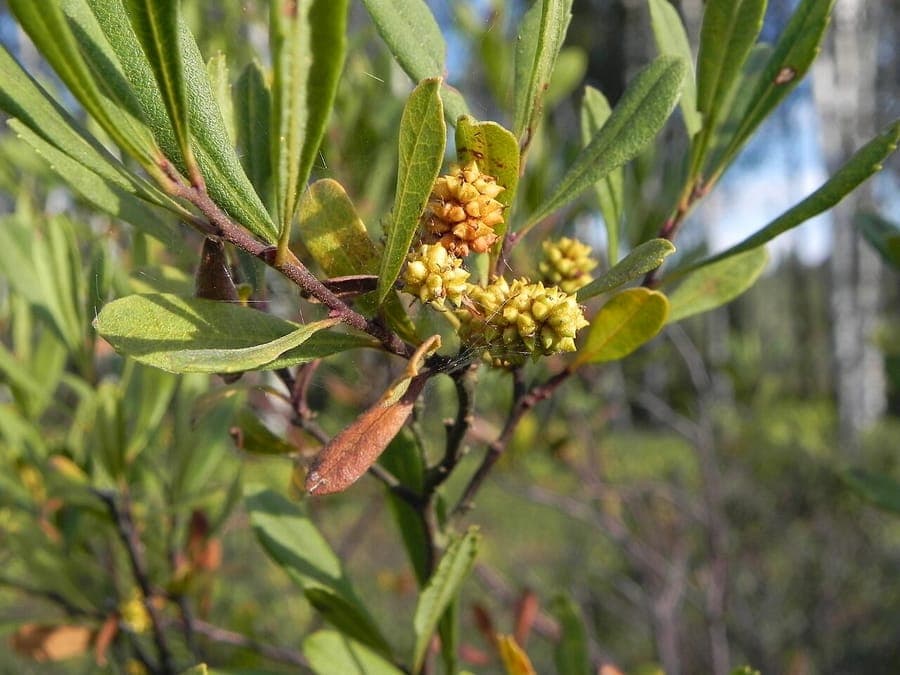
Hajotthu / CC BY 3.0, via Wikimedia Commons
Sweet gale: complete guide
Myrica gale
¿Quieres ver Sweet gale: complete guide en tu jardín?
1 minuto, sin tarjeta de crédito
Overview
Sweet gale (Myrica gale), also called bog myrtle, is a fascinating native shrub of the Myricaceae family. In its natural habitat, it thrives in nutrient-poor, acidic bogs and heaths across northern Europe and North America. This versatile plant combines aromatic, oil-rich foliage, decorative catkins (especially March-April), and ecological significance as a nitrogen-fixing partner via beneficial root fungi. Sweet gale is invaluable for difficult, acidic garden corners where other shrubs struggle. On gardenworld.app, you can design a natural wetland or heath border with sweet gale as the centerpiece.
Appearance & bloom cycle
Sweet gale is a compact to medium shrub reaching 100 to 200 cm tall, with finely branched twigs. The leaves are lanceolate, deep green, 2 to 4 cm long, and covered in fragrant reddish-brown resin dots that contain aromatic essential oils. When crushed, the foliage releases a warm, spicy-fresh aroma reminiscent of bay and lemongrass. Flowers are unique: both male and female catkins appear on the same plant (monoecious) from March to May. These are compact, aromatic catkins, reddish-brown to gold in color, about 1-2 cm long. Female catkins ripen into small, waxy nutlets. Sweet gale is semi-evergreen, retaining leaves partially through winter in milder climates.
Ideal location
Sweet gale thrives in full sun to partial shade (light scale 6 to 8 out of 10). In full sun (8/10), aromatic oils peak and leaf color is most intense. It also grows well in partial shade beneath high, scattered trees. Avoid heavy shade in woodland edges - growth becomes weak and aromatic compounds diminish. The plant tolerates windy sites better than many shrubs. Open moorland or wet slopes suit it well. In areas with intense summer drought (southern UK), light afternoon shade is beneficial. On gardenworld.app, design a heath garden combining sweet gale with heathers and dwarf conifers.
Soil requirements
Sweet gale fails on rich, neutral to alkaline soils. It truly requires very nutrient-poor, acidic to strongly acidic soils (pH 4.0 to 5.5). This is a major advantage: on sites where many shrubs fail (exhausted heathlands, old agricultural land), sweet gale flourishes. On neutral soil (pH 6-7), growth is moderate. Good drainage is essential - the plant tolerates waterlogging better than stagnation. For best results, add nothing except perhaps acidic peat or old heathland soil at planting. Avoid any commercial fertilizers entirely.
Watering
Sweet gale is a moist to wet-loving plant thriving in bog conditions with high water tables. In typical gardens, water regularly, especially for the first two years after planting. In dry spells, keep soil moisture at 5 to 10 cm depth. Once established (after 3-4 years), it's reasonably drought-tolerant through deep roots, though growth diminishes. Container plants need daily watering in summer. Use soft, acidic water (rainwater) rather than lime-rich tap water whenever possible.
Diseño gratis
¿Quieres ver Sweet gale: complete guide en tu jardín? Crea un diseño gratis ahora.
Pruning
Sweet gale requires minimal pruning. Light shaping after bloom (May-June) helps maintain compact form. Remove dead branches in early spring (February-March). Overgrown specimens can be cut back hard to 30-40 cm in late winter - they regrow vigorously. Avoid pruning after September, as it stimulates tender new growth vulnerable to winter.
Maintenance calendar
- Jan: Inspect for winter damage; remove wild growth
- Feb: Heavy shaping possible on mature plants
- Mar: Catkin peak; light prune after flowering
- Apr: Flowering peaks; water in dry spells
- May: Growth accelerates; less water if rainfall adequate
- Jun: Shape young plants; remove competing stems
- Jul: Growth slows; minimal care
- Aug: Check for drought stress; extra water only if needed
- Sep: Growth halts; no pruning starts
- Oct: Prepare for winter; protect young plants
- Nov: Dormant period
- Dec: Minimal care
Winter hardiness
Sweet gale is extremely hardy to USDA zone 4, suitable for all regions across the British Isles and northern Europe. Young plants (first two winters) may benefit from light protection with branches or straw in severe winters. Mature plants are completely self-sufficient. In harsh winters, leaves may suffer minor damage but recovery is quick in spring.
Companion plants
Sweet gale thrives with other heathland and wetland plants: cross-leaved heath (Erica tetralix), sundew (Drosera), sphagnum mosses, and cotton grass (Eriophorum). In mixed heath borders, combine it with dwarf juniper, wintergreen, and bog rosemary. In wetter situations, it pairs well with alder buckthorn (Frangula alnus) and common reed. Avoid heavy feeders like rhododendron and lavender - they require different soil pH and nutrients. On gardenworld.app, create a bird-friendly, pollinator-attracting heath garden.
Closing
Sweet gale is an underrated native shrub opening possibilities for specialized acidic and wetland garden experiments. Preferring acidic, nutrient-poor soil and consistent moisture, it thrives where others fail. It combines aromatic appeal, ecological benefit (nitrogen fixation), and aesthetic value. Propagate via seed or half-ripe cuttings in summer. UK and European nurseries increasingly stock it to support native planting schemes. For anyone with a garden corner where conventional shrubs struggle due to poor soil, sweet gale is a gift. Once established, it requires minimal attention and can serve for decades without intervention. It attracts butterflies and insects that feed wild birds. The fragrances of its leaves transport you back to wild European heaths of centuries past. This is gardening in harmony with nature - a trend of rising popularity among conservation-minded gardeners. Sweet gale teaches us that poor soil is not a garden curse, but an opportunity to create unique, specialized landscapes thatstandalone for their character and ecological significance. Use gardenworld.app to design a specialized acidic-site garden with sweet gale as a key component in a thriving native plant community.
¿Quieres ver Sweet gale: complete guide en tu jardín? Crea un diseño gratis ahora.
Sube una foto, elige un estilo y obtén un diseño fotorrealista con lista de plantas en menos de un minuto.
Más de 10.000 jardines diseñados
Sin tarjeta de crédito


Plantas similares
Acer pycnanthum: complete guide
Acer pycnanthum
Acer pycnanthum, the Japanese swamp maple, is a fast-growing tree with early red flowers and brilliant autumn color, ideal for damp garden settings.
Freeman maple: complete guide
Acer × freemanii
Everything about the Freeman maple (Acer x freemanii): a fast-growing shade tree with spectacular autumn colour for large gardens.
Silver vine: complete guide
Actinidia polygama
Discover silver vine (Actinidia polygama): a hardy climbing plant with silvery foliage, loved by gardeners and cats alike.