
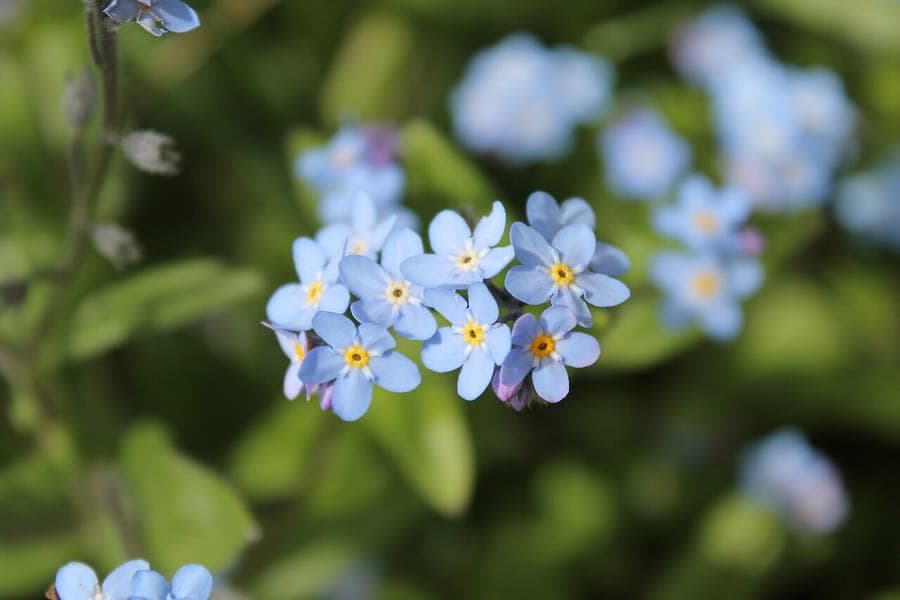
Kev22 / CC BY-SA 4.0, via Wikimedia Commons
Wood forget-me-not: complete guide
Myosotis sylvatica
¿Quieres ver Wood forget-me-not: complete guide en tu jardín?
1 minuto, sin tarjeta de crédito
Overview
Wood forget-me-not (Myosotis sylvatica) is a beloved biennial flower cherished for its mass of delicate sky-blue blooms. A member of the Boraginaceae family (bugloss family), it naturally inhabits woodlands and damp meadows across temperate Europe, from Germany to the Alps. The plant has long captured hearts and gardens alike, with its name evoking romantic sentiment. Today, it remains a staple of English cottage gardens and spring borders throughout Europe and North America. On gardenworld.app, you can design a woodland-inspired spring border featuring forget-me-nots beneath shade trees and alongside ferns.
Appearance & bloom cycle
Wood forget-me-not typically reaches 20 to 50 cm in height, with slender, softly hairy stems that branch from the base. The leaves are lanceolate to ovate, 2 to 4 cm long, with a distinctly hairy texture. The star attraction is the flowers: tiny, five-petalled blooms in vivid sky blue with golden yellow centers, each about 0.5 to 1 cm across. These appear in dense clusters from May through August, peaking in June. The flowering period lasts 10 to 12 weeks depending on temperature and moisture. After pollination, small dark-brown seeds develop and self-sow readily.
Ideal location
Forget-me-nots thrive in light shade to partial sun, scoring a 5 to 6 on the 10-point light scale. Full sun, especially in hot climates, can scorch leaves and shorten bloom time. An ideal position is beneath deciduous trees or shrubs where dappled light filters through, replicating their woodland origin. North to northeast-facing borders are perfect in warmer regions. In cooler climates like Scotland or northern England, they tolerate more direct sunlight. Avoid exposure to harsh afternoon sun in zones 8 to 9. A moist, cool north wall is ideal in southern England. On gardenworld.app, you can plan a shaded spring scheme with forget-me-nots, hellebores, and brunnera.
Soil requirements
Forget-me-nots prefer moist, humus-rich, well-drained soil with a pH between 6 and 7. They struggle in dry, sandy soils and compact clay without amendment. Work compost or peat into the bed before sowing to retain moisture without creating waterlogging. A natural forest floor of decaying leaves and wood mulch is ideal. Heavy clay should be broken up with grit and organic matter. Avoid boggy or permanently saturated ground, which invites root rot and fungal disease.
Watering
Keep soil consistently moist throughout the growing season, especially during establishment and flowering. Water seedlings once to twice weekly, depending on weather and soil drying. Young transplants need reliable moisture for the first four weeks. Mature flowering plants require weekly watering during dry spells from May to August. Use soft rainwater when possible - tap water with high lime can stress plants. Ensure water drains away from stem bases to prevent collar rot.
Pruning
Forget-me-nots require minimal pruning. Remove spent flower clusters regularly to extend blooming into late summer. If you wish to collect seed, leave a few flower clusters to mature (approximately six weeks after initial bloom). Once finished flowering, allow plants to die naturally so self-sown seeds can establish for next year's display. Cut flowers can be harvested at the second leaf node below blooms for bouquets.
Diseño gratis
¿Quieres ver Wood forget-me-not: complete guide en tu jardín? Crea un diseño gratis ahora.
Maintenance calendar
- Jan: Store seed in cool, dry location; check moisture levels
- Feb: Begin cold stratification of seed (4-week cold-wet treatment)
- Mar: Sow seed indoors in seed trays under glass; water gently
- Apr: Prick out seedlings into individual pots; keep in cool frame
- May: Transplant into final positions; water regularly
- Jun: Peak flowering period; dead-head spent flowers
- Jul: Flowering continues; monitor for seed development
- Aug: Late blooms appear; allow some flowers to set seed
- Sep: Harvest seed; remove faded plants
- Oct: Prepare soil for self-sown seedlings
- Nov: Store collected seed in cool, dry place
- Dec: Plan next year's display
Winter hardiness
Forget-me-nots are hardy to USDA zone 3, making them suitable for all UK regions and most of Europe. The plant normally dies after the first hard frost in autumn unless grown as a tender annual. Seed survives winter without protection. Young plants set in autumn may benefit from a light 5 cm mulch of straw or bark in harsh winters, especially on heavy soils.
Companion plants
Forget-me-nots are perfect edging plants along shaded borders, especially between taller perennials. Pair them with grape hyacinths, white Silene, yellow primrose, and pale hellebores. In cottage gardens, plant in drifts of 15 to 20 plants per square meter for maximum impact. Avoid very dry-loving companions like artemisia or helianthemums. Lovely in rock gardens with creeping thyme and veronica. They make excellent supporting flowers in mixed borders and cut-flower arrangements. On gardenworld.app, design a spring-long display combining forget-me-nots with tulips, daffodils, and bleeding heart.
Closing
Wood forget-me-not is an unforgettable classic that brings millions of sky-blue flowers to gardens from April through July. With the right position - moist, lightly shaded - and consistent watering, your border will be transformed. Either collect seed annually and resow, or purchase fresh plants each year from garden centers. Self-sowing is economical and offers complete control over planting density. The flowers are not merely decorative; they attract bees, hoverflies, and other essential pollinators, making forget-me-not a valuable component of any sustainable garden ecosystem. For extended spring color, combine forget-me-nots with tulips, daffodils, and grape hyacinths for a multi-month floral display of unrivaled beauty. Many gardeners across the UK and Northern Europe have discovered that forget-me-nots self-perpetuate through natural seed dispersal, meaning once established, they return year after year with minimal intervention. This makes them ideal for anyone seeking a low-maintenance spring border. Remember that moisture is critical - position plants against north-facing house walls to protect them from wind desiccation, especially during dry spring weeks when young seedlings are most vulnerable to wilting. Use gardenworld.app to design a complete spring scheme with forget-me-nots as the jewel in your front garden, coordinating companion plants for seamless seasonal color transitions.
¿Quieres ver Wood forget-me-not: complete guide en tu jardín? Crea un diseño gratis ahora.
Sube una foto, elige un estilo y obtén un diseño fotorrealista con lista de plantas en menos de un minuto.
Más de 10.000 jardines diseñados
Sin tarjeta de crédito


Plantas similares
Western waterleaf: complete guide
Hydrophyllum occidentale
Full growing guide for western waterleaf (Hydrophyllum occidentale): shade tolerance, soil needs, watering, winter hardiness and naturalistic garden use.
Limestone phacelia (Phacelia affinis): complete guide
Phacelia affinis
Full guide to Phacelia affinis, the limestone phacelia: sowing tips, purple-blue bee flowers, drought tolerance and uses in dry or wildlife gardens.
Pyrenean viper's bugloss: complete guide
Echium asperrimum
Echium asperrimum is a striking biennial from the western Mediterranean with rough bristly stems and vivid blue flowers. A magnet for bees and a bold border plant.