
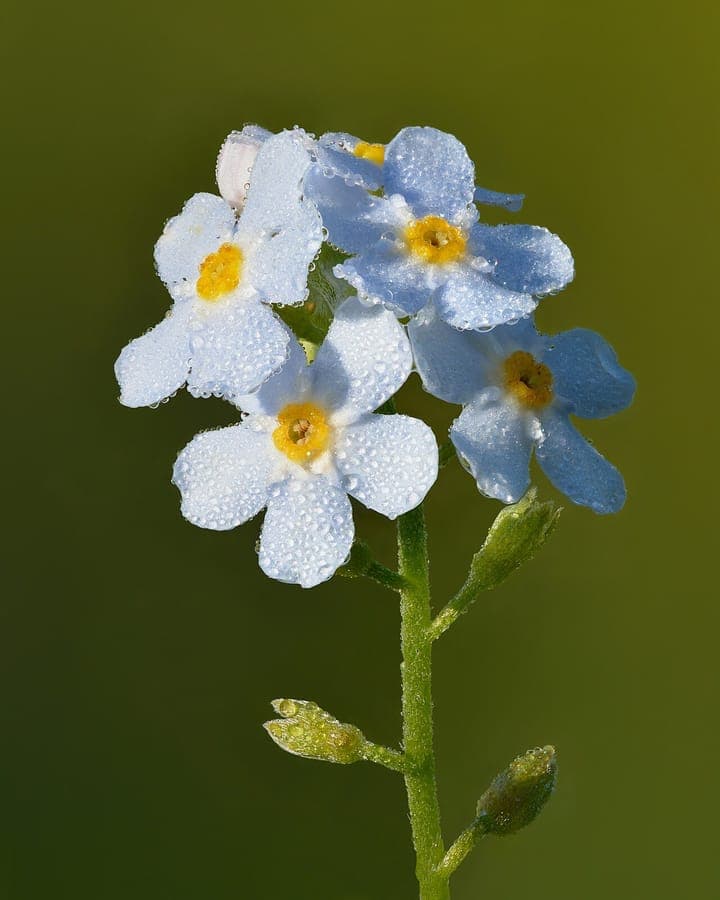
Ivar Leidus / CC BY-SA 4.0, via Wikimedia Commons
Myosotis scorpioides: complete guide
Myosotis scorpioides
¿Quieres ver Myosotis scorpioides: complete guide en tu jardín?
1 minuto, sin tarjeta de crédito
Overview
Myosotis scorpioides, the water forget-me-not or water mouse-ear, is the classic aquatic plant for freshwater ponds and permanently wet waterside zones. This species naturally inhabits stream banks, marshes, and shallow water areas from Europe through Siberia to the Himalayas. Unlike many forget-me-nots, this species actually thrives with permanent waterside conditions. It forms dense, soft-green carpets along water edges, interrupted by long stems bearing characteristic curved flower spikes (the name "scorpioides" refers to the curved, scorpion-tail-like inflorescence). The plant blooms continuously from May through October or even until first frost, meaning it delivers nearly six months of blue color. The plant is hardy to minus 25 degrees Celsius and disappears underwater in winter, recovering in spring.
This is the plant for those seeking a classical, naturalistic water garden look. It's reliable, long-blooming, low-maintenance, and ecologically valuable (insects love it). In front-yard designs where water plays a role - garden ponds, fountain basins, natural water features - Myosotis scorpioides is essential. The plant has long history in European garden architecture and is considered a classic water-margin plant.
Appearance and Bloom
The flowers of Myosotis scorpioides are small but distinctly observable, approximately 5 to 8 millimeters in diameter, with five blue (rarely pink or white) petals forming a five-pointed star. They grow in characteristic curved, spiral-like inflorescences. The name "scorpioides" exactly references this shape: when viewed from the side, the flower spike's tip curves downward in a manner resembling a scorpion's tail. This is a very distinctive and beautiful morphology.
The leaves are small, linear-lanceolate, approximately 1 to 2.5 centimeters long, very soft to touch (almost woolly), green to gray-green. They grow densely along weak, creeping or semi-upright stems. The plant forms dense, horizontally-growing mats along waterside margins, with stems extending into water. Under good conditions it reaches 30 to 50 centimeters height (especially in water) and forms closed, complete ground cover along waterside margins. The plant is very decorative throughout the entire season, not just during bloom.
Ideal Location
Myosotis scorpioides thrives best directly alongside water: pond edges, water channels, streams, ditches. Plant it so roots remain in moist to wet soil. For maximum flowering, ensure at least four to six hours direct sunlight daily. It accepts partial shade under light tree canopies, though flowering decreases. In full shade the plant survives but rarely flowers. For water garden designs, position it along the direct water edge where it can extend leaves and roots into or immediately adjacent to water.
The plant is excellent at tolerating regular inundation (flooding by rainwater or water level rise). It accepts water that periodically rises and falls. In pure drought the plant clearly dies back, so always ensure moist environment.
Soil
Soil quality is less critical than water availability. The plant grows on virtually any soil provided it remains moist. Ideal are heavy clay, peat, or very peaty soils. Add substantial organic material: decomposed leaf mold, compost, peat constituting 50 percent of soil mixture. The plant thrives on acidic to neutral soil (pH 5.5 to 7.5). Very high pH (above 8.5) can cause problems, though the plant is relatively adaptive.
For pot culture or in artificial ponds, use very nutrient-rich potting soil mixed with abundant perlite or orchid bark for aeration. The plant roots easily and grows rapidly in nutrient-rich media.
Watering
This is not applicable in traditional sense: plant stands continuously in water or very wet environment. Plant directly in water (as an aquatic) or in very wet soil immediately next to water. Ensure the top centimeter of soil remains consistently moist. During dry periods, water as often as necessary to prevent soil drying. In natural water environments, you probably need not add supplementary water as water remains constantly available.
For pot culture (not ideal but possible) place pot in water tray and refill regularly. Change water weekly to prevent stagnation.
Diseño gratis
¿Quieres ver Myosotis scorpioides: complete guide en tu jardín? Crea un diseño gratis ahora.
Pruning
Myosotis scorpioides requires no pruning. It naturally forms a beautiful shape. You can remove spent flower spikes for neat appearance, though unnecessary for continued flowering: the plant flowers continuously. In very dense conditions you can remove some overlapping stems in spring to improve air circulation. Dead material should be removed regularly, especially if water is still (stagnation promotes diseases).
Maintenance Calendar
APRIL: Plant develops rapidly as water warms. Remove winter-dead sections.
MAY TO OCTOBER: Continuous bloom. Plant is at its most beautiful. Remove dead leaves regularly.
OCTOBER TO NOVEMBER: Bloom tapers as night temperatures drop.
NOVEMBER TO MARCH: Plant dies back aboveground, underground parts (crowns and roots) survive submerged or in wet soil.
Winter Hardiness
Myosotis scorpioides is completely cold-hardy to minus 25 degrees Celsius. In winter the aboveground material disappears and the plant appears dead, but underground parts always survive in moist soil or water. Plant begins new growth once water conditions change (April-May). No winter protection needed.
Companion Planting
Myosotis scorpioides pairs beautifully with other waterside plants. Plant it with Lobelia cardinalis (cardinal flower), Iris laevigata (water iris), Trollius (globeflower), Acorus gramineus (Japanese sweet flag), and Hosta. For classical water gardens, combine with pink Astilbe, white Filipendula, and yellow Caltha palustris. The blue flowers of Myosotis scorpioides create beautiful contrasts with yellow or red aquatic plants.
For natural waterscapes, plant with native water grasses, rushes (Juncus) and Carex species (sedges). Also suitable as underplanting around Nymphaea (water lilies): it forms a lovely blue border around the larger water plant foliage.
Propagation and Seed
Myosotis scorpioides produces abundant seed that forms underwater. This seed is extremely frost-tolerant and overwinters effortlessly on pond bottoms or in wet soil layers. In spring, these seeds germinate spontaneously once water temperatures rise. This means that once planted, you maintain the same population for years without intervention. The plant reproduces itself under ideal conditions. For propagation you can collect seed from ripened seed heads and sow in moist seed mix. Germination percentages are very high and growth is rapid once germination begins. Seedlings establish quickly in aquatic environments.
Ecological Value
This plant is invaluable for water habitats. Insects adore it: dragonflies, mayflies and other aquatic insects use the sturdy stems as perching and egg-laying sites. Bird species also appreciate the seed structures for food. The plant stabilizes water turbidity by trapping sediment around root systems. Because it naturally grows alongside water, it perfectly supports local waterecosystems. For gardeners seeking to attract wildlife, Myosotis scorpioides is essential.
Container Culture
Myosotis scorpioides can be cultivated in containers, though this is not ideal. Use very large containers (at least 40 centimeters diameter) filled with moist potting soil. Position the pot permanently in a water tray or fountain water tank so water is always available. Change water weekly to prevent stagnation and disease. Container-grown plants can be transplanted from container to open water if you later wish to relocate them to larger habitats. This is a good starting stage for hesitant gardeners who want to observe plant performance before full pond integration.
Conclusion
Myosotis scorpioides is the perfect classical water plant for freshwater ponds and permanent water features. Its extended bloom period, reliable growth, winter hardiness, and low maintenance needs make it ideal for gardenworld.app gardens with water features of all sizes. Plant it along any waterside margin and you'll get six months of uninterrupted blue. This is gardening as it should be: working with nature, using native water plants, maximizing ecological value, and minimizing intervention.
This plant defines classical water garden architecture. No water feature is complete without Myosotis scorpioides.
¿Quieres ver Myosotis scorpioides: complete guide en tu jardín? Crea un diseño gratis ahora.
Sube una foto, elige un estilo y obtén un diseño fotorrealista con lista de plantas en menos de un minuto.
Más de 10.000 jardines diseñados
Sin tarjeta de crédito


Plantas similares
Western waterleaf: complete guide
Hydrophyllum occidentale
Full growing guide for western waterleaf (Hydrophyllum occidentale): shade tolerance, soil needs, watering, winter hardiness and naturalistic garden use.
Limestone phacelia (Phacelia affinis): complete guide
Phacelia affinis
Full guide to Phacelia affinis, the limestone phacelia: sowing tips, purple-blue bee flowers, drought tolerance and uses in dry or wildlife gardens.
Pyrenean viper's bugloss: complete guide
Echium asperrimum
Echium asperrimum is a striking biennial from the western Mediterranean with rough bristly stems and vivid blue flowers. A magnet for bees and a bold border plant.