
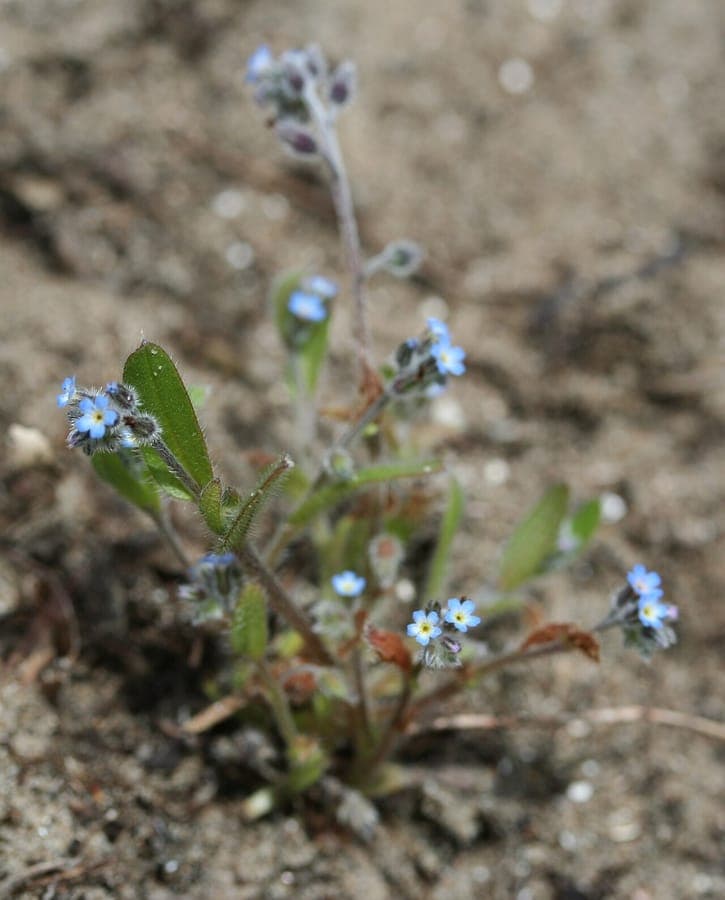
No machine-readable author provided. Svdmolen assumed (based on copyright claims). / CC BY 2.5, via Wikimedia Commons
Myosotis ramosissima: complete guide
Myosotis ramosissima
¿Quieres ver Myosotis ramosissima: complete guide en tu jardín?
1 minuto, sin tarjeta de crédito
Overview
Myosotis ramosissima, the early forget-me-not, is a tiny annual distinguished by extreme branching and exceptionally compact growth. It naturally inhabits dry mountain regions of Europe extending into North Africa, where it blooms on lean, gravelly slopes. The name "ramosissima" literally refers to maximum branching (ramosus = branched, -issima = superlative). Indeed: while most forget-me-nots produce dozens of flowers per plant, Myosotis ramosissima often yields over 100 tiny flowers on a single plant barely 10 to 15 centimeters tall! This makes it perfect for small gardens, rock gardens, and clustering on dry rocks. The plant flowers early in the season - February through April in favorable years - before most competitors emerge. This makes it an ideal early-season color provider.
Historically, this plant is widely used in alpine gardens and rock gardens because it occupies so little space while flowering so profusely. With its extremely lean soil requirements and drought tolerance, it functions perfectly as a gap-filler between stonework where other plants cannot grow. The botanical range extends from Macaronesia (Canary Islands, Madeira) through Morocco and throughout Europe, indicating a highly adaptive species with broad environmental tolerance.
Appearance and Bloom
The flowers of Myosotis ramosissima are extremely small, approximately 2 to 3 millimeters in diameter, much smaller than other forget-me-nots. Flower color varies from white to very light blue with a yellow center. Some populations produce predominantly white flowers, others light blue - this is normal variation. They grow in very dense, repeatedly branched clusters. The characteristic feature is this excessive branching: the plant forms a densely packed, triangular silhouette as it expands fully. Each branch subdivides, each twig carries flowers.
The leaves are very small, linear to narrowly lanceolate, approximately 0.5 to 1 centimeter long, hairy, and green. They grow densely along slender, numerous stems. The plant reaches barely 10 to 15 centimeters height and forms an extremely compact, conical-triangular silhouette. Due to extreme branching, the plant appears almost moss-like from above. This is a true miniature forget-me-not, ideal for those with limited space.
Ideal Location
Myosotis ramosissima thrives best on very dry, sunny sites. It requires full sun to develop well and produce abundant flowers. Partial shade results in sparse flowering and leggy growth. Plant it on rocks, roofs, dry slopes, or in rock gardens where sunlight dominates. The plant is very tolerant of windy locations because it grows densely and stays low. It also accepts considerable foot traffic as long as it isn't continuously trampled. For front-yard designs: place it on dry, sunny areas where other plants struggle.
Avoid moist, shaded sites: there the plant etiolates (becomes tall and leggy) and grows poorly. The plant thrives in mountainous climates and tolerates significant temperature fluctuations. In very warm, dry regions, it outperforms many other forget-me-nots.
Soil
The soil must be extremely well-drained. This is non-negotiable. Stagnation is lethal. Ideal are gravels, stone chips, very lean sandy soil, or rocky terrain. Do not add organic material to the soil: this only promotes fungi and root problems. The plant actually prefers pure mineral soil. pH can vary widely from strongly acidic (pH 4.5) to basic (pH 8.5) - the plant adapts. Nutrient poverty is beneficial: abundant nutrition leads to excessive foliage and reduced flowering.
For container cultivation, use gritty sand mix: two parts sand, one part perlite or stone chips, one part standard potting soil. Add no compost. Provide excellent drainage. Plant in shallow containers (4 to 6 centimeters deep) as it has shallow roots. Water very sparingly.
Diseño gratis
¿Quieres ver Myosotis ramosissima: complete guide en tu jardín? Crea un diseño gratis ahora.
Watering
This plant doesn't enjoy water. Water only when the top 1 centimeter of soil feels completely dry. In rainy climates, you probably need not water at all. The plant is extremely drought-tolerant because roots nestle deep in gravel or rock fissures where moisture persists. Ensure water doesn't stagnate under foliage. The principle is: grow dry from below and remain dry from above.
Underwater rather than overwater. A completely desiccated plant recovers easily. A plant in stagnant water dies certainly. This is probably the most critical factor for successfully growing Myosotis ramosissima.
Pruning
Myosotis ramosissima requires no pruning. It naturally forms a perfect silhouette. You can remove spent flower clusters to delay seed production and thus extend blooming, though this is optional. If you wish to harvest seed, leave some flower clusters unpruned until seed ripens and turns brown.
The plant produces abundant seed, and under favorable conditions will self-sow next year. So if you want the plant to reappear: allow some seedheads to ripen.
Maintenance Calendar
MARCH TO APRIL: In many regions, you already observe bloom, especially on early, sunny sites. Plant develops rapidly.
APRIL TO MAY: Peak bloom. Plant can be completely covered with hundreds of tiny flowers.
MAY TO JUNE: Seed ripens. Plant accelerates seed production as weather warms.
JUNE TO OCTOBER: Plant senescences, seed remains below surface, overwinters.
NOVEMBER TO FEBRUARY: Seed germinates in late autumn or early spring. Plant grows slowly in winter, accelerates in spring.
Winter Hardiness
Myosotis ramosissima, as an annual or fall-sown plant, is very cold-hardy. In many regions, the plant self-seeds, the seedlings overwinter in a state of germinal initiation, and shoot forth widely in spring. This means you essentially get the same plants year after year without intervention. In very harsh winters (below minus 20 degrees Celsius for weeks), seed may be damaged, but usually sufficient seed survives.
Companion Planting
Myosotis ramosissima fits perfectly in rock gardens and rocky outcrops alongside other alpine miniatures: Sedum species (diverse colors), Sempervivum (hen-and-chicks), alpine Saxifraga species, very small Dianthus and dwarf Phlox subulata cultivars. Also attractive between alpine grasses like Festuca glauca (blue fescue) or Carex brunnea (brown sedge). For roof gardens on lava walls or in shallow containers, mix with other early bloomers like Cyclamen coum (alpine cyclamen) and Helleborus niger (Christmas rose).
The very small flowers of Myosotis ramosissima create softer, more refined compositions than larger forget-me-nots. Use it as filler around larger stonework or between rock formations where you want subtle blue-white tints.
Conclusion
Myosotis ramosissima is a small but highly striking plant proving that size doesn't matter. Hundreds of minute flowers on a plant barely 15 centimeters tall makes this an absolute eyecatcher in front-yard designs. Its very low maintenance needs, self-seeding behavior, and extreme drought tolerance make it a sustainable, ecological choice. Perfect for gardenworld.app gardens with dry, difficult corners that still need color.
Plant it once and nature does the rest. This is gardening in harmony with biology.
¿Quieres ver Myosotis ramosissima: complete guide en tu jardín? Crea un diseño gratis ahora.
Sube una foto, elige un estilo y obtén un diseño fotorrealista con lista de plantas en menos de un minuto.
Más de 10.000 jardines diseñados
Sin tarjeta de crédito


Plantas similares
Western waterleaf: complete guide
Hydrophyllum occidentale
Full growing guide for western waterleaf (Hydrophyllum occidentale): shade tolerance, soil needs, watering, winter hardiness and naturalistic garden use.
Limestone phacelia (Phacelia affinis): complete guide
Phacelia affinis
Full guide to Phacelia affinis, the limestone phacelia: sowing tips, purple-blue bee flowers, drought tolerance and uses in dry or wildlife gardens.
Pyrenean viper's bugloss: complete guide
Echium asperrimum
Echium asperrimum is a striking biennial from the western Mediterranean with rough bristly stems and vivid blue flowers. A magnet for bees and a bold border plant.