
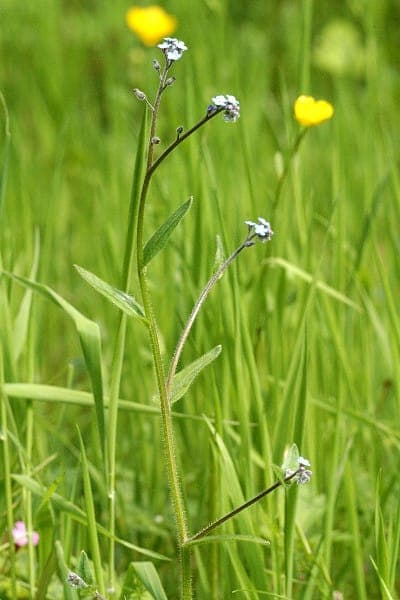
James K. Lindsey / CC BY-SA 3.0, via Wikimedia Commons
Woodland forget-me-not: complete guide
Myosotis nemorosa
¿Quieres ver Woodland forget-me-not: complete guide en tu jardín?
1 minuto, sin tarjeta de crédito
Overview
Woodland forget-me-not (Myosotis nemorosa), also known as Hain-vergissmeinnicht or forest forget-me-not, is a charming perennial wildflower native to Europe. This small, delicate plant is beloved for its delicate blue-violet flowers that bloom in spring and early summer. It is widely used in natural and woodland gardens, wildflower meadows, and landscape plantings where it creates a magical atmosphere.
Appearance and Bloom
Woodland forget-me-not grows to approximately 20-50 cm in height and forms compact, bushy clusters of fine green foliage. The plant blooms from April to June with numerous small, five-petaled flowers in delicate shades of blue and violet, often with yellow or white centers. The flowers are highly decorative and attract butterflies and bees. After flowering, small seed capsules form that ripen in autumn.
Ideal Location
Woodland forget-me-not grows best in locations with partial shade, although it can also bloom in full sun. In forests and woodland settings, the plant flourishes particularly well. The plant appreciates somewhat moist conditions but can also tolerate drier soils. It works well along pathways in wild gardens.
Soil
The plant is not fussy about soil type and grows well in virtually any soil, except extremely dry soils. Preference is given to moderately moist, well-draining soil. The plant tolerates acidic to neutral soils, with pH around 4.5-7.0.
Diseño gratis
¿Quieres ver Woodland forget-me-not: complete guide en tu jardín? Crea un diseño gratis ahora.
Watering
Woodland forget-me-not requires regular water when growing, especially in the first growing period. Once established, it can tolerate drought quite well, although it has a preference for moist conditions. In very dry periods, supplemental water can help improve flowering.
Pruning
Minimal pruning is needed. Deadheading (removal of spent flowers) can extend the flowering period. After flowering, the plant can be cut back to approximately 10 cm to remain compact. Self-seeding can be discouraged by removing spent seed capsules before dispersal.
Maintenance Calendar
Spring: Dig and transplant plants; water regularly. Summer: Deadhead regularly to extend bloom. Autumn: Allow seeds to ripen. Winter: Minimal maintenance; plant is dormant.
Winter Hardiness
Woodland forget-me-not is fully hardy to approximately -15 to -20 degrees Celsius. The plant is very robust in cold climates and is a perfect choice for Northern European gardens. In warm regions, it may show summer decline.
Companion Plants
The plant combines beautifully with other spring-flowering wildflowers such as common forget-me-not (Myosotis), primrose, multicolored violets, and gray-flowering sorrel. It also works well in woodland and shaded gardens with ferns and hostas.
Closing
Woodland forget-me-not is an excellent choice for wild and natural gardens. With its delicate flowers, easy cultivation, and complete winter hardiness, it enriches any garden in a subtle and charming way. Ideal for lovers of wildflowers and natural garden design.
¿Quieres ver Woodland forget-me-not: complete guide en tu jardín? Crea un diseño gratis ahora.
Sube una foto, elige un estilo y obtén un diseño fotorrealista con lista de plantas en menos de un minuto.
Más de 10.000 jardines diseñados
Sin tarjeta de crédito


Plantas similares
Western waterleaf: complete guide
Hydrophyllum occidentale
Full growing guide for western waterleaf (Hydrophyllum occidentale): shade tolerance, soil needs, watering, winter hardiness and naturalistic garden use.
Limestone phacelia (Phacelia affinis): complete guide
Phacelia affinis
Full guide to Phacelia affinis, the limestone phacelia: sowing tips, purple-blue bee flowers, drought tolerance and uses in dry or wildlife gardens.
Pyrenean viper's bugloss: complete guide
Echium asperrimum
Echium asperrimum is a striking biennial from the western Mediterranean with rough bristly stems and vivid blue flowers. A magnet for bees and a bold border plant.