
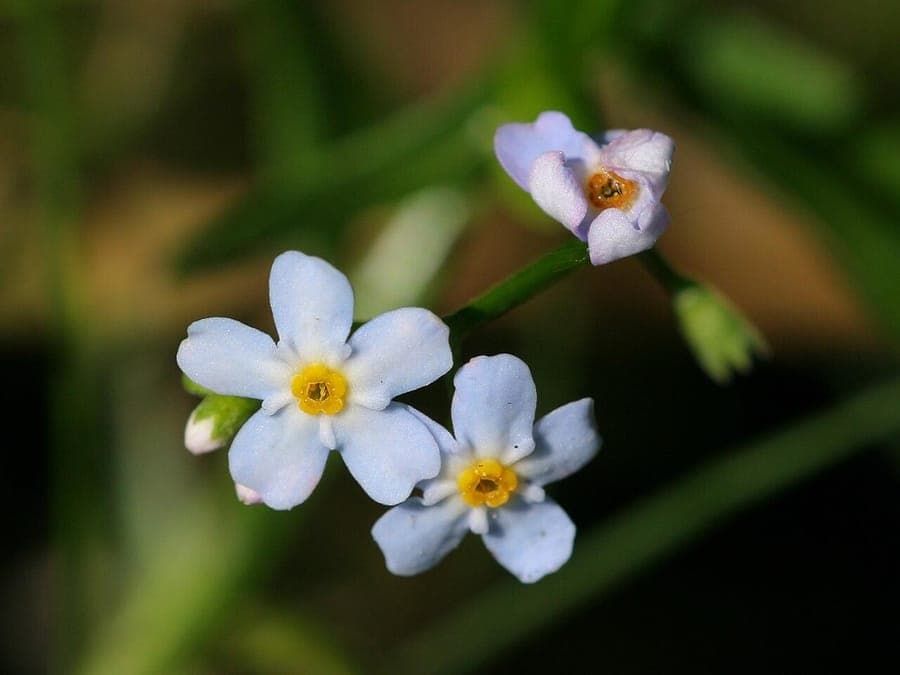
Kristian Peters -- Fabelfroh 08:49, 30 June 2007 (UTC) / CC BY-SA 3.0, via Wikimedia Commons
Myosotis laxa: complete guide
Myosotis laxa
¿Quieres ver Myosotis laxa: complete guide en tu jardín?
1 minuto, sin tarjeta de crédito
Overview
Myosotis laxa, known as tufted forget-me-not or loose forget-me-not, is a moisture-loving plant from temperate zones of the Northern Hemisphere. This species naturally inhabits stream banks, marshes, and wet meadows where groundwater remains at or near the surface. This makes Myosotis laxa an excellent choice for gardeners with persistently wet low spots, pond edges, and water features. Unlike many other forget-me-nots, this species thrives in partial shade and full shade, making it useful for dark garden corners and shaded woodland margins. The plant reaches 20 to 40 centimeters tall and forms loose tufts of green foliage from which numerous small blue flower spikes emerge. It blooms from May through October in favorable conditions, providing an exceptionally long flowering season. The plant is completely cold-hardy to minus 25 degrees Celsius, making it ideal for northern European gardens.
The botanical name "laxa" refers to the loose, open leaf arrangement and scattered way flowers are distributed along the stems. This gives the plant a lighter, less compact appearance than species like Myosotis scorpioides. This is actually an advantage in wet environments, where this open habit ensures better air circulation and drainage around stems. The plant produces abundant seed, and under favorable conditions self-seeds into surrounding wet areas, allowing natural populations to expand. This self-seeding behavior makes it particularly valuable for naturalistic garden design and ecological garden planning.
Appearance and Bloom
The flowers of Myosotis laxa are small, approximately 3 to 5 millimeters wide, with five blue petals forming a typical alpine forget-me-not shape. They grow in loose clusters at stem ends, arranged on separate delicate pedicels. A distinctive characteristic is the progressive flowering pattern: individual flowers open along a single stem, the stem continues extending, and more flowers open sequentially along its length. This creates continuous bloom over several weeks per stem.
The leaves are lanceolate, approximately 1.5 to 3 centimeters long, dull green with very fine hairs. They arrange alternately along slender, upright stems. At maturity, the plant reaches 20 to 40 centimeters tall and 20 to 30 centimeters wide, with an open, loose growth pattern. Because the plant grows in wet environments, it lacks the dense, compact form of desert-adapted species. The plant's loose architecture creates a soft, natural effect. Leaves turn yellowish-green in autumn and eventually disappear below ground. The plant forms underground rhizomes that survive winter dormancy.
Ideal Location
Myosotis laxa loves wet, moisture-rich sites with consistent water availability. It thrives along stream banks, in marshes, on wet meadows, and beside ponds. In front-yard designs, position it as edging around pond excavations or in low-lying areas where rainwater collects. The plant tolerates occasional inundation but doesn't survive permanently submerged. Freshwater environments are ideal; salt tolerance is low. The plant flourishes in partial and full shade, making it suitable for shaded woodland margins and beneath open tree canopies. It also accepts full sun, though flowering decreases slightly and plants require more consistent moisture to offset transpiration.
Avoid highly exposed windy locations: strong winds inhibit early growth. The plant thrives in cool microclimates and grows more easily where summers aren't extremely hot. In warm, dry regions, Myosotis laxa is challenging and requires constantly wet soil to survive.
Soil
Myosotis laxa has very specific soil requirements. The soil must remain continuously moist rather than cycling between wet and dry. Ideal are heavy clay or peat-rich soils with substantial organic matter (up to 50 percent peat moss or compost mixed with garden soil). Drainage is less critical than moisture retention. A pH of 5.5 to 7.0 (slightly acidic to neutral) is optimal. Very high pH (above 8.0) often causes yellow foliage.
Incorporate substantial organic material: decomposed leaf mold, nutrient-rich compost, and peat constituting 40 to 50 percent of the soil mixture. This improves moisture retention and provides nutrients. For container cultivation, use moisture-retentive potting soil (wetland plant mix) composed of two parts nutrient-rich compost and one part perlite. Place the container in a water tray maintained with 1 to 2 centimeters of constant water. This simulates the moist environment found in nature.
Diseño gratis
¿Quieres ver Myosotis laxa: complete guide en tu jardín? Crea un diseño gratis ahora.
Watering
This is critical: Myosotis laxa cannot survive without adequate water. Ensure soil never dries completely. Ideally, soil feels somewhat moist at all times, not waterlogged, but noticeably moist 1 to 2 centimeters deep. During dry periods, water two to three times weekly. In naturally wet areas (depressions, seepage zones), supplementary watering is usually unnecessary as groundwater remains near the surface.
For container cultivation, place pots in water trays and refill regularly. Change water weekly to prevent stagnation. Don't allow pots to sit in standing water (root rot develops), but maintain 1 to 2 centimeters of water in the tray beneath the pot.
Pruning
Myosotis laxa requires no pruning. It's a naturally growing plant that determines its own form. However, you can remove spent flower spikes (deadheading) to encourage secondary bloom in August or September. Remove dead material, yellow leaves, and any infected sections immediately. Because it grows in wet environments, regularly monitor for fungal diseases (botrytis, Septoria) and remove affected foliage.
In dense growth, you can pinch selected stems in spring to increase plant density: remove shoot tips when plants reach approximately 15 centimeters tall. This stimulates lateral branching. Leave seedheads on the plant for natural seed dispersal, though harvest them before ripening if you wish to control self-seeding.
Maintenance Calendar
FEBRUARY TO MARCH: Sow seed indoors in moist seed mix or directly outdoors in wet soil after last frost.
APRIL TO MAY: Water young plants, transplant once they develop two to three true leaves. Position in wet areas.
MAY TO OCTOBER: Heavy flowering. Deadhead for continued bloom.
OCTOBER TO NOVEMBER: Seed collection. Plant begins to senesce.
DECEMBER TO JANUARY: Dormancy period. Underground rhizomes overwinter. Plant is fully hardy.
Winter Hardiness
Myosotis laxa is completely cold-hardy to minus 25 degrees Celsius and thrives in all northern European winter environments. In winter, aboveground material disappears and the plant appears dead, but underground rhizomes survive and emerge in April. The plant requires no winter protection. On extremely windy sites, some mulching (twigs, dead leaves) provides protection for overwintering rhizomes, though this is not strictly necessary. Plant regrows spontaneously in spring without intervention.
Companion Planting
Myosotis laxa fits wonderfully into wet front-yard designs and ecological gardens. Combine it with other moisture lovers: Caltha palustris (marsh marigold, yellow), Bistorta officinalis (bistort, pink), Veratrum album (false hellebore, green), and Primula japonica (Japanese primrose, red to purple). Also attractive beside grasses: Carex elata (Bowles' golden sedge), Acorus gramineus (Japanese sweet flag), and Juncus species (rushes).
In wildlife-supporting designs, pair with plants attracting insects: Helenium (sneezeweed), Eupatorium (boneset), and Thalictrum aquilegifolium (meadow rue). For water features, plant at pond edges alongside Nymphaea (water lily), shaded Hosta (plantain lily), and Iris laevigata (water iris). The blue flowers of Myosotis laxa create beautiful contrast with yellow Caltha or pink Bistorta.
Conclusion
Myosotis laxa provides a reliable, cold-hardy solution for wet front-yard areas. Its extended flowering season (May through October), self-seeding behavior, and minimal maintenance needs make it a sustainable, ecologically sound choice. Perfect for gardenworld.app designs where wet depressions or water landscapes must be integrated. Plant a few specimens along approaches and you'll enjoy years of spontaneous regrowth and bloom without intervention.
The plant symbolizes natural water dynamics: where water gathers, forget-me-not flowers in graceful blue. This is garden design in perfect balance.
¿Quieres ver Myosotis laxa: complete guide en tu jardín? Crea un diseño gratis ahora.
Sube una foto, elige un estilo y obtén un diseño fotorrealista con lista de plantas en menos de un minuto.
Más de 10.000 jardines diseñados
Sin tarjeta de crédito


Plantas similares
Western waterleaf: complete guide
Hydrophyllum occidentale
Full growing guide for western waterleaf (Hydrophyllum occidentale): shade tolerance, soil needs, watering, winter hardiness and naturalistic garden use.
Limestone phacelia (Phacelia affinis): complete guide
Phacelia affinis
Full guide to Phacelia affinis, the limestone phacelia: sowing tips, purple-blue bee flowers, drought tolerance and uses in dry or wildlife gardens.
Pyrenean viper's bugloss: complete guide
Echium asperrimum
Echium asperrimum is a striking biennial from the western Mediterranean with rough bristly stems and vivid blue flowers. A magnet for bees and a bold border plant.