
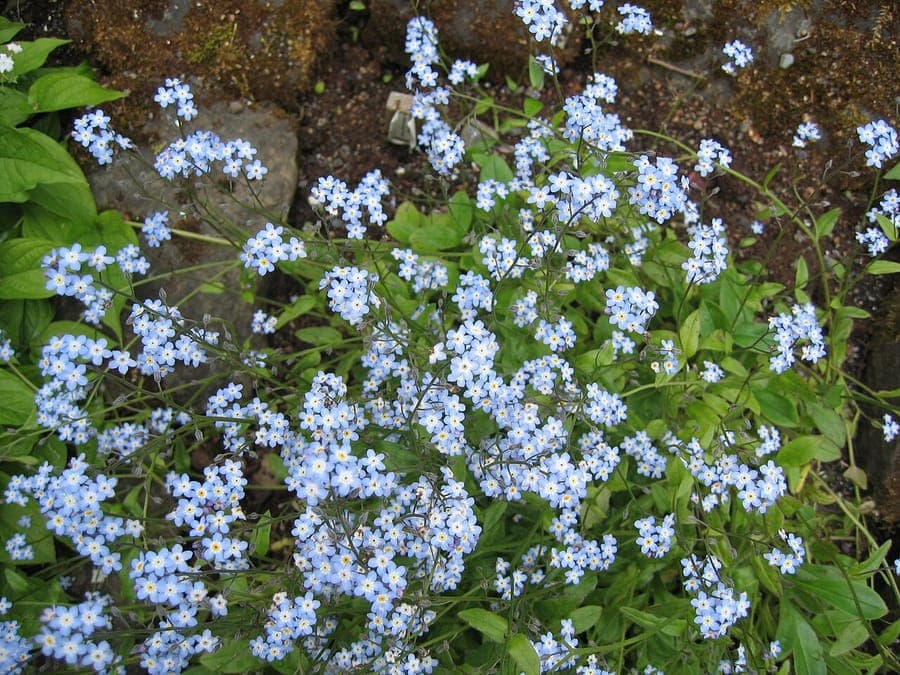
Salvör Gissurardóttir / Public domain, via Wikimedia Commons
Myosotis decumbens: complete guide
Myosotis decumbens
¿Quieres ver Myosotis decumbens: complete guide en tu jardín?
1 minuto, sin tarjeta de crédito
Overview
Myosotis decumbens, also known as Prostrate Forget-me-not, is a charming alpine plant from the Boraginaceae family. This low-growing plant is naturally found in the Alps and parts of Northern Europe, where it thrives in moist mountain meadows and along streams.
The plant is renowned for its delicate sky-blue flowers and hairy foliage. Its low-growing character makes it ideal for rock gardens, crevices, and alpine gardens. With compact growth and extended blooming period, Myosotis decumbens is a valuable addition to cooler gardens.
Appearance and Bloom
Myosotis decumbens is a low-growing, semi-woody plant reaching only 10 to 25 centimeters in height. The plant forms dense growth mats with numerous fine, hairy leaves.
The flowers are small, approximately 5 to 8 millimeters wide, and bright blue to violet-blue in color. They are produced during late spring and early summer in dense, branched clusters. Each flower has a yellow center. The flowering period typically lasts four to six weeks, depending on temperature.
Ideal Location
Myosotis decumbens grows best in partial shade situations. Direct afternoon sun can exhaust the plant, especially in warm climates.
The ideal spot is beneath half-shaded trees, against north-facing rock walls, or in gardens receiving morning sun. In alpine gardens, the plant thrives even without strong sun exposure.
Good air circulation is important to prevent fungal diseases. Avoid damp, enclosed corners.
Soil
Myosotis decumbens requires moisture-retaining, well-drained soil. The plant grows best in acidic soil with pH values around 6.0 to 7.0.
Generously adding organic material helps both water retention and drainage. A mixture of garden soil, leaf mold, and sand or gravel in a 3:2:1 ratio is ideal. For rock gardens, add plenty of gravel.
Waterlogged layers in the soil must be avoided, as excessive water causes root rot.
Diseño gratis
¿Quieres ver Myosotis decumbens: complete guide en tu jardín? Crea un diseño gratis ahora.
Watering
Myosotis decumbens requires regular moisture. The soil should remain slightly moist at all times, without waterlogging. Water in small amounts but regularly.
During the growing period (spring and summer), regularly check soil moisture. Drought stress causes flower drop and blooming cessation. During winter months, reduce watering but do not stop completely.
Avoid overhead spraying to prevent fungal diseases. Water at soil level instead.
Pruning
Myosotis decumbens requires minimal pruning. Remove any dead plant material after flowering. This also promotes new flower stems.
Heavy pruning is not recommended. After the flowering period, light pinching of faded flowers can be done to encourage further bloom production.
Maintenance Calendar
January to March: Minimal care. Check moisture. Prepare for bloom.
April to May: Flowering period begins. Provide regular watering. Begin removing faded flowers.
June to July: Blooming at peak. Continue watering. Remove faded flowers.
August to September: Blooming declining. Slightly reduce watering. Collect seeds if desired.
October to December: Rest period. Further reduce watering. Prepare for winter.
Winter Hardiness
Myosotis decumbens is very winter hardy and tolerates frost well. The plant grows in its natural habitat even at elevations up to 2,500 meters.
The plant can tolerate temperatures down to minus 20 degrees Celsius. Protection during exceptionally cold periods is rarely needed, except in very cold regions.
Companion Planting
Myosotis decumbens works well with other alpine plants:
- Saxifraga species for additional rock garden charm
- Sedum or Sempervivum for contrasting forms
- Phlox subulata for simultaneous pink flowers
- Dwarf conifers for structure
Grouping three to five plants gives better effect than single plants.
Conclusion
Myosotis decumbens is a delightful choice for gardeners who enjoy cultivating alpine plants. Its low-growing character, delicate flowers, and modest requirements make it suitable for rock gardens and mountain-themed designs.
With attention to moisture and partial shade, this plant will grow into a mature specimen. For cooler gardens and rock gardens, it is absolutely recommended.
Visit gardenworld.app for more alpine garden design inspiration.
¿Quieres ver Myosotis decumbens: complete guide en tu jardín? Crea un diseño gratis ahora.
Sube una foto, elige un estilo y obtén un diseño fotorrealista con lista de plantas en menos de un minuto.
Sin tarjeta de crédito


Plantas similares
Western waterleaf: complete guide
Hydrophyllum occidentale
Full growing guide for western waterleaf (Hydrophyllum occidentale): shade tolerance, soil needs, watering, winter hardiness and naturalistic garden use.
Limestone phacelia (Phacelia affinis): complete guide
Phacelia affinis
Full guide to Phacelia affinis, the limestone phacelia: sowing tips, purple-blue bee flowers, drought tolerance and uses in dry or wildlife gardens.
Pyrenean viper's bugloss: complete guide
Echium asperrimum
Echium asperrimum is a striking biennial from the western Mediterranean with rough bristly stems and vivid blue flowers. A magnet for bees and a bold border plant.