
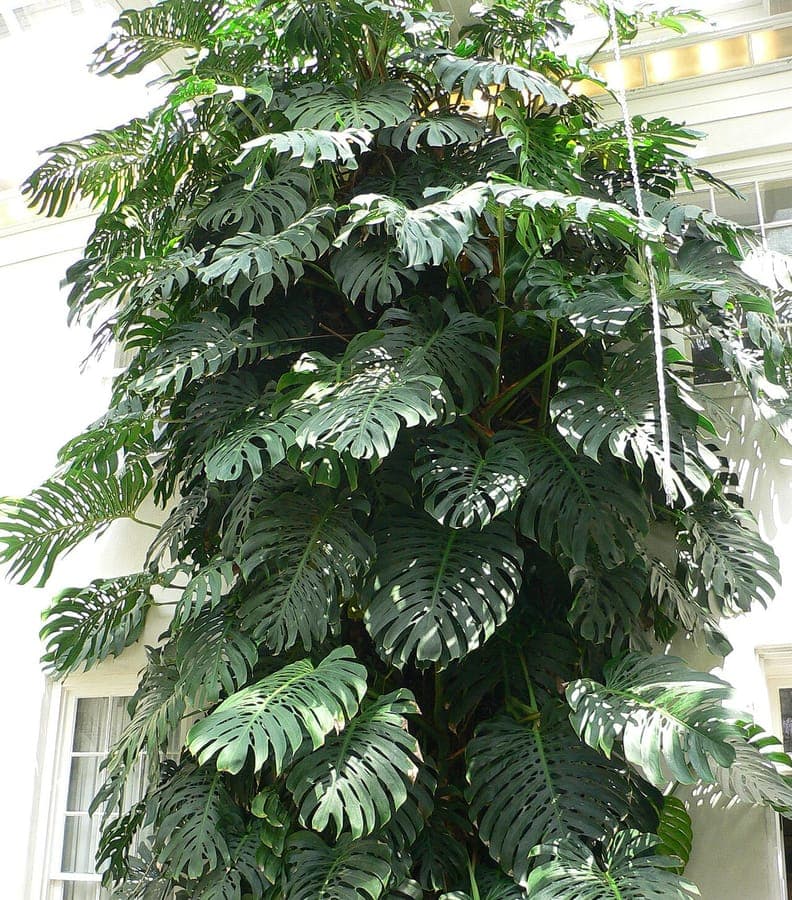
Wikimedia Commons / CC BY-SA 3.0, via Wikimedia Commons
Monstera deliciosa: complete guide
Monstera deliciosa
¿Quieres ver Monstera deliciosa: complete guide en tu jardín?
1 minuto, sin tarjeta de crédito
Overview
Monstera deliciosa, also known as the Swiss cheese plant, fruit-salad plant, or split-leaf philodendron, is one of the most popular houseplants in the world. This tropical plant from the Araceae family is prized for its dramatic, large leaves with characteristic holes (fenestrations). These holes develop as the plant matures, giving it unique visual appeal.
Originally from the tropical rainforests of Mexico and Guatemala, Monstera deliciosa can be easily grown in households. The plant is relatively forgiving and grows even under suboptimal conditions. With basic care, your plant will grow quickly and transform your interior.
Appearance and bloom cycle
Monstera deliciosa is a vigorous climbing plant (in the wild) or climber with large heart-shaped leaves. Leaves can reach 30-90 centimeters in length, and this is where the characteristic holes appear. These fenestrations develop as the plant matures, likely as an adaptation to better withstand wind and allow light to reach lower leaves.
In tropical conditions, the plant produces small, inconspicuous flowers that appear in a spathe (a type of flower bract). These rarely occur in cultivation. The plant can also produce remarkably large, edible fruits that taste like pineapple - hence the name "fruit-salad plant".
Ideal location
Monstera deliciosa thrives best in a place with bright, indirect light. An east or north-facing window is ideal. The plant can also grow in average home lighting, though growth will be slower. Avoid direct afternoon sun, as this can cause leaf scorch.
The plant tolerates temperatures between 15 and 25 degrees Celsius, but grows best at warmer temperatures (18-25 degrees). Avoid placing it in drafts and away from cold air currents from air conditioners or fans.
Soil requirements
Monstera deliciosa prefers loose, well-draining potting soil. A mixture of standard potting soil, perlite, and orchid bark works well. Ensure a pH of approximately 6.0 to 6.5.
Ensure your pot has drainage holes. This plant can be sensitive to root rot in overly wet soil. You can also grow the plant on moss poles and coconut fiber for better support.
Diseño gratis
¿Quieres ver Monstera deliciosa: complete guide en tu jardín? Crea un diseño gratis ahora.
Watering
Water your Monstera regularly, but ensure you don't overwater. Water when the top 5 centimeters of soil feel dry. In winter, you can water less.
Dried-out roots lead to slower growth and leaf loss. Ensure good drainage by using drainage holes. A good rule of thumb: when you insert your finger 5 centimeters into the soil and it feels dry, it's time to water.
Pruning
Monstera deliciosa grows naturally as a strong climber. You can prune the plant to control shape and size. Cut just above a leaf node (these small bumps along the stem where leaves emerge) to encourage side-shoot development.
Regularly remove yellow or damaged leaves. The plant responds well to training and can be guided along a moss pole or trellis.
Maintenance calendar
March-May: Start feeding, provide more light. June-August: Feed regularly (monthly), check supports. September-October: Reduce feeding, decrease watering frequency. November-February: Minimal feeding and water; Rest period. Year-round: Wipe leaves with a damp cloth to remove dust.
Winter hardiness
Monstera deliciosa is not a hardy plant. In the UK, northern Europe, and North America, this plant must always be kept indoors. The plant will die when temperatures fall below 10 degrees Celsius. In very warm parts of Southern Europe, specimens might possibly grow outdoors as permanent installations, but this is unusual.
Companion plants
Monstera deliciosa combines beautifully with other tropical houseplants such as Philodendron, Anthurium, and Epipremnum. These can be grown together in a warm, humid environment for a jungle-like effect.
Propagation
The plant can be easily propagated from cuttings. Cut a stem just below a leaf/node and place it in water or moist soil. Plantlets will develop roots in 2-4 weeks.
Closing remarks
Monstera deliciosa is an excellent choice for both beginners and experienced plant lovers. With basic care for light, water, and temperature, this plant grows quickly and transforms your interior. On gardenworld.app, you'll find more inspiration for tropical indoor gardens and plant combinations. Visit gardenworld.app for more tips on caring for houseplants and creating green spaces at home.
¿Quieres ver Monstera deliciosa: complete guide en tu jardín? Crea un diseño gratis ahora.
Sube una foto, elige un estilo y obtén un diseño fotorrealista con lista de plantas en menos de un minuto.
Más de 10.000 jardines diseñados
Sin tarjeta de crédito


Plantas similares
Arrowhead vine: complete guide
Syngonium auritum
Everything about Syngonium auritum, the tropical five-fingers houseplant. Care, location, watering, and pruning explained clearly for beginners and enthusiasts.
Minute duckweed: complete guide to Lemna perpusilla
Lemna perpusilla
Everything about Lemna perpusilla, the minute duckweed: ecology, pond management, water quality and care in garden water features.
Dead horse arum lily: complete guide
Helicodiceros muscivorus
Everything about the dead horse arum lily (Helicodiceros muscivorus): growing conditions, spectacular bloom, thermogenesis, and care for this Mediterranean aroid.