
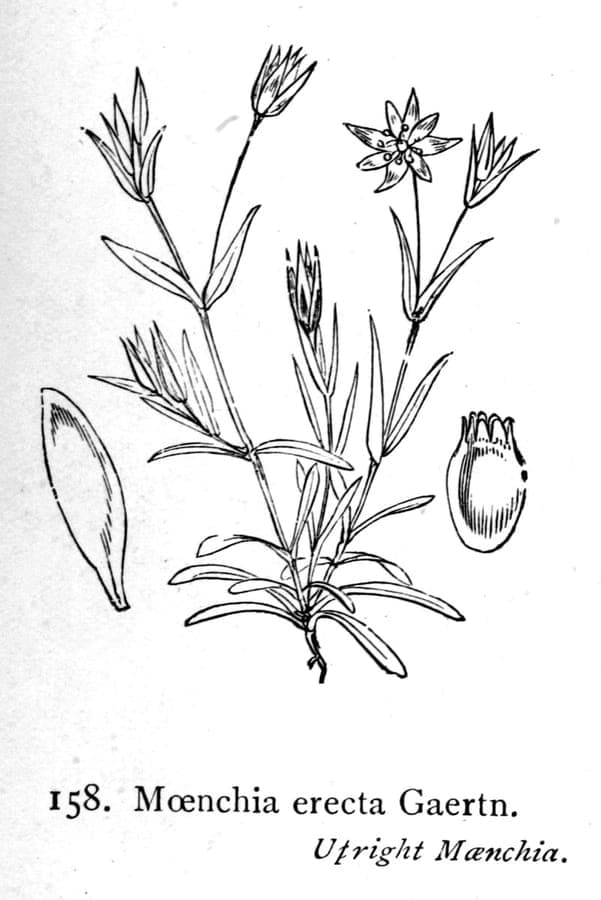
Walter Hood Fitch / Public domain, via Wikimedia Commons
Upright chickweed: complete guide
Moenchia erecta
¿Quieres ver Upright chickweed: complete guide en tu jardín?
1 minuto, sin tarjeta de crédito
Overview
The Upright Chickweed, scientifically known as Moenchia erecta, is a delicate annual or biennial plant native to Europe and the Mediterranean region. This diminutive plant is recognized for its elegant white flowers and compact growth habit, making it an ideal choice for rock gardens, alpine troughs, and garden borders. The plant is easy to maintain and offers early-season blooms when other plants are just emerging from winter dormancy.
Appearance and bloom
The Upright Chickweed grows only 10 to 20 centimeters tall, forming compact, upright rosettes of narrow green foliage. The plant produces small, four-petaled white flowers between March and May, appearing radiant amid the green leaves. The flowers are self-pollinating and attract small insects. After blooming, small seed capsules form, ripening in early summer, after which the plant dies back or self-seeds if grown as an annual.
Ideal location
The Upright Chickweed thrives in full sun to light partial shade. Provide at least 4 to 6 hours of direct sunlight daily. Plant in alpine troughs, rock gardens, or borders where drainage is excellent. The plant also grows well in stone crevices and protected locations away from salty winds and heavy rainfall.
Soil
This plant is very tolerant of soil types but performs best in very well-drained soil with a pH between 6.0 and 7.0. Alpine and rocky environments are ideal because they promote drainage. Heavy clay soils should be significantly improved with gravel or sand. The plant tolerates dry soil well once established.
Diseño gratis
¿Quieres ver Upright chickweed: complete guide en tu jardín? Crea un diseño gratis ahora.
Watering
The Upright Chickweed has moderate water requirements and tolerates drought excellently once established. During the growing period in spring and fall, keep soil slightly moist, but ensure the soil never becomes waterlogged. Excessive watering during summer dormancy can lead to root rot. Summer rainfall is usually sufficient without additional watering.
Pruning
Pruning is not necessary for this small plant. Dead leaf litter can be gently removed in late winter. As it is typically an annual plant, it will die back after flowering and seed capsule formation. Allow some plants to mature seed for natural propagation next season.
Maintenance calendar
January-February: Stratify seeds if growing new plants. March-April: No fertilizer needed unless soil is very poor. May-June: Allow seed capsules to ripen and dry. July-August: Limited growing period; minimal watering. September-October: Conditions favor reseeding. November-December: Rest period.
Winter hardiness
The Upright Chickweed is hardy to -15C and blooms in zones 4-9. As an annual, no winter protection is needed. If plants self-seed, young seedlings will be winter-hardy. In severe climates, glass or branch protection may be beneficial.
Companion plants
The Upright Chickweed pairs well with other alpine plants such as saxifrages and alpine forget-me-nots. Also suitable with low-growing evergreens and dwarf conifers in rock gardens. Plant in groups for maximum visual effect. Other season bloomers can provide extended color.
Closing remarks
The Upright Chickweed is a charming, easy-care plant requiring minimal maintenance. Perfect for gardeners appreciating delicate plants and natural seed distribution. With its early-season blooms, it offers hope and beauty when many plants are still dormant. Visit gardenworld.app/nl and gardenworld.app/en for more gardening inspiration.
¿Quieres ver Upright chickweed: complete guide en tu jardín? Crea un diseño gratis ahora.
Sube una foto, elige un estilo y obtén un diseño fotorrealista con lista de plantas en menos de un minuto.
Más de 10.000 jardines diseñados
Sin tarjeta de crédito


Plantas similares
Dianthus karami: complete guide
Dianthus karami
Dianthus karami is a rare Lebanese mountain pink with fringed pink blooms on limestone cliffs, ideal for rock gardens and troughs.
Sicilian pink: complete guide
Dianthus siculus
Discover Dianthus siculus, an elegant purple bloomer from Sicily. Cultivation, June-September flowering and garden combinations.
Alpine mouse-ear chickweed: complete guide
Cerastium pedunculatum
Full growing guide for Cerastium pedunculatum: ideal location, soil, watering, winter hardiness, and companion plants for rock gardens.