
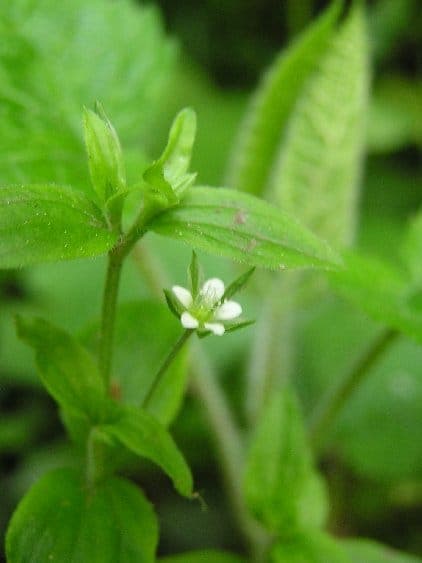
Michael Becker / CC BY-SA 3.0, via Wikimedia Commons
Moehringia trinervia: complete guide
Moehringia trinervia
¿Quieres ver Moehringia trinervia: complete guide en tu jardín?
1 minuto, sin tarjeta de crédito
Overview
Moehringia trinervia, commonly known as apetalous sandwort or three-nerved sandwort, is an elegant and remarkably tough ground cover that thrives in shaded environments where many plants struggle. This delicate plant belongs to the Caryophyllaceae family and naturally occurs throughout Europe and North Africa. With its fine, thread-like foliage and tiny white flowers, it provides subtle beauty to woodland gardens, shaded borders, and naturalistic planting schemes. Gardenworld.app recognizes this gem as an essential plant for creating textured, layered garden compositions.
Moehringia trinervia typically grows 15-25 centimetres in height, forming airy carpets of fine foliage. The plant's value lies in its ability to colonize shaded niches where grass refuses to grow, creating natural transitions between larger specimen plants. Its moss-like quality makes it invaluable for collectors and gardeners seeking naturalistic aesthetics.
Appearance & Bloom Cycle
Moehringia trinervia displays extremely narrow, linear leaves arranged in opposite pairs - a characteristic feature of the Caryophyllaceae family. Each leaf measures only 1-2 millimetres wide, contributing to the plant's delicate, almost grass-like appearance. The stems are thin, wiry, and flexible, often tinged reddish-purple, particularly in younger growth.
The flowers emerge from May through July, though occasionally into early August. Each bloom measures approximately 4-5 millimetres in diameter, with four to five white or pale pink petals complemented by yellowish stamens creating gentle colour contrast. The flowering period extends 6-8 weeks, depending on season and weather conditions. When planted en masse, hundreds of tiny flowers create a cloud-like effect that transforms the planting area. After blooming, the plant produces minute seeds that ripen in August and September.
The foliage remains evergreen in mild climates, maintaining its fine structure throughout winter. In colder regions, the leaves take on a greyish-green tone, adding subtle winter interest to shaded gardens.
Ideal Location
Moehringia trinervia is a shade plant of the highest order, thriving in partial to deep shade beneath tree canopies and north-facing walls. Optimal conditions provide 1-4 hours of indirect morning sunlight daily. Full sun exposure should be avoided, particularly in warm climates where the plant quickly deteriorates and loses its vibrant character.
In landscape design, this plant excels beneath deciduous trees, along woodland margins, and as a delicate foreground planting. The fine texture provides stunning contrast against architectural foliage plants such as hostas, hellebores, and ferns. It functions exceptionally well as a transitional element between shaded and semi-shaded zones.
The plant proves invaluable for creating naturalistic borders where conventional grass alternatives fail. Its ability to colonize difficult spaces beneath large root systems makes it indispensable for sophisticated woodland garden designs.
Soil Requirements
Moehringia trinervia is remarkably flexible regarding soil conditions. The plant performs best in loose, well-draining soil with a pH range of 5.5 to 7.5 (slightly acidic to neutral). Organic matter incorporation improves establishment, though poor, sandy soils are tolerated once established.
Optimal growing medium consists of garden soil mixed with 30% compost and 20% coarse sand by volume. The plant tolerates nutrient-poor soils well, making excessive fertilization unnecessary and potentially counterproductive. In natural woodland settings, Moehringia thrives on humus-rich, slightly acidic soils beneath mature hardwoods.
Waterlogging must be strictly avoided; the plant demands excellent drainage. Heavy clay soils should be amended with grit and organic matter before planting. Once established, Moehringia demonstrates remarkable resilience in challenging soil conditions, making it ideal for gardeners seeking low-maintenance, ecologically sound plantings. Gardenworld.app recommends thorough soil preparation at planting time.
Diseño gratis
¿Quieres ver Moehringia trinervia: complete guide en tu jardín? Crea un diseño gratis ahora.
Watering
Moehringia trinervia requires moderate watering, especially during establishment. Water regularly during the growing season (April through August) until the plant is fully rooted, typically 4-6 weeks after planting. Thereafter, reduce frequency as the plant demonstrates good drought tolerance.
During the growing season, maintain soil moisture without creating waterlogged conditions. In shaded locations with regular rainfall, natural precipitation often suffices. Monitor carefully during dry spells exceeding two weeks without rain; supplemental watering prevents stress and decline.
Once fully established, Moehringia thrives on minimal water input in shaded locations. The dense canopy of overhead trees naturally conserves soil moisture. Winter watering is rarely necessary in temperate climates; water only during exceptionally dry periods. A 2-3 centimetre mulch layer of fine leaf matter aids moisture retention and mimics natural woodland conditions.
Pruning
Moehringia trinervia requires minimal pruning. The plant grows naturally compact and neat, rarely needing intervention. Light cleanup of winter-damaged material in March maintains appearance and encourages vigorous new growth.
As the plant matures, selective pruning after flowering (August) prevents overgrowth. Remove at most one-third of the plant material to maintain its delicate character. Use sharp, sterile pruning tools to minimize damage and prevent disease entry.
Severe rejuvenation pruning is rarely necessary but proves effective if the plant becomes woody or unproductive after 5-6 years. Cut back to ground level in April; the plant responds with vigorous regrowth, though first-year flowering is reduced.
Maintenance Calendar
March: Inspect for winter damage. Apply light pruning if needed. Incorporate a thin layer of leaf compost (1 centimetre). Begin watering as temperatures exceed 10°C.
April-May: Growth accelerates. Water regularly during dry spells. Remove accumulated leaf litter. Plant may spread to desired dimensions.
June-July: Peak flowering period. Maintain moderate moisture. Deadheading is optional and has minimal impact on subsequent flowering.
August: Flowering declines gradually. Optional light pruning maintains form. Reduce watering frequency as growth slows.
September-October: Dormancy begins as temperatures cool. Minimal care required. Remove surrounding dead leaves.
November-February: Resting period. No watering or feeding necessary except during extreme drought (rare under tree canopies). The plant requires no cold protection in USDA zones 4-9.
Winter Hardiness
Moehringia trinervia demonstrates excellent cold hardiness to USDA zone 4 (winter minimums around -30°C). Throughout the Netherlands, Belgium, and Germany, the plant is completely hardy in all regions without protection. The evergreen foliage persists year-round, though leaves may become greyish-green during dark winter periods.
Extreme frost (below -25°C) occasionally damages above-ground foliage, but roots invariably survive intact. Protection is rarely necessary except for extremely exposed plantings. In warmer regions where winter minimums rarely fall below -10°C, Moehringia behaves as a semi-evergreen.
Snow cover provides natural insulation, protecting the plant and enhancing winter survival in continental climates.
Companion Planting
Moehringia trinervia combines beautifully with other shade-loving ground covers. Large-leaved hostas, particularly 'Halcyon' and 'Blue Angel', provide striking textural contrast with their architectural foliage. Sedges like Carex oshimensis 'Evergold' offer structural interest and golden tones.
Soft ferns such as Polystichum setiferum (soft shield fern) contribute refinement and grace. Lenten roses (Helleborus niger) bloom simultaneously, creating compatible white-to-cream colour schemes. Actaea simplex provides height and architectural presence.
For colour, consider Pulmonaria species like 'Silver Splash' with their silvery leaf markings, or delicate Aquilegia (columbine). Ruscus aculeatus (butcher's broom) supplies structural backbone. Lamium maculatum 'White Nancy' occupies similar ecological niches.
Wild hellebores, trilliums, and epimediums create authentic woodland associations. Gardenworld.app recommends these plant combinations for ecologically sound, layered garden designs of enduring beauty.
Closing
Moehringia trinervia stands as an underappreciated treasure in shaded gardens worldwide. Its delicate beauty, remarkable resilience in difficult conditions, and minimal maintenance requirements make it essential for thoughtful garden design. Whether creating woodland gardens, filling shaded borders, or simply seeking a refined ground cover, Moehringia trinervia delivers. With guidance from Gardenworld.app, this plant becomes the foundation for sophisticated, ecologically sensitive landscape designs. Readily available through garden centres, this plant awaits integration into your garden vision.
¿Quieres ver Moehringia trinervia: complete guide en tu jardín? Crea un diseño gratis ahora.
Sube una foto, elige un estilo y obtén un diseño fotorrealista con lista de plantas en menos de un minuto.
Sin tarjeta de crédito


Plantas similares
Dianthus karami: complete guide
Dianthus karami
Dianthus karami is a rare Lebanese mountain pink with fringed pink blooms on limestone cliffs, ideal for rock gardens and troughs.
Sicilian pink: complete guide
Dianthus siculus
Discover Dianthus siculus, an elegant purple bloomer from Sicily. Cultivation, June-September flowering and garden combinations.
Alpine mouse-ear chickweed: complete guide
Cerastium pedunculatum
Full growing guide for Cerastium pedunculatum: ideal location, soil, watering, winter hardiness, and companion plants for rock gardens.