
Yummifruitbat / CC BY-SA 4.0, via Wikimedia Commons
Common iceplant: complete guide
Mesembryanthemum crystallinum
¿Quieres ver Common iceplant: complete guide en tu jardín?
1 minuto, sin tarjeta de crédito
Overview
Common iceplant, scientifically known as Mesembryanthemum crystallinum, is a fascinating succulent from the Aizoaceae family (ice plant family). This southern Mediterranean native grows naturally on sandy and rocky coasts of North Africa, the Mediterranean region and some islands of Macaronesia. The plant is renowned for its striking crystalline leaf hairs that resemble dewdrops, giving it exceptionally decorative appearance.
Common iceplant is not only botanically fascinating but also culinarily valuable - young leaves have a salty-tart taste and are used in some Mediterranean kitchens as salad greens or potherb. On gardenworld.app, you can design Mediterranean gardens where this exotic succulent perfectly fits in dry, warm corners with minimal care.
Appearance & blooming cycle
Common iceplant forms a low, spreading mat only 10-30 cm tall with much greater spread (30-60 cm). The stems are reddish to purplish-coloured, juicy and creeping over ground. The leaves are spoon-shaped, 2-4 cm long, thick and fleshy green to purple-red.
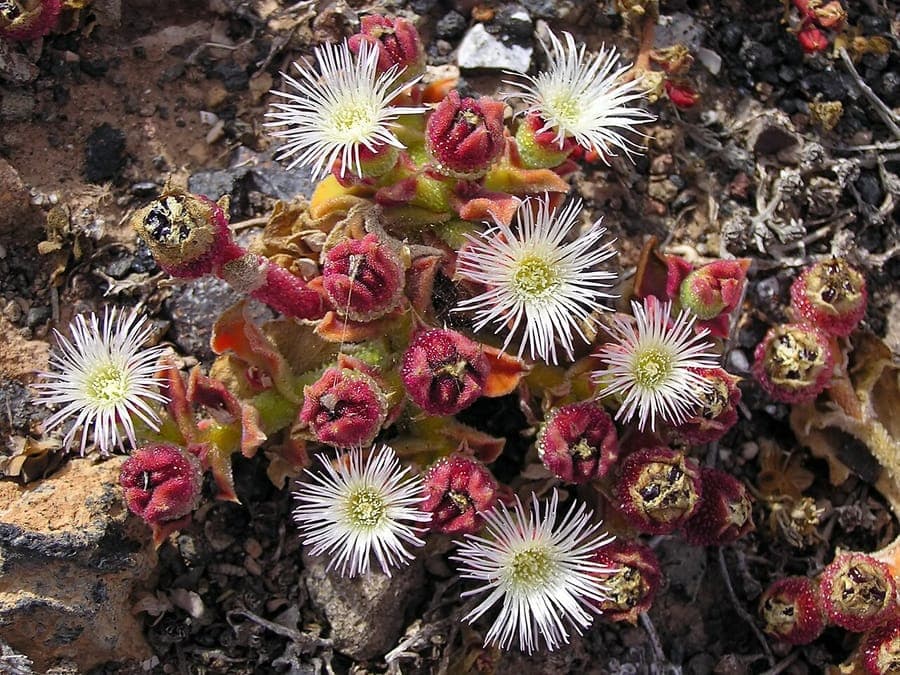
The most striking feature, however, is the crystalline structure on the leaves: small, glittering hairs resembling ice crystals that sparkle dew-like in light. These hairs function as salt glands that excrete salt from the plant, which gives it the iceplant name. Flowers are small, about 1.5 cm across, pink to purple or white, appearing from May to October (5-6 month bloom). Each flower lasts only one day, but new flowers continuously appear.
Ideal location
Common iceplant is an absolute sun-lover and thrives only in full sun (8+ hours daily). The plant cannot grow in shade and will stretch and become lax with insufficient light. This is actually advantageous - place it in your sunniest location, such as against warm south or east-facing walls, on dry patios, or in container gardens on sunny spots.
In the Netherlands (USDA 5-7), Common iceplant must overwinter indoors or in a heated greenhouse, unless you grow it in containers that you bring inside for winter.
Soil & feeding
Common iceplant grows best on very well-draining, sandy to clayey soil with pH 6.5-7.5 (neutral to slightly alkaline). This is very important: waterlogged soils are fatal to this succulent. Mix of sand (50%), fine gravel (25%) and potting soil (25%) is ideal. In containers use standard succulent/cactus potting mix.
No feeding needed. Excessive nutrition actually worsens crystalline hair formation and makes the plant lax.
Diseño gratis
¿Quieres ver Common iceplant: complete guide en tu jardín? Crea un diseño gratis ahora.
Watering
This is CRUCIAL: Common iceplant must be kept very dry. Watering once weekly during growth period (May-October) is more than sufficient. In winter (if you keep it indoors) almost no water. Use well-draining pots with drainage holes and allow water to drain thoroughly.
When in doubt: do NOT water. Drought is far better than moisture for this plant. Slightly moist soil for 3-4 days after watering is ideal.
Pruning & shaping
Common iceplant requires no pruning. This creeping growth habit is actually where its beauty lies. Pinching spent flowers encourages new blooming, but this is optional.
If the plant becomes too long, you can gently trim a few stems, but this disturbs the natural form.
Maintenance calendar
April-May: Move outdoors (after last frost), begin careful watering May-October: Growing, flowering, very careful watering October-November: Move indoors for winter, reduce water December-March: Winter rest indoors, minimal water
Winter hardiness
Common iceplant is NOT winter-hardy in the Dutch climate. USDA zones 9-11 is what it requires. This means you grow it in pots and bring it indoors as temperatures drop below 10°C (October-November). In a bright, cool room (5-10°C) or unheated greenhouse it survives easily.
Alternative: resow each spring - the plant grows quickly from seed in warm conditions.
Companion plants
Common iceplant combines beautifully with other dry, warm succulent species:
- Harrisia cactus (Harrisia martinii) for height
- Purple iceplant (Lampranthus productus) for grouping, purple flowers
- Aloe vera (Aloe barbadensis) for structure
- Echeveria (Echeveria elegans) for rosette forms
- Stonecrop (Sedum spathulifolium) for texture contrast
- Delosperma (Delosperma cooperi) for yellow-pink flowers
Conclusion
Mesembryanthemum crystallinum, the fascinating Common iceplant, is essential for anyone with dry, sunny garden corners wanting something exotic. This is a true Mediterranean connection in your home garden. Though it must move indoors for winter in the Netherlands, it's worth it for its crystalline hairs and long flowering season. On gardenworld.app, you can design warm, dry gardens where this gem functions superbly.
Common iceplant is available from many garden centers as annual succulents, or you can order seed and grow your own plants. Try this special specimen - it requires minimal care yet provides maximum botanical interest!
¿Quieres ver Common iceplant: complete guide en tu jardín? Crea un diseño gratis ahora.
Sube una foto, elige un estilo y obtén un diseño fotorrealista con lista de plantas en menos de un minuto.
Más de 10.000 jardines diseñados
Sin tarjeta de crédito


Plantas similares
Carpobrotus glaucescens: complete guide
Carpobrotus glaucescens
Pigface or angular sea-fig is a succulent from Australia. Learn cultivation, care, and use for coastal and container gardens.
Delosperma nubigenum: complete guide
Delosperma nubigenum
Everything about Delosperma nubigenum: a prolific-flowering succulent from South Africa with orange blooms. Growing tips, care and design ideas for your garden.
Crocea Iceplant: complete guide
Malephora crocea
Discover Crocea Iceplant (Malephora crocea), a South African succulent with coppery-orange flowers. Perfect for dry, sunny gardens and rock gardens.