
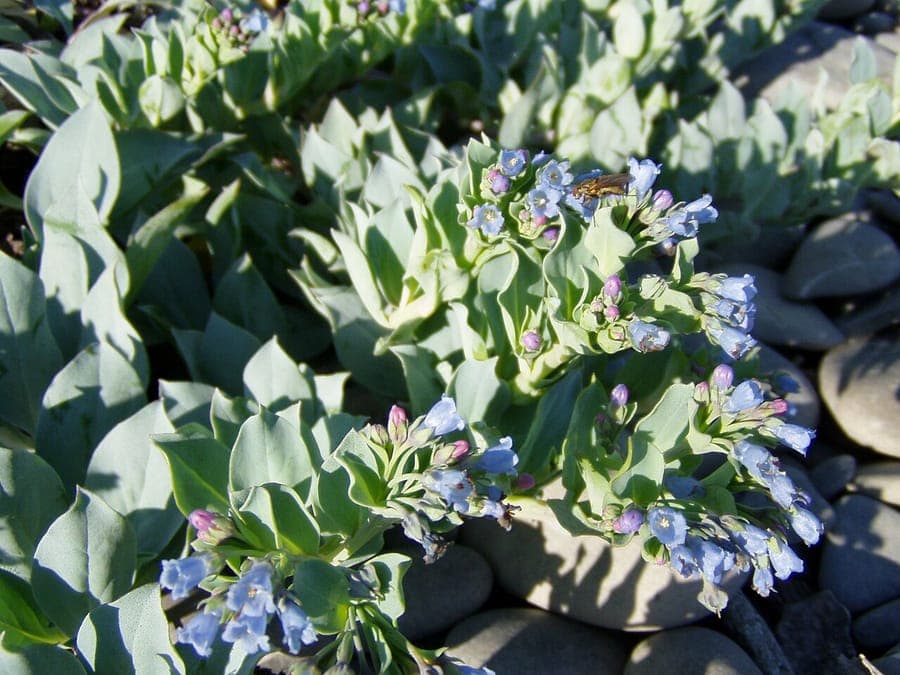
No machine-readable author provided. Dlanglois assumed (based on copyright claims). / CC BY-SA 3.0, via Wikimedia Commons
Oysterleaf: complete guide
Mertensia maritima
¿Quieres ver Oysterleaf: complete guide en tu jardín?
1 minuto, sin tarjeta de crédito
Overview
Mertensia maritima, known as oysterleaf or sea lungwort, is an extraordinarily special plant native to subarctic coastal zones. This plant grows naturally in Alaska, Norway, Siberia, and Great Britain, always near the sea. It is a low-growing, biennial herbaceous plant from the Boraginaceae family, famous for its edible leaves that taste distinctly of oysters.
Oysterleaf is a true rarity in garden cultivation, perfect for culinary herb enthusiasts. The beautiful blue flowers attract pollinators, while the crumbly-blue leaves provide a culinary sensation. This plant demands cool, moist growing conditions and is ideal for alpine gardens and coastal landscapes.
Appearance and Bloom
Oysterleaf remains low and compact, typically 15 to 30 centimeters tall. The leaves are grayish-green to blue-tinged, succulent and smooth without hairy texture. They feature a characteristic waxy coating that repels water. The flowers are small, five-petaled and bright blue to violet-blue, arranged in loose spirals.
The blooming period runs from June to August, depending on growing conditions. After flowering, small nutlets develop containing seeds. The entire plant usually disappears completely at the end of the growing season, typical of alpine species.
Ideal Location
Oysterleaf thrives best in cool, half-shaded to sunny locations depending on climate. In warm regions, it prefers afternoon shade. A location with good air circulation is essential, as this prevents fungi. In northern Europe, it can tolerate full sun.
The plant grows best in alpine gardens, rock gardens and scree beds. It also grows well in pots on cool terraces exposed to sea winds. Avoid warm, sheltered locations; it only succeeds in cool environments.
Soil
Oysterleaf demands extremely well-draining, sandy soil with plenty of gravel. The soil must be excellently drained; waterlogging quickly leads to root rot. A pH between 7 and 8 is preferred - so rather neutral to alkaline. Add coarse sand, gravel and small stones abundantly to the planting hole.
In pots use alpine potting mix with extra perlite and gravel. The plant cannot grow in regular garden soil. Organic material like peat mold or compost should be minimal. Well-drained, poor soil is much better than rich, wet soil.
Diseño gratis
¿Quieres ver Oysterleaf: complete guide en tu jardín? Crea un diseño gratis ahora.
Watering
Oysterleaf must never dry out, but must not stay wet either. This is the critical balance for successful cultivation. During the growing period water when soil surface feels dry, approximately twice to three times weekly. Overwatering is fatal.
Water at the base, never over foliage. In cooler periods water much less. After flowering and during rest, water severely reduced. In winter, when the plant is dormant, barely water at all.
Pruning
Pruning is neither necessary nor desirable with oysterleaf. Let the plant grow without intervention. You may carefully remove spent flower clusters to maintain neat appearance. Remove damaged leaves gently.
Leave seed if you want self-seeding. Leave damaged parts alone - the plant recovers poorly from drastic pruning.
Maintenance Calendar
January to March: Plant dormant, minimal watering. April: Carefully resume watering. May to July: Water regularly, flowers appear. August: Leave seed or collect it. September to December: Reduce watering as plant dies back.
Winter Hardiness
Oysterleaf is extremely winter-hardy and survives frosts well below freezing. In arctic climates it grows without protection. In temperate climates it needs no additional frost protection. A dry winter, however, is much harder than frost. Protect against winter rain with a small glass roof.
In climates with warm winters the plant will not grow well, as it demands cool growing conditions.
Companion Plants
Oysterleaf grows well with other alpine species. Combine with alpine phlox, miniature saxifrages and mountain heath. Low sedges and sedums make good partners. Avoid companions demanding lots of moisture.
From a culinary standpoint, oysterleaf can grow alongside other edible alpines like alpine thyme, but they demand different growing conditions.
Closing
Mertensia maritima is not an easy plant for beginners, but for lovers of alpines and culinary herbs it is essential. Its unique flavors and beauty justify the effort. Seeds available from specialized suppliers. Be patient and careful; the rewards are extraordinary. For more garden inspiration consult gardenworld.app. Discover more about arctic and alpine plants on gardenworld.app.
¿Quieres ver Oysterleaf: complete guide en tu jardín? Crea un diseño gratis ahora.
Sube una foto, elige un estilo y obtén un diseño fotorrealista con lista de plantas en menos de un minuto.
Más de 10.000 jardines diseñados
Sin tarjeta de crédito


Plantas similares
Western waterleaf: complete guide
Hydrophyllum occidentale
Full growing guide for western waterleaf (Hydrophyllum occidentale): shade tolerance, soil needs, watering, winter hardiness and naturalistic garden use.
Limestone phacelia (Phacelia affinis): complete guide
Phacelia affinis
Full guide to Phacelia affinis, the limestone phacelia: sowing tips, purple-blue bee flowers, drought tolerance and uses in dry or wildlife gardens.
Pyrenean viper's bugloss: complete guide
Echium asperrimum
Echium asperrimum is a striking biennial from the western Mediterranean with rough bristly stems and vivid blue flowers. A magnet for bees and a bold border plant.