
Wikimedia Commons / Public domain, via Wikimedia Commons
Dog mercury: complete guide
Mercurialis perennis
¿Quieres ver Dog mercury: complete guide en tu jardín?
1 minuto, sin tarjeta de crédito
Overview
Dog mercury, scientifically known as Mercurialis perennis, is a modest perennial plant from the Euphorbiaceae family (spurge family). This European native grows naturally in damp woodlands, woodland understory and shaded areas from Europe to northern Iran. This is a classic woodland-understory plant that has been part of European forest ecosystems for centuries.
Unlike the fast-growing annual cousin (Mercurialis annua), Dog mercury is a slow, careful grower that patiently occupies the same place for years. It is highly suitable for woodland-style gardens, shade ecologies and nature-friendly understory. On gardenworld.app, you can design natural woodland understory with this patiently growing plant as core material.
Appearance & blooming cycle
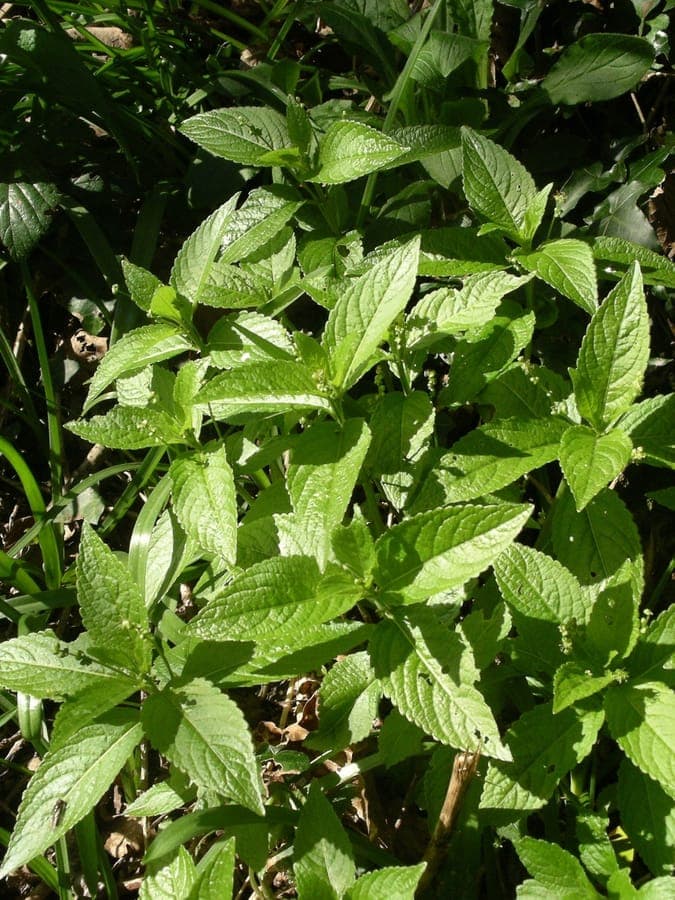
Dog mercury forms low, spreading mounds 20-40 cm tall with roughly equal spread. The stems are square, smooth, often deep purple to red-coloured, especially in shaded environments. The leaves are elliptic to lanceolate, 4-8 cm long, finely serrated, green with distinct veining and feeling firm (not soft like M. annua).
The plant is dioecious (separate male and female plants). Flowers are inconspicuous, greenish to reddish, 3-5 mm across appearing in May-June (4-6 weeks blooming). Male flowers form dense catkin-like inflorescences, while female flowers form more scattered groups with subsequent greenish seed fruits.
Ideal location
Dog mercury is a true shade-lover that grows optimally in full to deep shade (1-3 hours sun daily or filtered light). The plant cannot grow in any full sun and will die from intense sun exposure. This makes it ideal for woodland-style gardens, under tree canopies or amongst woodland plantings.
Plant this under native trees like oak, beech, ash or coniferous forests where it mimics its natural habitat.
Soil & feeding
Dog mercury grows best in humus-rich, moist woodland soil with pH 6.0-7.0 (slightly acidic to neutral). Heavy clay soils mixed with abundant organic material are ideal. The plant also grows on acidic peaty soils as long as they're humus-rich.
No synthetic fertilizer needed. Annual application of leaf litter or thin leaf layer (2-3 cm) in autumn supplies all the plant needs.
Diseño gratis
¿Quieres ver Dog mercury: complete guide en tu jardín? Crea un diseño gratis ahora.
Watering
Once established, Dog mercury is reasonably drought-tolerant in shade-woodland environments where evaporation is low. Ensure soil doesn't dry out during hot summers though, especially in younger years. Regular moisture during growth season (April-June) promotes better seed fruit formation.
In rainy climates like the Netherlands, supplemental watering is barely needed.
Pruning & shaping
Dog mercury requires no pruning. This is actually advantageous: you can let this plant grow for years without intervention. The plant naturally forms an elegant, open growth habit.
A few dead or damaged stems can be removed, but this is rarely necessary.
Maintenance calendar
April-May: Growth begins, check moisture May-June: Flowering and seed-setting July-October: Growth slows in summer, seeds ripen November-March: Winter rest, add leaf litter in autumn
Winter hardiness
Dog mercury is fully hardy in USDA zones 5-9, making it suitable for all northern and central European regions including the Netherlands. The plant experiences no damage from temperatures to -20°C.
Companion plants
Dog mercury combines perfectly with other woodland understory plants:
- False hellebore (Maianthemum dilatatum) for white flowers
- Sedges (Carex pendula, C. sylvatica) for grassy texture
- Ground ivy (Ajuga reptans) for low carpet
- Shield Ferns (Polystichum setiferum) for structure
- Wood Geranium (Geranium sylvaticum) for purple flowers
- Herb Bennet (Geum urbanum) for yellow accents
Conclusion
Mercurialis perennis, the patient Dog mercury, is essential for anyone wanting to create true woodland-plant ecosystems in the garden. This is no fast grower, but a true classic woodland-understory component. On gardenworld.app, you can design natural woodland gardens with this patiently growing plant.
Dog mercury is available from specialized woodland-planting nurseries and wildflower suppliers. It's not easily found in normal garden centres. Many landscape designers use this plant for damp woodland plantings - order through recognized wildflower traders!
¿Quieres ver Dog mercury: complete guide en tu jardín? Crea un diseño gratis ahora.
Sube una foto, elige un estilo y obtén un diseño fotorrealista con lista de plantas en menos de un minuto.
Más de 10.000 jardines diseñados
Sin tarjeta de crédito


Plantas similares
Woolly mercury: complete guide
Mercurialis tomentosa
All about Mercurialis tomentosa, the woolly mercury from southwestern Europe: site, soil, watering, care and garden design tips.
Shurur: complete guide
Euphorbia fruticosa
Everything about Shurur: cultivation in dry climates, xeriscaping, care and tips for drought-resistant gardens in warm climates
Glary spurge: complete guide
Euphorbia glareosa
Everything about glary spurge: cultivation, maintenance, frost hardiness and use in Mediterranean and mountain-inspired gardens