
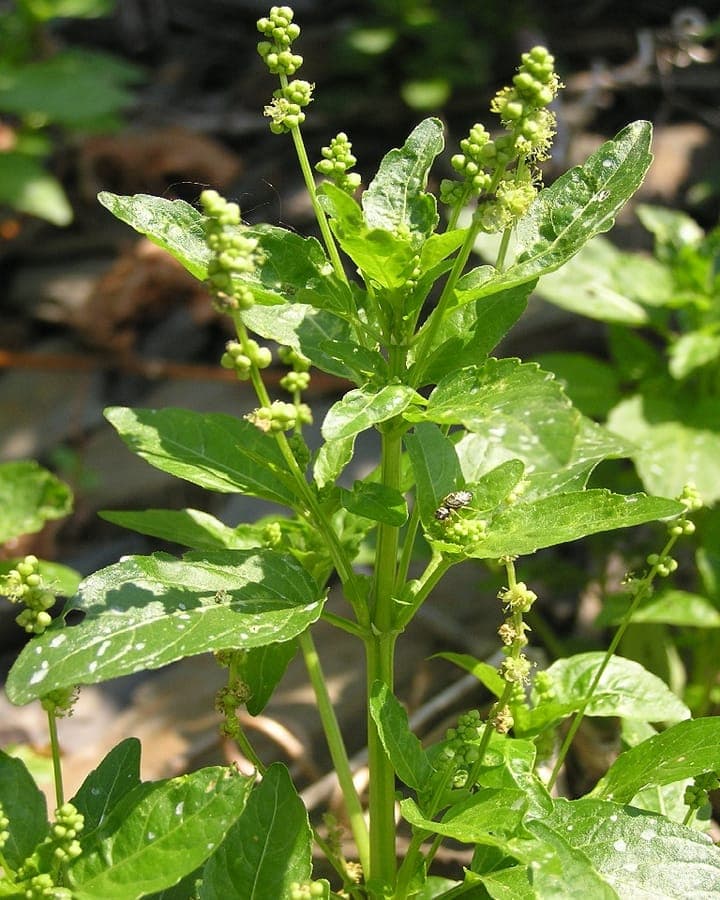
Michael Becker / CC BY-SA 3.0, via Wikimedia Commons
Annual mercury: complete guide
Mercurialis annua
¿Quieres ver Annual mercury: complete guide en tu jardín?
1 minuto, sin tarjeta de crédito
Overview
Annual mercury, scientifically known as Mercurialis annua, is a fast-growing annual plant from the Euphorbiaceae family (spurge family). This Mediterranean and European native grows naturally as a pioneer on disturbed ground, field margins, vegetable gardens and bird-food-rich habitats. The plant is renowned for rapid growth and ability to quickly cover bare ground with lush foliage.
Though often considered a weed, Mercurialis annua has culinary and fodder value - young plant parts have traditionally served as vegetables in many Mediterranean countries. On gardenworld.app, you can rapidly fill overlooked garden corners with this energetic plant, which produces abundant bird food.
Appearance & blooming cycle
Annual mercury forms an upright, sometimes somewhat lax-growing shrub of 20-60 cm height. The stems are square, smooth and usually hairless. The leaves are oval to lanceolate, 3-8 cm long, finely serrated, green and smooth with delicate venation. They feel soft and have a minuscule waxy sheen.
The flowers are inconspicuous, greenish to yellowish-green, about 2-3 mm across and not particularly showy. They appear from May to October in inflorescences at stem tips and leaf axils (7-8 month blooming period), making this plant exceptionally long-flowering. Female plants bear small greenish fruits with two seed compartments per fruit.
Ideal location
Annual mercury thrives in full sun to partial shade (4+ hours sun daily), though full sun (6+ hours) provides faster growth and richer seed development. The plant grows on practically any soil, including poor, disturbed or compacted ground where other plants struggle.
Plant this pioneer-plant on locations where you want quick biomass: along eroding stream banks, under construction shelters, in vegetable garden experiments, or in bird-food seed beds.
Soil & feeding
Annual mercury grows on virtually every soil type: sand, clay, chalky and acidic soils are all accepted with pH 6.0-7.5. The plant grows better on more fertile soils with some humus content, but accepts extremely poor substrates as well. This is actually one of this plant's strong points - it grows on ground unsuitable for many other plants.
No synthetic fertilizer needed. Light early-season feeding promotes faster growth but isn't essential.
Diseño gratis
¿Quieres ver Annual mercury: complete guide en tu jardín? Crea un diseño gratis ahora.
Watering
Once established, Annual mercury is reasonably drought-tolerant though it grows faster with regular moisture. During dry periods, one thorough watering per week usually suffices. The plant grows vigorously and rapidly even in quite dry conditions, making it ideal for neglected garden corners.
In rainy growing seasons (May-October), supplemental watering is barely needed.
Pruning & shaping
Annual mercury requires no pruning for healthy growth. However, if you want the plant to grow more compactly and develop more branching, you can gently pinch (top) when the plant reaches 20-25 cm height, resulting in greater leaf mass per plant.
When you want to harvest bird-food seeds, pruning is not recommended. Let the plant assume its natural shape.
Maintenance calendar
April-May: Sow for regrowth May-October: Growth and flowering, occasional watering during dry spells October-November: Seed ripening and harvesting, remove plant December-March: Winter rest (plant survives no real winter)
Winter hardiness
Annual mercury is not winter-hardy - it's a true annual that dies as soon as frost temperatures arrive. In USDA zones 8+ it can sometimes overwinter if sheltered, but in the Netherlands (USDA 5-7) the plant inevitably dies in November/December.
This means you must resow each spring if you want to maintain this crop.
Companion plants
Annual mercury combines well with other fast-growing annuals:
- Black nightshade (Solanum nigrum) also bird food
- Sorrel relatives (Oxyria digyna, some Rumex species)
- Cow cockle (Saponaria vaccaria) for flower contrast
- Clematis (Clematis vitalba) for climbing effect
- Common nettle (Urtica dioica) for bird-food biodiversity
Conclusion
Mercurialis annua, the fast-growing Annual mercury, is perfect for anyone wanting rapid greenery and bird food in neglected garden corners. This annual crop demands minimal care yet produces abundant biomass and bird-food seeds. On gardenworld.app, you can design rapid-growth planting schemes where this energetic pioneer plant is optimally utilized.
Annual mercury seed is available from many seed merchants and online retailers. Sow the plant in spring on warm soil and enjoy years of bird-food abundance!
¿Quieres ver Annual mercury: complete guide en tu jardín? Crea un diseño gratis ahora.
Sube una foto, elige un estilo y obtén un diseño fotorrealista con lista de plantas en menos de un minuto.
Más de 10.000 jardines diseñados
Sin tarjeta de crédito


Plantas similares
Woolly mercury: complete guide
Mercurialis tomentosa
All about Mercurialis tomentosa, the woolly mercury from southwestern Europe: site, soil, watering, care and garden design tips.
Shurur: complete guide
Euphorbia fruticosa
Everything about Shurur: cultivation in dry climates, xeriscaping, care and tips for drought-resistant gardens in warm climates
Glary spurge: complete guide
Euphorbia glareosa
Everything about glary spurge: cultivation, maintenance, frost hardiness and use in Mediterranean and mountain-inspired gardens