
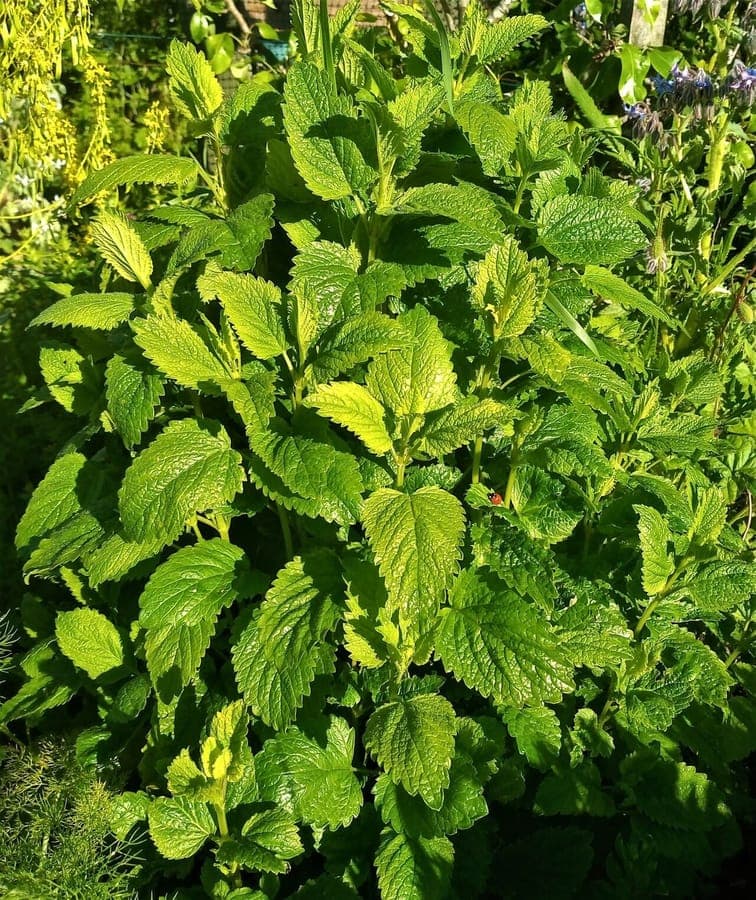
Amitchell125 / CC BY-SA 4.0, via Wikimedia Commons
Lemon balm: complete guide
Melissa officinalis
¿Quieres ver Lemon balm: complete guide en tu jardín?
1 minuto, sin tarjeta de crédito
Overview
Lemon balm (Melissa officinalis) is a frost-hardy perennial from the Mediterranean to Central Asia distinguished by its unmistakable lemon fragrance when leaves are touched. Also known as balm or true melissa, this plant is essential in contemporary tea gardens and medicinal herb gardens because of its exceptional suitability for tea, culinary use, and traditional medicine. Lemon balm grows to 60-90 cm and quickly forms dense bushy clusters of green leaves studded with softly colored white or pale-pink flowers from May to September. This plant is ideal for gardeners seeking a hardy, low-maintenance herb plant that is also attractive to bees and butterflies.
The naming is interesting: the Latin name melissa derives from the ancient Greek word for bee dance, as this plant is a classic bee-friendly plant. Officinalis points to its medicinal properties and long-established place in European herbal medicine.
Appearance and Bloom Cycle
Lemon balm grows as a compact, herbaceous perennial that reaches 30-50 cm in the first season and can become 60-90 cm after multiple years. The plant naturally forms dense bushes thanks to its numerous side stems. The growth pattern is purely herbaceous, with no woody parts even after years of growth.
The stems are square and green (characteristic of Lamiaceae family), with very fine hairiness. They snap when you touch them, which enhances the classic herb quality.
The leaves are the most characteristic feature: ovate to oval, approximately 3-8 cm long, bright green, with a finely toothed margin. These leaves are full of essential oil containing that famous lemon fragrance. When you touch or pinch them, an immediate, pleasantly strong lemon aroma releases - one of the most recognizable herb garden scents.
The bloom period runs from May through October, with peak around July-August. Flowers grow in vertical spires in leaf axils. Individual flowers are small, approximately 6-8 mm, white with sometimes light pink speckles. These flowers are exceptionally nectar-rich, making lemon balm a magnet for honeybees, bumblebees, and many other insects.
Ideal Location
Lemon balm grows optimally in full sun to partial shade: 5-6 hours of direct sunlight daily is ideal, although it functions well even in 4-5 hours of sun. With less sun (2-3 hours) the plant grows taller and thinner, seeking light, but can still produce decent bloom. In very shady locations (2 hours or less) growth becomes sparse and bloom minimal.
The plant tolerates partial shade well, especially in warm climates where afternoon shade is cooling in summer. Sheltered locations are favorable because fine stems can topple in strong wind.
Soil Requirements
Lemon balm is reasonably adaptable with soils. pH 5.5 to 7.5 is acceptable. The plant grows best on well-draining, moderately fertile soils. Heavy clay or strongly waterlogged soils can lead to rot.
Basic ground preparation is sufficient: 3-4 cm of well-aged compost worked into the top 15 cm. On very poor soils, additional leaf mold (5 cm) can help. The plant needs no extra feeding once growth begins, although annual compost application (2-3 cm) in spring stimulates growth.
Drainage is critical. Really poor drainage - solid clay without any sand - requires improvement: mix 20-25% coarse sand to 30 cm depth.
Watering
Once established (4-6 weeks after planting) lemon balm is moderately drought-tolerant for an herb. It has no deep taproot like some herbs; roots are more surface-oriented. This means consistently moist (but not waterlogged) soil is ideal.
Young plants should be kept consistently moist during their first 6-8 weeks: water two to three times weekly so soil feels like a wrung-out sponge.
Once established, in normal Dutch growing season, usually no supplemental water needed except in very dry periods (no rain 2+ weeks). Then one watering per week helps.
Overwatering is more damaging than underwatering for lemon balm. Too much water stimulates weak growth and mildew.
Diseño gratis
¿Quieres ver Lemon balm: complete guide en tu jardín? Crea un diseño gratis ahora.
Pruning
Lemon balm responds very positively to pruning. It becomes more compact and bushy as you pinch off leaf tops. In May, when new growth starts, pinch off the top 5-7 cm to encourage lateral branching. This creates wider, fuller plants with more foliage.
Annually in early spring (March) cut back hard, removing dead stems from the previous year. The plant regrows quickly from the base.
Regular leaf harvesting for tea or use stimulates much more growth. This is actually the best "pruning method" - by constantly removing leaves.
Maintenance Calendar
April-May: Plant young plants or sow seed under glass. Space 40-50 cm apart. Water regularly. Pinching can begin once the plant has 3-4 leaf pairs.
June-July: Begin regular leaf harvesting for tea or culinary use. This stimulates more growth. Check moisture in dry periods.
August-September: Continue bloom and leaf harvesting. Plant can now be dense and bushy.
October-November: Reduce harvesting. Let seed set in-situ for self-seeding next spring. Leaves become reddish-tinted in cooler weather.
December-March: Minimal activity. In March, cut back hard and apply compost.
Winter Hardiness
Lemon balm is a true hardy perennial in zones 4-11 (USDA). In the Netherlands (zones 8a/8b) it overwinters very reliably. The plant dies back to ground level in winter but returns every spring without issue from the base.
In very severe winters (below -20°C) young plants can sustain damage. A mulch layer (5-7 cm) in November protects young root systems in extreme winters.
Companion Plants
Lemon balm combines well with other Mediterranean herbs and in medicinal herb gardens. Grouping ideas:
In tea gardens: combine with Salvia officinalis (green), Origanum vulgare, and Thymus vulgaris. This grouping, when harvested for tea, also looks beautiful.
In bee gardens: combine with Nepeta cataria, Mentha spicata, and Lavandula for a nectar-rich cluster that attracts insects heavily.
In small borders: Melissa officinalis as middle, with lower frontal Teucrium chamaedrys and Dianthus carthusianorum.
Medicinal Application (Informational)
Lemon balm is known from traditional medicine for stress relief, insomnia, and digestive support. Modern studies confirm that leaves contain essential oil with muted calming effect on the nervous system. This makes tea effective for relaxation. For medicinal use, always consult a qualified practitioner.
Culinary Use
Lemon balm leaves are excellent in tea (fresh or dried), in lemonades, in sauces for seafood, and in desserts. The lemon fragrance adds refined dimension without acidity.
Closing
Lemon balm is one of the most user-friendly herbs for beginning gardeners. The combination of hardiness, easy growth, attractive appearance, culinary utility, and bee value makes it an essential herb. For seed check specialist nurseries; for container plants, all garden centers stock Melissa officinalis.
This perennial plant delivers years of benefit: tea, culinary use, medicine support, and insect feeding all from one low-maintenance plant. With minimal care and regular harvesting lemon balm remains productive from spring through fall. Visit gardenworld.app for integration of lemon balm in medicinal and tea gardens. Gardenworld.app helps you design herb gardens that are both productive and beautiful.
¿Quieres ver Lemon balm: complete guide en tu jardín? Crea un diseño gratis ahora.
Sube una foto, elige un estilo y obtén un diseño fotorrealista con lista de plantas en menos de un minuto.
Sin tarjeta de crédito


Plantas similares
Catmint: complete guide
Nepeta cataria
Catmint (Nepeta cataria) is a hardy, aromatic herb that attracts cats and pollinators. Thrives in full sun and well-drained soil, blooming from June to September.
Sage: complete guide
Salvia officinalis
Everything you need to grow and care for Salvia officinalis: ideal spot, soil needs, pruning, and winter hardiness for gardens in temperate climates.