
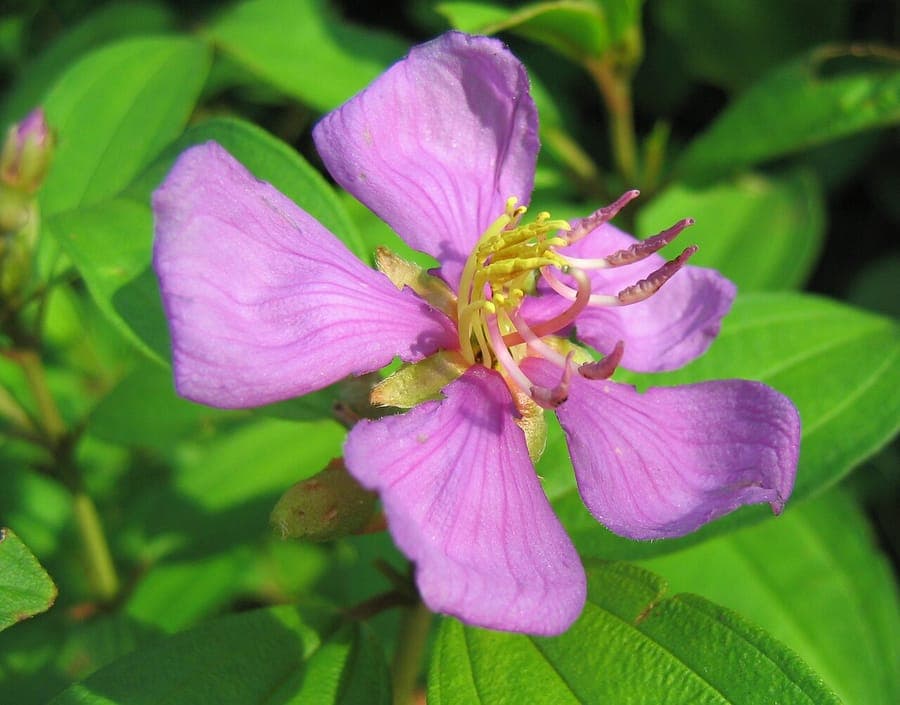
Vinayaraj / CC BY-SA 3.0, via Wikimedia Commons
Indian Rhododendron: complete guide
Melastoma malabathricum
¿Quieres ver Indian Rhododendron: complete guide en tu jardín?
1 minuto, sin tarjeta de crédito
Overview
The Indian Rhododendron (Melastoma malabathricum, also known as Asian melastome) is a striking tropical shrub from South and Southeast Asia. This beautiful plant belongs to the Melastomataceae family and is known for its lovely pink flowers and dark berries. The plant grows wild from India to Australia and from Seychelles to Philippines.
This plant is ideal for gardeners in warm climates or as a houseplant in cooler regions. The pink flowers appear continuously and attract insects. The plant adds exotic beauty to any environment. For anyone wanting tropical beauty in their home or garden, this is the perfect plant.
Appearance and Bloom
The Indian Rhododendron grows as a striking shrub with dark, hairy foliage. The plant reaches heights of 1 to 2 meters or more in favorable conditions. The flowers are pink to purple colored and have striking yellow stamens in the center.
The leaves are dark green, oval to lance-shaped with clearly visible ribs. The foliage has a rough, hairy appearance. The flowers appear continuously during the growing season. After flowering, the plant produces ink-blue to purple berries that are highly decorative.
The combination of pink flowers and dark berries makes this plant truly exotic and striking. This is a real eye-catcher in any garden.
Ideal Location
The Indian Rhododendron thrives best in full sun to light shade. In warm climates, the plant prefers some shade during the hottest hours. Place the plant in a location with at least 4-6 hours of sunlight daily.
In tropical regions, the plant grows well in semi-shade under other trees. In temperate climates as a houseplant, the plant prefers a bright, sunny windowsill. The plant cannot tolerate complete darkness.
Soil
The Indian Rhododendron requires humus-rich, well-draining soil. In the ground, you can use a mixture of garden soil and leaf mold. For potted plants, use nutrient-rich potting soil.
The plant prefers slightly acidic to neutral soil (pH 5.5 to 7.0). Ensure good drainage to avoid waterlogging. In pots, good drainage is very important. Add some extra organic matter to balance soil moisture.
Watering
Provide regular, generous watering, especially during the growing season. Allow the soil surface to dry slightly between waterings. In pots, regular watering is necessary. In hot periods, daily watering may be needed.
In winter, watering can be reduced. However, ensure the soil never dries out completely. Water from a saucer can be used. Regular misting can help support humidity needs, especially for houseplants.
Pruning
Pruning promotes compact growth. Pinch out younger growth regularly to stimulate a full, bushy form. This can be done in spring or early summer. Remove dead or damaged branches when you see them.
The plant responds well to pruning and regrows quickly. Regular pruning promotes more flowers. Old, overgrown stems can be cut back harder. This stimulates new, healthy growth.
Maintenance Calendar
February-March: Beginning of growing season. Start regular watering.
April-September: Active growth and blooming. Provide generous water and regular pruning.
October-November: Blooming decreases. Watering can be slightly reduced.
December-January: Winter period. Minimal growth. Reduce water and maintenance.
Winter Hardiness
The Indian Rhododendron does not tolerate frost and dies at temperatures below 5 degrees Celsius. In temperate climates, the plant must be overwintered indoors. Bring the plant inside before the first frost.
Inside, the plant should be in a bright, cool location. Normal room temperature is acceptable but cooler is better. At temperatures below 5 degrees, leaves may fall.
Diseño gratis
¿Quieres ver Indian Rhododendron: complete guide en tu jardín? Crea un diseño gratis ahora.
Companion Plants
In tropical gardens, the Indian Rhododendron combines well with:
- Fuchsia: other exotic flowers
- Hibiscus: tropical shrubs with colorful flowers
- Bougainvillea: exotic flowers
- Passiflora: climbing and exotic
- Plumbago: blue flowers contrast nicely
In indoor combinations with other tropical houseplants works well.
Closing Thoughts
The Indian Rhododendron is a beautiful, exotic plant for those who love tropical beauty. With the right conditions - warmth, humidity, and regular watering - this plant will delight you for years with continuous blooming and attractive berries.
Visit gardenworld.app for more tropical plant inspiration. Visit gardenworld.app for all your garden planning needs!
Vermeerdering en voortplanting
De plant kan gemakkelijk vermenigvuldigd worden uit zaad. Zaden kunnen in het voorjaar gezaaid worden in potgrond. Houd de zaaigrond vochtig maar niet nat totdat kiemling verschijnt. Dit duurt meestal 2 tot 3 weken. Zaailing kunnen worden uitgeplant wanneer zij groot genoeg zijn om te hanteren.
Natuurlijke vermeerdering gebeurt wanneer zaad van rijpe zaadschillen op geschikte plaatsen terechtkomt. Dit is een methode die de plant in het wild gebruikt om zich uit te breiden naar nieuwe gebieden. In de tuin kan je dit bevorderen door zaadschillen op geschikte plaatsen los te laten.
Zieken en plagen
Cobb berglupin is vrij resistent tegen zieken en plagen. De meest voorkomende problemen zijn schimmelziekten in zeer vochtige omstandigheden. Zorg voor goede luchtstroom rond de plant. Bladziekten kunnen voorkomen en kunnen met fungicide worden behandeld.
Insectenplagen zijn zeldzaam maar bladluizen kunnen soms voorkomen. Deze kunnen met insecticide worden behandeld of eenvoudigweg met sterke waterstraal weggespoten. Het is beter om biologische bestrijding te gebruiken wanneer mogelijk.
Opslag en bewaring van zaden
Zaden van Cobb berglupin kunnen opgeslagen worden voor toekomstige zaaiing. Verzamel rijpe zaadschillen en laat deze volledig drogen in een schone, droge ruimte. Verwijder de zaden uit de schillen en berg op in een droge plek. Zaden kunnen tot 2 tot 3 jaar levensvatbaar blijven als ze goed opgeslagen worden.
Historische en culturele betekenis
Deze plant heeft grote betekenis gehad in traditionele tuinen en natuurlijke ecosystemen. Inheemse volkeren hebben deze planten gebruikt voor diverse doeleinden gedurende eeuwen. De plant vertegenwoordigt een belangrijk onderdeel van de biologische erfgoed in zijn natuurlijke habitat.
De plant is ook belangrijk voor wetenschappelijk onderzoek omdat het onderdeel uitmaakt van diverse ecosystemen. Botanici en onderzoekers bestuderen deze plant om beter te begrijpen hoe planten zich aanpassen aan hun omgeving.
Gebruikswaarde en voordelen
Buiten de decoratieve waarde biedt deze plant verschillende praktische voordelen voor de tuin. Veel tuiniers waarderen de plant om zijn onderhoudsarme karakter en robuustheid. De plant kan jaren lang groeien zonder veel tussenkomst.
De plant draagt ook bij aan de biodiversiteit door voedsel en schuilplaats te bieden aan insecten en andere dieren. Dit maakt het een waardevolle toevoeging aan elke ecologisch bewuste tuin.
Ras en cultivars
Hoewel Lupinus sericatus primair als wilde plant voorkomt, zijn er enkele cultivars en selecties beschikbaar voor tuingebruik. Deze kunnen verschillen in bloemkleur of grootte. Kwekers hebben gewerkt aan het selecteren van de beste vormen voor tuingebruik.
Sommige botanische tuinen focussen op het behouden van pure, wilde types van deze plant. Dit helpt erfgoed en genetische diversiteit in stand te houden voor toekomstige generaties.
¿Quieres ver Indian Rhododendron: complete guide en tu jardín? Crea un diseño gratis ahora.
Sube una foto, elige un estilo y obtén un diseño fotorrealista con lista de plantas en menos de un minuto.
Sin tarjeta de crédito


Plantas similares
Acer pycnanthum: complete guide
Acer pycnanthum
Acer pycnanthum, the Japanese swamp maple, is a fast-growing tree with early red flowers and brilliant autumn color, ideal for damp garden settings.
Freeman maple: complete guide
Acer × freemanii
Everything about the Freeman maple (Acer x freemanii): a fast-growing shade tree with spectacular autumn colour for large gardens.
Silver vine: complete guide
Actinidia polygama
Discover silver vine (Actinidia polygama): a hardy climbing plant with silvery foliage, loved by gardeners and cats alike.