
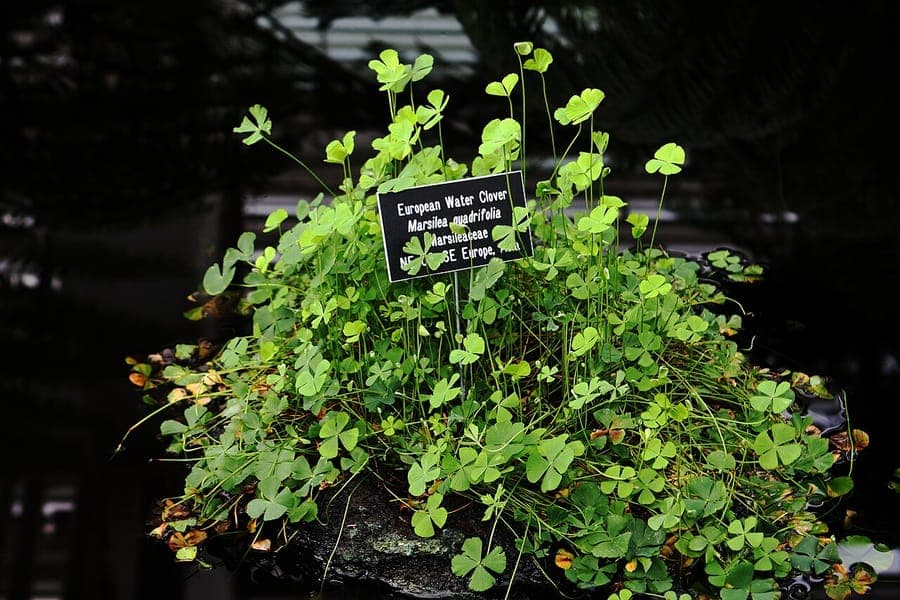
Hardyplants / CC0, via Wikimedia Commons
Water clover (Marsilea quadrifolia): complete guide
Marsilea quadrifolia
¿Quieres ver Water clover (Marsilea quadrifolia): complete guide en tu jardín?
1 minuto, sin tarjeta de crédito
Overview
Water clover (Marsilea quadrifolia), also called European water fern or marsilia, is a fascinating aquatic plant belonging to the fern family Marsileaceae, native to Mediterranean regions, Europe, and Asia extending to Japan and Iran. This unique plant represents a rare lineage of aquatic ferns with remarkable growth plasticity, capable of thriving in both floating and completely submerged forms. In natural habitats - shallow waters, marshes, and lakeside margins - water clover stabilizes waterbank erosion and provides critical microhabitats for aquatic invertebrates and fish fry. The plant reproduces through microscopic spores contained in distinctive hard sporocarps (spore-bearing structures) forming on submerged portions rather than flowers or typical seeds.
Water clover gains popularity in pond and aquatic gardens due to its adaptive growth, distinctive four-leafed clover-like foliar pattern, and ecological contributions. In temperate ponds, water clover survives winters through dormant submersion, making it invaluable for gardeners maintaining permanent aquatic plant communities. This is literally a living fossil representing ancient botanical lineages persisting for millions of years. The plant teaches aquatic gardeners lessons in ecological relationships, water conservation, and historical plant diversity.
Appearance & growth
Water clover develops as a rosette-like cluster of long petioles bearing characteristic four-leafed foliage. Each complete leaf (frond) consists of approximately four equal leaflets (pinnae) measuring 1-2 centimeters length, radiating from a central point in distinctive four-clover configuration. These leaves demonstrate remarkable plasticity: floating leaves are larger, thinner-textured and light green; completely submerged leaves are finer-textured, more delicate. The plant forms underground horizontal runners (rhizomes) that expand slowly, creating new plantlets. Characteristic small, hard brown-black sporocarps develop at the plant's base - rough-textured spheres containing reproductive spores viable for years even when desiccated.
The plant lacks true roots but develops fine rootlets. Overall dimensions remain modest: mature water clover colonies occupy footprints of merely 10-30 centimeters diameter. Individual fronds reach 5-15 centimeters petiole length, making this an elegant, fine-textured aquatic choice.
Ideal location
Water clover thrives in shallow water columns, typically 5-25 centimeters deep, though it tolerates depths to 50 centimeters. The plant prefers full sun to partial shade, requiring minimum 4-6 hours direct sunlight daily for vigorous growth. The plant grows more slowly in reduced light but tolerates shadier positions acceptably. Optimal locations feature still to very slowly-moving water; rapid current prevents rhizome establishment and disturbs young plantlets. Position water clover in pond shallows, along margins, or in specialized shallow basins where water remains stable. The plant dislikes rapid temperature fluctuations; established plants in stable water perform optimally.
Soil & water requirements
Water clover performs best in sediment-rich environments. Plant in aquatic mud, 1:1 mixture of commercial potting soil and coarse sand, or specialized aquatic growing medium. The plant tolerates various water conditions from soft to hard, though neutral to slightly alkaline water (pH 6.5-7.5) optimizes growth. The plant accepts nutrient-poor waters well, though occasional supplemental nutrition benefits growth. Water temperature optimally ranges 15-25 degrees Celsius; the plant enters dormancy below 5 degrees Celsius, surviving winters through submersion in sediment. In extremely warm summers (exceeding 30 degrees Celsius), growth slows and light shade provides benefit.
Diseño gratis
¿Quieres ver Water clover (Marsilea quadrifolia): complete guide en tu jardín? Crea un diseño gratis ahora.
Water management
Water clover requires no special water management beyond maintaining consistent water presence. Ensure water doesn't disappear through rapid evaporation; supplement weekly during very hot periods. Never allow the planting basin to completely dry, as this damages sporocarps. Water pollution prevention matters: avoid heavy contamination or nutrient excess promoting algal blooms, though water clover itself contributes positively by actively absorbing nutrients from water. The plant actually improves water quality through nutrient uptake.
Propagation
Water clover reproduces naturally through two methods: sporocarps and rhizome expansion. For home gardeners, rhizome fragmentation proves simplest. Carefully sever rhizome fragments from the parent colony and plant in shallow sediment. New plantlets emerge within 4-6 weeks; ensure each fragment includes at least one growing apex. Spore propagation is possible but requires sporocarps collection and specialized germination conditions. Sporocarps mature July-September, appearing brown-black and hard. Collect ripe sporocarps, store dry (they remain viable for years), then place in wet sand in spring (March-April) until germination occurs.
Maintenance calendar
March-April: Plant overwintering plantlets into ponds as water temperatures exceed 10 degrees Celsius. New growth initiates as water warms.
May-June: Vigorous growth. Foliage rapidly fills aquatic zones. Inspect for unwanted algae. Apply modest supplemental fertilization if needed.
July-September: Growth peaks. Sporulation begins in July; sporocarps mature and harden progressively through September.
October-November: Growth decelerates as temperatures cool. Sporocarps are now fully mature, brown-black, and hard. Above-ground plant portions may disappear, particularly in freezing regions.
December-February: Plant persists submersed as dormant tissue or disappears beneath ice. Sporocarps survive in bottom sediment through harsh winters.
Winter hardiness
Water clover is exceptionally winter-hardy, surviving permanently under pond ice through dormant submersion strategy. Above-ground plant portions may be killed by hard frost, but sporocarps in sediment survive to -10 degrees Celsius. In extremely harsh winters where ponds freeze completely, no supplemental protection is necessary: the plant regenerates spontaneously when ice melts and water temperatures rise in spring.
In USDA hardiness zones 3-11, water clover can be maintained permanently. Regions colder than zone 3 may require indoor overwintering of sporocarps during extreme winters, though this is rarely necessary as sporocarps are remarkably hardy.
Companion plants
Water clover grows beautifully alongside other shallow-water plants: dwarf papyrus, sedges, water-spring plants, watermint, and fine-textured aquatic plants form harmonious pond ecosystems. The plant combines well with water hawthorn and water violet in submerged zones. Ensure fast-growing aquatic plants don't completely overshadow delicate water clover. Plan zoning carefully so that water clover occupies visible, well-lit positions while larger marginal plants provide background structure.
Closing
Water clover represents a connection to deeply ancient botanical heritage. This plant belongs to a small living genus of "fossil" aquatic ferns surviving unchanged for millions of years. Cultivation in garden ponds brings paleobotanical significance to contemporary gardening. For pond gardeners seeking distinctive elements beyond typical lotuses and water lilies, water clover offers fine, elegant structure and biologically fascinating reproduction strategies. Learn more about aquatic plants and pond gardening at gardenworld.app.
Beginning pond gardeners need not fear water clover: it is simple, self-maintaining, and propagates without intervention. Plant it, enjoy its distinctive clover-like foliage, and understand you cultivate a plant proven reliable across millions of years. Discover more aquatic plant selections and pond gardening strategies at gardenworld.app.
¿Quieres ver Water clover (Marsilea quadrifolia): complete guide en tu jardín? Crea un diseño gratis ahora.
Sube una foto, elige un estilo y obtén un diseño fotorrealista con lista de plantas en menos de un minuto.
Más de 10.000 jardines diseñados
Sin tarjeta de crédito


Plantas similares
Acer pycnanthum: complete guide
Acer pycnanthum
Acer pycnanthum, the Japanese swamp maple, is a fast-growing tree with early red flowers and brilliant autumn color, ideal for damp garden settings.
Freeman maple: complete guide
Acer × freemanii
Everything about the Freeman maple (Acer x freemanii): a fast-growing shade tree with spectacular autumn colour for large gardens.
Silver vine: complete guide
Actinidia polygama
Discover silver vine (Actinidia polygama): a hardy climbing plant with silvery foliage, loved by gardeners and cats alike.