
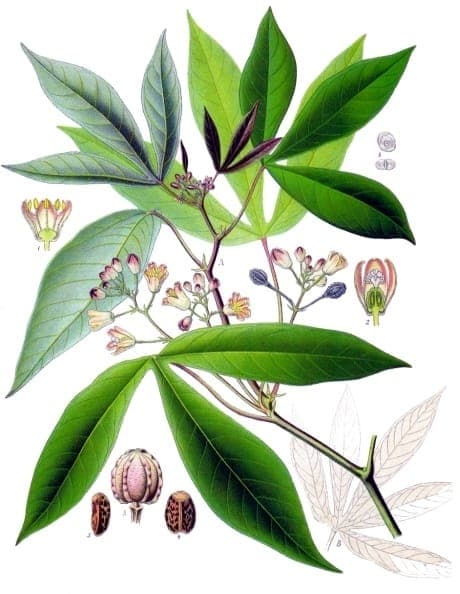
Franz Eugen Köhler, Köhlers Medizinal-Pflanzen / Public domain, via Wikimedia Commons
Cassava (Manihot esculenta): complete guide
Manihot esculenta
¿Quieres ver Cassava (Manihot esculenta): complete guide en tu jardín?
1 minuto, sin tarjeta de crédito
Overview
Cassava (Manihot esculenta), commonly called manioc or yuca depending on regional convention, is a fundamental tropical food crop originating from Brazil and the Amazon Basin. This shrubby perennial from the Euphorbiaceae family produces starchy tuberous roots that constitute a primary staple carbohydrate source for hundreds of millions of people across tropical Africa, Asia, and the Americas. The plant exhibits remarkable resilience, thriving in poor soils that challenge other crops, and producing dependable yields even under drought stress. Beyond its critical role as a global food security crop, cassava offers temperate-climate gardeners opportunities for experimental cultivation, though successful root production requires understanding tropical growth cycles and careful post-harvest processing.
Cassava roots contain naturally occurring cyanogenic compounds requiring proper processing before consumption, but when appropriately prepared, they provide excellent nutrition including vitamin C, fiber, and minerals. The plant's leafy biomass is equally nutritious as cooked greens, serving as protein-rich spinach substitute in traditional cuisines. Temperate gardeners can propagate cassava from cuttings with nearly effortless success and enjoy decorative tropical foliage even if root yields remain modest. For food-security conscious gardeners or enthusiasts of global food crops, cassava represents both historical significance and practical cultivation interest.
Appearance & growth cycle
Cassava develops as a woody shrub reaching 1.5-2.5 meters height in tropical conditions, though 1-1.5 meters represents typical cultivated dimensions. The plant's most striking feature consists of deeply palmate leaves featuring 5-9 distinct leaflets, each reaching 20-30 centimeters length, with distinctive burgundy or purplish undersides contrasting green upper surfaces. Young stems are pale green and succulent, becoming woody, brown, and thick-barked with age as plants mature.
Most importantly, beneath the soil develop the starchy tuberous storage roots - the plant's primary economic asset. These roots expand to 25-40 centimeters length and 4-8 centimeters diameter, developing thick brown skins with ivory to pale yellow starchy flesh inside. Root maturation requires 8-12 months from initial planting, though smaller roots suitable for consumption may be harvested as early as 6 months. The plant periodically produces small, yellowish-orange flowers in axillary panicles, but flowers hold little horticultural or culinary significance. Cassava's growth acceleration occurs dramatically during warm months (April-September in temperate regions), remaining nearly dormant when temperatures drop below 15 degrees Celsius.
Ideal location
Cassava thrives in full sun locations receiving minimum 6-8 hours direct sunlight daily, actually preferring completely unshaded positions. The plant grows faster and produces superior roots in warm conditions, appreciating temperatures between 20-30 degrees Celsius. Below 15 degrees Celsius, growth slows substantially; frost kills above-ground portions and damages or destroys underground roots. In temperate climates, select the sunniest, warmest available location, ideally against south-facing structures that radiate stored heat during cool nights.
The plant requires shelter from severe winds that snap brittle branches and cause leaf damage, though gentle air circulation prevents fungal diseases. In containers, position plants where afternoon shade protects from intense midsummer heat in extremely hot climates (over 35 degrees Celsius), though northern temperate regions rarely provide excessive heat. Wind protection becomes increasingly important as plants grow taller and develop heavier foliage loads that catch gusts.
Soil requirements
Cassava demonstrates remarkable soil tolerance, producing acceptable yields in soils that challenge most crops - sandy loams, clay-dominant soils, and even poor laterite soils support reasonable productivity. The plant strongly prefers well-drained soil with pH 5.5-7.0, though tolerates up to pH 8.0. Unlike many crops, cassava actually performs adequately in nutritionally depleted soils, making it valuable for marginal land restoration. This tolerance reflects the plant's evolutionary origin in tropical environments where soils undergo intense leaching.
For optimized root production, prepare soil mixing standard garden soil with 25-30% coarse sand and well-composted organic matter (aged animal manure, leaf mold). This combination maintains porosity while retaining nutrients. Avoid excessive nitrogen fertilization, which promotes excessive leafy growth at the expense of root development. At initial planting, incorporate modest NPK fertilizer at 10-10-10 ratio, then apply minimal additional feeding during the growing season. Drainage remains absolutely critical - waterlogging kills cassava rapidly through root rot and oxygen deprivation. If your garden suffers poor drainage, elevate planting areas by 20-30 centimeters.
Watering
Despite cassava's reputation as drought-tolerant (reflecting its development in variable tropical climates), consistent moisture accelerates growth substantially during the establishment phase. For the first 3-4 months after planting, water thoroughly when the top 4-5 centimeters of soil become dry to touch. Established plants (beyond 4-5 months) tolerate 1-2 weeks of complete drying without serious stress, though yields remain superior with regular irrigation. Reduce watering frequency during cooler months (October-March) when growth nearly ceases.
Exercise extreme caution against overwatering, which exceeds the plant's drought tolerance by far. Consistently wet soil rapidly promotes fungal root diseases, particularly fungal pathogens causing soft rot. Water at the soil surface rather than overhead, preventing leaf-wetness diseases in cool or humid conditions. In containers, ensure drainage holes remain unobstructed and elevate pots on feet to prevent water accumulation beneath. During winter dormancy in temperate climates, reduce watering to minimal amounts - allow soil to approach near-dryness without complete desiccation.
Diseño gratis
¿Quieres ver Cassava (Manihot esculenta): complete guide en tu jardín? Crea un diseño gratis ahora.
Harvesting & processing
Roots reach harvest maturity at 8-12 months, though earlier harvesting (6 months) yields smaller but edible roots. Carefully excavate around plants, beginning from the outer edge, and gently extract individual roots while leaving smaller roots to continue developing. This selective harvesting allows gradual root removal across the growing season without destroying the parent plant. In temperate climates, harvest remaining roots before first frost kills foliage, since root quality deteriorates rapidly after frost damage.
Critical processing requirement: raw cassava contains potentially toxic cyanogenic glucosides, especially concentrated in skins and tissues near the bark. Safe processing methods include thorough peeling, cutting into pieces, and either extended drying (at least 48 hours in sunlight) or cooking at high temperature for minimum 30 minutes. Freezing roots for several days before processing reduces cyanide content. Cooked cassava becomes safe and transforms into tender, easily digestible starch. Young leaves may be cooked like spinach after thorough rinsing and extended boiling, providing excellent protein and micronutrients.
Propagation
Cassava propagates with remarkable ease via hardwood stem cuttings, making this the preferred multiplication method. Select mature, woody stem sections 15-20 centimeters long from healthy parent plants, removing lower leaves. Insert cuttings halfway deep into moist propagation medium (equal parts sand and peat) under warm conditions (20-25 degrees Celsius) with high humidity. Rooting occurs within 2-3 weeks; properly rooted cuttings develop several inches of new top growth within 4 weeks, then transition to individual containers. Cutting-propagated plants mature 1-2 weeks faster than seed-grown specimens and reproduce parental characteristics exactly.
Alternatively, air-layering produces larger, faster-growing specimens but requires more labor. Seed propagation is possible but produces highly variable offspring with inferior root-development characteristics, so cuttings strongly remain preferred.
Maintenance calendar
March-April: Start cutting propagation in heated propagation bed under controlled humidity. Maintain 20-25 degrees Celsius. Root formation appears by week 3.
May: Harden propagated cuttings gradually over 2 weeks. After last frost danger passes, transplant into containers (minimum 20-liter pots) or garden beds. Space at least 75-100 centimeters apart for mature size.
June-July-August: Vigorous growth phase. Water consistently without waterlogging. Apply 5-10 centimeter mulch layer to conserve moisture and suppress weeds. Inspect periodically for spider mites or whiteflies.
September-October: Growth decelerates as temperatures cool. Continue watering but reduce frequency. Monitor for early leaf yellowing indicating nutrient depletion or root rot.
November-December-January: In temperate climates, move container plants indoors or to protected greenhouse. Outdoor-grown garden plants require 15-20 centimeter mulch layer if frost threatens. Minimize watering - approximately once monthly suffices.
February: Prepare for upcoming season. Remove dead branches. Inspect for frost damage. Gradually increase water as temperatures warm.
Winter hardiness
Cassava tolerates no frost whatsoever. Light freezing (0 to -2 degrees Celsius) kills foliage; temperatures below -2 degrees Celsius kill stems and damage or destroy roots. In temperate climates, container cultivation with indoor winter placement is mandatory. Outdoor gardeners in regions with frost risk must provide 15-20 centimeter heavy mulch layers (straw, leaves, wood chips) covering the planting zone completely. This insulation provides modest protection but remains unreliable; southern-facing locations with afternoon sun reflection improve winter survival probability.
In USDA hardiness zones 9b-11 with protected microsites, established plants may survive winters outdoors. Zones 9a and colder require mandatory indoor containment or seasonal destruction and spring replanting from stored cuttings.
Companion plants
Cassava integrates well into tropical polyculture systems with bananas, sweet potatoes, taro, and ginger sharing comparable cultural requirements. In mixed food gardens, cassava complements maize and beans in traditional "three sisters" polyculture, though cassava's slower establishment means it shouldn't be overshadowed by faster-growing nitrogen-fixing companions. Pair cassava with other deep-rooted plants benefiting from loose, well-drained soil. Avoid positioning cassava adjacent to moisture-demanding plants or poorly drained areas where drainage requirements diverge significantly.
Closing
Cassava cultivation brings tropical food-security consciousness and global agricultural perspective to temperate-zone gardens. While root yields in cool climates remain substantially less impressive than tropical counterparts, cassava offers remarkable propagation ease, ornamental tropical foliage, and modest but genuine root production even in marginal conditions. The plant's resilience teaches valuable lessons about crop performance under stress and about food-security crops supporting billions worldwide. For food-gardening enthusiasts or globally minded cultivators, cassava provides living curriculum in tropical agriculture and food self-sufficiency. Learn more about global food crops and tropical gardening techniques at gardenworld.app.
Whether growing cassava for experimental root production or enjoying the ornamental foliage in container displays, the plant rewarding attention with dependable growth and fascinating insights into tropical food systems. Start with propagated cuttings for rapid establishment, progressively refine your cultivation technique, and discover the satisfactions of producing this historically significant crop in temperate climates. Explore more exotic food plants and tropical gardening strategies at gardenworld.app.
¿Quieres ver Cassava (Manihot esculenta): complete guide en tu jardín? Crea un diseño gratis ahora.
Sube una foto, elige un estilo y obtén un diseño fotorrealista con lista de plantas en menos de un minuto.
Más de 10.000 jardines diseñados
Sin tarjeta de crédito


Plantas similares
Woolly mercury: complete guide
Mercurialis tomentosa
All about Mercurialis tomentosa, the woolly mercury from southwestern Europe: site, soil, watering, care and garden design tips.
Shurur: complete guide
Euphorbia fruticosa
Everything about Shurur: cultivation in dry climates, xeriscaping, care and tips for drought-resistant gardens in warm climates
Glary spurge: complete guide
Euphorbia glareosa
Everything about glary spurge: cultivation, maintenance, frost hardiness and use in Mediterranean and mountain-inspired gardens