
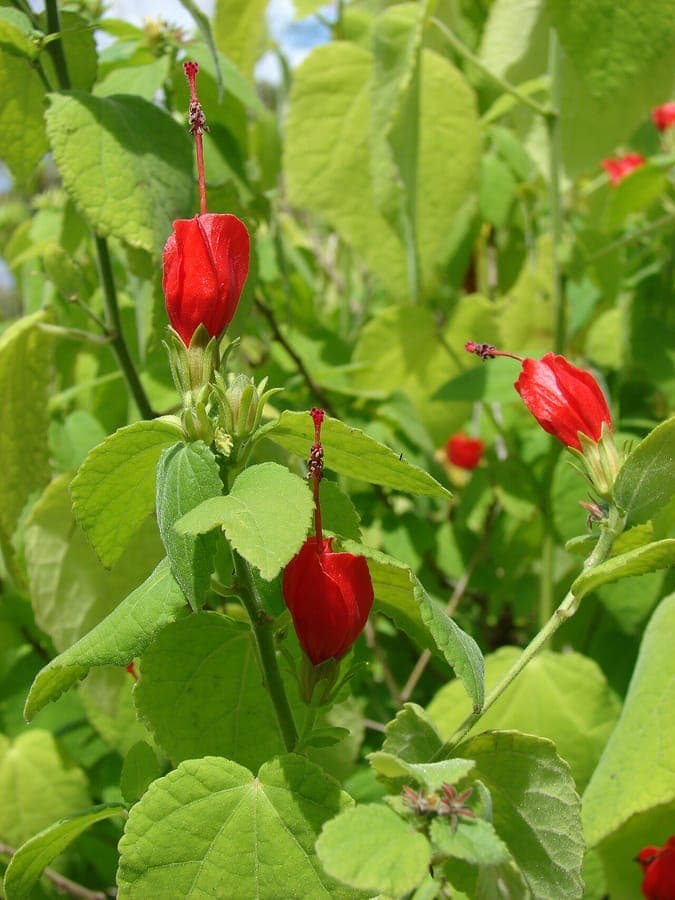
Forest & Kim Starr / CC BY 3.0, via Wikimedia Commons
Turk's-cap: complete growing guide and tropical care
Malvaviscus arboreus
¿Quieres ver Turk's-cap: complete growing guide and tropical care en tu jardín?
1 minuto, sin tarjeta de crédito
Overview
Turk's-cap (Malvaviscus arboreus) is a fascinating shrub from Mexico and Central America in the Malvaceae family. This plant is particularly known for its highly unusual flowers that don't fully open - they remain partially closed in a characteristic tulip-like form that attracts considerable attention. The plant grows quickly and delivers beautiful bright red to orange-red flowers for many months in warm climates. This is a very unique plant that receives much attention and interaction from garden visitors because of its unusual flower form and bird-attracting properties.
Turk's-cap grows as a shrub or small tree to 2-3 meters height with broad, dark green leaves approximately 10-15 centimeters long. Flowers are extremely distinctive and unusual: approximately 3-4 centimeters across, bright red to orange-red, remaining largely closed in a small tulip-like form that appears highly decorative. Flowers appear from August through October in warm climates, or even through November/December in very warm conditions. This unusual flower system attracts hummingbirds, birds and butterflies. The plant is particularly striking in autumn and offers a spectacular show.
Following the flowers form characteristic seed pods that also remain decorative. The plant grows vigorously and can increase substantially in size within several years. A mature Turk's-cap forms a lovely garden feature with permanent interest. However, the plant is not winter hardy in temperate climates and requires protection.
Appearance and bloom
Turk's-cap grows as a shrub or small tree to 2-3 meters height with broad, dark green leaves approximately 10-15 centimeters long. Leaves are oval to heart-shaped with soft texture. Growth habit is broad and spreading with sturdy, somewhat hairy leaf stalks.
Flowers are extremely distinctive and highly conspicuous: approximately 3-4 centimeters across, bright red to orange-red colored, remaining largely closed in a small tulip-like form that appears quite remarkable and decorative. Each flower remains mostly closed with only the tip slightly opening. The flower color is bright and striking against the green foliage. Flowers appear massively from August through October (or longer in very warm conditions). This unusual flower system makes Turk's-cap exceptionally recognizable and attractive to hummingbirds, birds and butterflies that are drawn to the flowers.
The fruits are characteristic seed pods that also remain decorative and generate significant bird interest.
Ideal location
Turk's-cap grows optimally in very sunny positions, requiring at least 6-7 hours direct sunlight daily. The plant prefers warm, sheltered locations. In warmer regions (southern France, southern Spain) it grows well outdoors year-round. In temperate climates (Netherlands, Belgium, northern Europe) it's a container plant needing sheltered or heated location in winter. Plant against warm house walls where it benefits from extra heat and wall reflection.
Protection from strong cold wind is essential. Position the plant where it receives plenty of heat and sun. Very sunny locations are absolutely necessary for optimal blooming.
Diseño gratis
¿Quieres ver Turk's-cap: complete growing guide and tropical care en tu jardín? Crea un diseño gratis ahora.
Soil
This Malvaviscus prefers nutrient-rich, well-draining soil. pH should be neutral to slightly acidic (pH 6.0-7.0). In ground: blend garden soil with compost and sand for drainage. In pots: use nutrient-rich potting mix blended with extra sand for good drainage and air porosity. This plant is a heavy feeder and grows much better with good nutrition. Add compost regularly or use slow-release fertilizers.
When planting in containers add generous drainage material to the bottom of the pot.
Watering
Turk's-cap loves moist soil during the growing season. Water regularly 2-3 times weekly in warm periods, more in very hot periods. Ensure good drainage and prevent water accumulation. In winter water less, especially in unheated conditions. Don't let soil completely dry, but reduce watering significantly. However excess water can cause root rot so ensure good drainage.
Monitor soil moisture carefully, especially in container specimens.
Pruning
Turk's-cap grows vigorously and can develop foliage loss on older parts. Pruning in March before growth starts helps maintain compact form and encourages new branches. Remove all dead and diseased branches after winter. Can be pruned significantly without damage. This helps the plant grow dense and full. Regular pruning also promotes heavier blooming.
Maintenance calendar
January-February: Bring into sheltered location or greenhouse. Inspect for damage. March-April: Prune, repot in fresh soil. May-October: Regular watering and feeding, enjoy blooms. May-July: Likely pinching to encourage bushiness. August-October: Peak bloom period, enjoy spectacular red flowers. November-December: Taper water supply, prepare for dormancy.
Winter hardiness
Turk's-cap is frost-sensitive below 0 degrees Celsius and cannot tolerate true frost. In Netherlands and Belgium only permanent outdoors in warmest exposures (South Limburg against house wall). Elsewhere overwinter as container plant in sheltered location (greenhouse, conservatory, cold frame) or against house wall. This requires careful planning. In very cold winter the plant can suffer serious damage.
Bring the plant indoors as soon as temperatures drop below 5 degrees Celsius.
Companion planting
In containers combine with heat-loving plants like mandevilla, bougainvillea, fuchsia and impatiens. In southern gardens group with other tropical and semi-tropical plants. Works well with bold red stonework and red mortar. This creates very dramatic and tropical effects. The red flowers contrast beautifully with silver-leaved plants.
Closing thoughts
Turk's-cap offers an exceptionally unique flower form and tropical expression. The extended blooming season and bird-attraction makes it valuable for those seeking tropical and biodiversity aspects. In cooler climates grow as a container specimen. Available at specialty nurseries and online. Gardenworld.app provides extensive inspiration for tropical garden design. Turk's-cap certainly deserves a place with those seeking something special. The plant will absolutely be a conversation starter and attract significant bird visits.
¿Quieres ver Turk's-cap: complete growing guide and tropical care en tu jardín? Crea un diseño gratis ahora.
Sube una foto, elige un estilo y obtén un diseño fotorrealista con lista de plantas en menos de un minuto.
Más de 10.000 jardines diseñados
Sin tarjeta de crédito


Plantas similares
Crimean linden: complete guide
Tilia × euchlora
Crimean linden is an elegant, fast-growing shade tree ideal for large gardens. Discover cultivars, spacing, maintenance tips and winter hardiness.
California flannelbush: complete guide
Fremontodendron californicum
Everything about California flannelbush (Fremontodendron californicum): sunny placement, drainage, pruning and care for this spectacular yellow-flowering shrub.
Hairy rose mallow: complete guide
Hibiscus moscheutos subsp. lasiocarpos
Full growing guide for hairy rose mallow (Hibiscus moscheutos subsp. lasiocarpos): location, soil, watering, winter hardiness and garden design tips.