
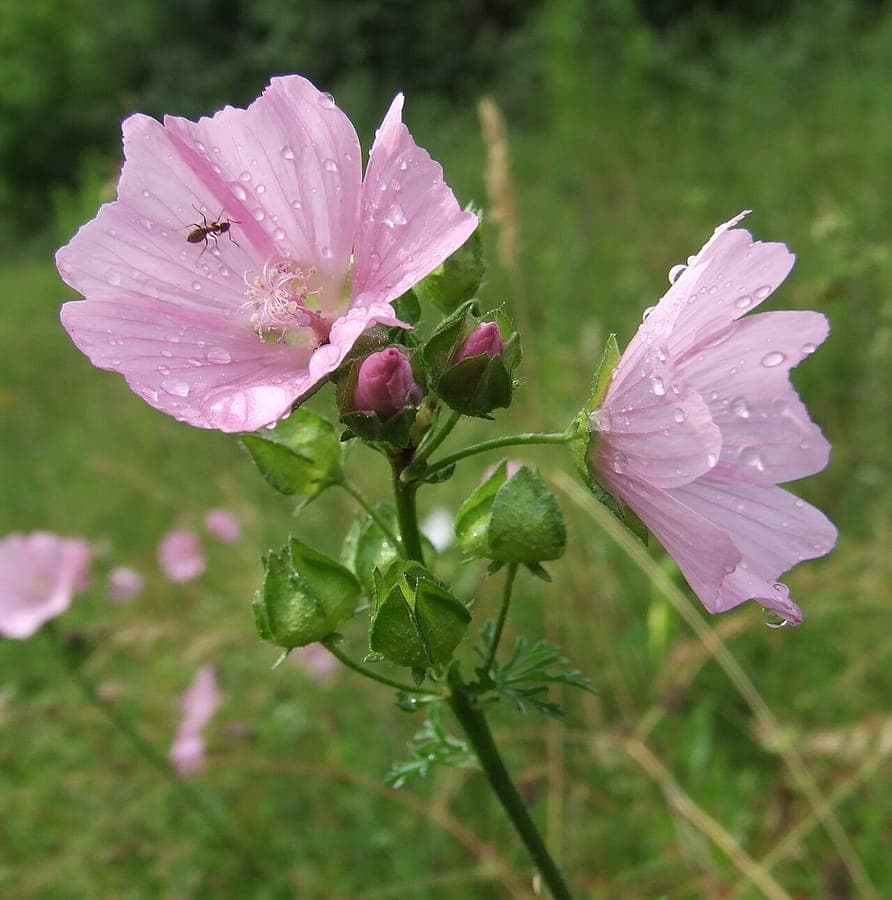
Albert H. / CC BY-SA 3.0, via Wikimedia Commons
Malva moschata: complete guide
Malva moschata
¿Quieres ver Malva moschata: complete guide en tu jardín?
1 minuto, sin tarjeta de crédito
Overview
Malva moschata, commonly known as musk mallow, is a charming herbaceous perennial native to Europe and extending westward to Turkey. This member of the Malvaceae family earns its Latin epithet 'moschata' from its distinctly musky scent, particularly noticeable when foliage is brushed or crushed. The species distinguishes itself from its taller relative Malva alcea through noticeably more refined stature, finely divided foliage, and characteristically lighter-colored flowers. This is an exceptionally suitable plant for informal garden styles, naturalistic plantings, and conservation-oriented gardens that prioritize ecological function. The musk mallow blooms prolifically from May through September, providing essential nectar and pollen resources for numerous bee species, butterflies, and other insect pollinators. Its generously self-seeding habit contributes to dynamic garden ecology, allowing spontaneous plant colonization in unexpected locations, thereby supporting a more evolutionary approach to garden design. At gardenworld.app, we recognize Malva moschata as essential infrastructure for pollinator-supporting gardens and sustainable landscaping practices. The plant establishes readily and maintains itself with minimal intervention once established in appropriate conditions.
Appearance and Bloom Period
Malva moschata develops as a compact to medium-sized plant, typically reaching heights of 45-75 cm with lateral spread of 45-60 cm. The growth habit is naturally full and bushy with abundant lateral branching from the base. The foliage is exceptionally finely dissected with deeply divided leaves featuring 5-9 delicate segments creating an almost feathery, fern-like appearance. This refined foliage texture provides elegant visual interest even during non-flowering periods. Flowers emerge abundantly from May through September across the plant's framework. Individual flowers measure 2-3 cm in diameter displaying typically soft pink coloration, though white-flowered forms and occasionally deeper pink cultivars are available through cultivation. The petals feature delicate darker pink venation creating intricate linear patterns. The prominent yellow stamens are conspicuously displayed, creating particular attractiveness to pollinators seeking pollen. Each individual flower persists for a single day, but continuous new flower opening ensures sustained bloom throughout the extended growing season. Notably, the plant self-seeds generously, allowing gardeners to expect spontaneous young plant emergence which perpetually refreshes the planting design and maintains population vigor. The flowering season typically spans May/June through September/October, providing more than four months of continuous color.
Diseño gratis
¿Quieres ver Malva moschata: complete guide en tu jardín? Crea un diseño gratis ahora.
Ideal Location and Light Requirements
Malva moschata thrives in full sun to part-shade positions. Minimum 4-6 hours of direct daily solar radiation proves optimal, although plants manage with less light in temperate climates. In warmer regions, afternoon shade actually benefits the species. USDA hardiness zones 5-10 support successful cultivation. The plant demonstrates exceptional winter hardiness, tolerating temperatures to -30°C without protection.
Soil Requirements
Malva moschata succeeds in virtually any well-drained soil ranging from poor to moderately fertile. The plant accepts sandy, clayey, and medium-heavy soils providing drainage remains adequate. Soil pH tolerance extends from neutral to slightly acidic (pH 6.0-7.5). Preference favors moderate soil moisture - neither excessively dry nor waterlogged. The plant thrives vigorously in lean soils, rendering it perfect for ecological gardens.
Watering and Fertilization
Once established, Malva moschata exhibits moderate drought tolerance. Regular watering during the first growing season improves establishment; thereafter, minimal supplemental irrigation proves necessary except during severe drought. Fertilization proves unnecessary in typical gardens; optional spring compost application suffices. Excessive fertilization promotes vegetative growth at flowering expense - avoid high-nitrogen formulations.
Maintenance Calendar
April-May: Young growth emerges, self-sown seedlings may already be visible May-June: Flowering commences July-September: Peak flowering period, deadheading extends season duration October-November: Growth slows naturally, seeds mature December-March: Complete dormancy, fully winter-hardy
Companion Planting
Malva moschata combines effectively with:
- Catananche caerulea - blue flowers provide striking contrast
- Persicaria - red flowers, simultaneous blooming
- Agapanthus - globular flower structure, textural contrast
- Fine ornamental grasses - textural interest and movement
- Salvias - structural foliage and color contrast
Self-Seeding Management
Malva moschata's self-seeding proves largely beneficial but can occasionally become excessive. For control: deadhead flowers before seed set, or periodically remove unwanted seedlings. Many gardeners actually embrace the natural self-seeding process, allowing spontaneous plant colonization wherever it occurs, creating naturalistic garden dynamics.
Conclusion
Malva moschata delivers elegant, airy flowering and self-perpetuating vitality to informal gardens. For gardenworld.app users embracing biodynamic gardening principles, this represents an ideal choice. Direct sow in spring and enjoy years of continuous self-renewal.
¿Quieres ver Malva moschata: complete guide en tu jardín? Crea un diseño gratis ahora.
Sube una foto, elige un estilo y obtén un diseño fotorrealista con lista de plantas en menos de un minuto.
Más de 10.000 jardines diseñados
Sin tarjeta de crédito


Plantas similares
Crimean linden: complete guide
Tilia × euchlora
Crimean linden is an elegant, fast-growing shade tree ideal for large gardens. Discover cultivars, spacing, maintenance tips and winter hardiness.
California flannelbush: complete guide
Fremontodendron californicum
Everything about California flannelbush (Fremontodendron californicum): sunny placement, drainage, pruning and care for this spectacular yellow-flowering shrub.
Hairy rose mallow: complete guide
Hibiscus moscheutos subsp. lasiocarpos
Full growing guide for hairy rose mallow (Hibiscus moscheutos subsp. lasiocarpos): location, soil, watering, winter hardiness and garden design tips.