
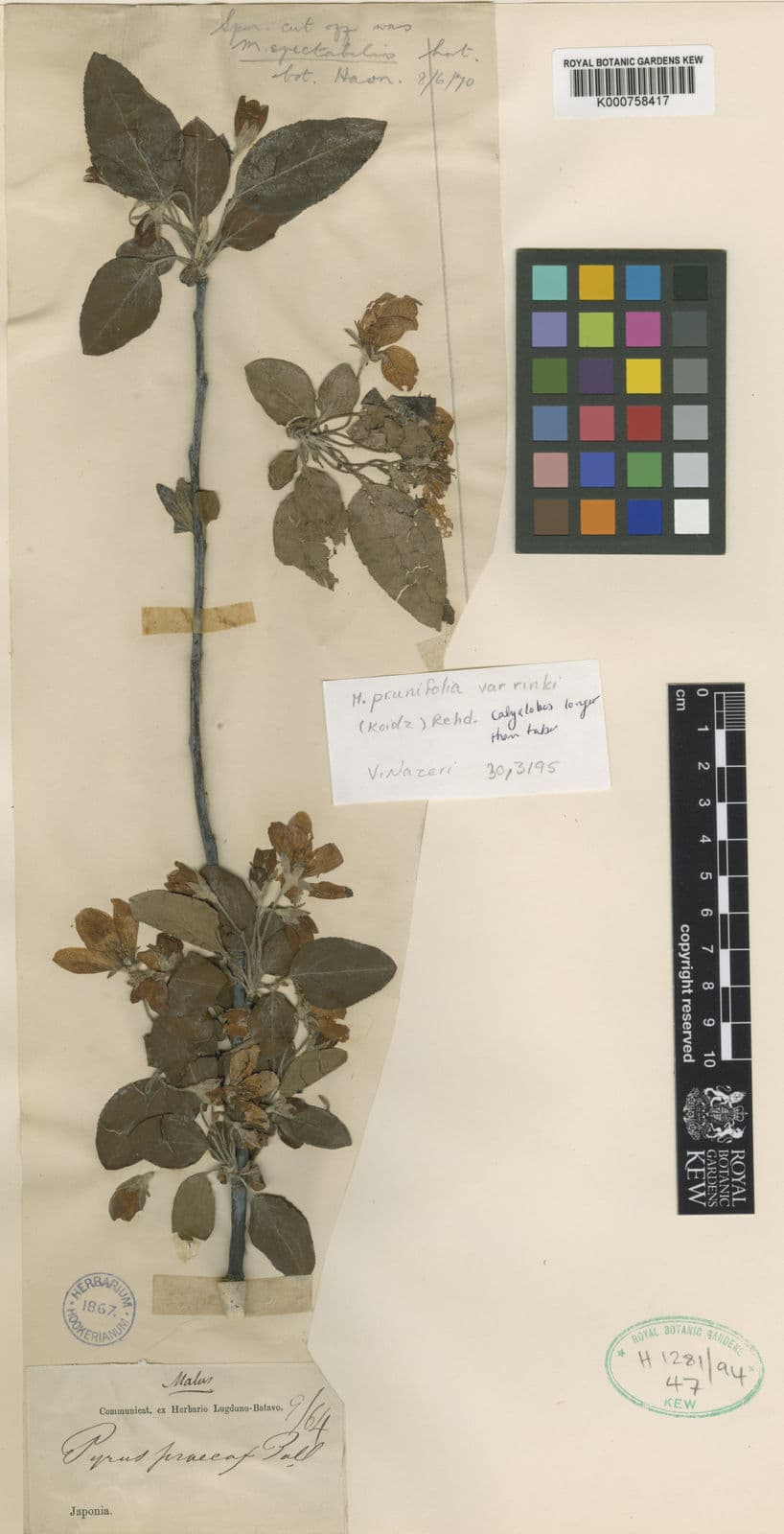
Malus asiatica: complete guide
Malus asiatica
¿Quieres ver Malus asiatica: complete guide en tu jardín?
1 minuto, sin tarjeta de crédito
Overview
Malus asiatica, known as Chinese crabapple or Ringo apple, is an attractive deciduous tree belonging to the Rosaceae family. This species native to China has become established in Korea and now thrives in temperate gardens globally. Malus asiatica is renowned for attractive pink flowers in spring followed by glossy red fruit in autumn.
As a fruit-bearing ornamental tree, Malus asiatica combines aesthetic value with functional benefit. The red fruits persist long on branches proving valuable bird food, rendering it suitable for wildlife gardens. Within gardenworld.app design frameworks, landscape architects frequently employ Malus asiatica as specimen trees, garden structures, or focal plantings in mixed borders.
Appearance and bloom cycle
Malus asiatica grows at moderate rate achieving 4 to 8 meters height and 3 to 6 meters width at full maturity. Growth habit involves multiple stems (multiple stem growth form) meaning the tree develops from several thick branches rather than single trunk. This creates broad, spreading crown form.
Bark is rough and gray-brown adding texture and winter interest. Leaves are large, 6 to 10 cm long, oval to oblong, green with coarse textured surface. Autumn color is moderate, shifting to yellow-green and light red.
Flowers appear April through May in dense clusters along young shoots. Flower buds are dark purple-pink opening to pink flowers approximately 3-4 cm diameter with white to pale-pink petals. Each flower features yellow stamens highly attractive to pollinators.
Fruit ripens August through September measuring approximately 2-3 cm diameter, brilliant red to dark-red. Fruit provides bird food and often persists until December on branches.
Ideal location
Malus asiatica performs optimally in full sun receiving 6-8 hours direct sunlight daily. The tree tolerates partial shade but blooms and fruits better in full sun. Well-lit locations also increase bird visitation.
The tree exhibits good wind resistance but due to spreading crown form, heavy snow and ice loads pose challenges in very cold regions. Shelter from strong winds benefits but remains non-essential.
Within gardenworld.app design philosophy, Malus asiatica functions frequently as structure tree: specimen for small gardens, border background, or focal center planting. The tree excels in ornamental styles and particularly suits natural/wild-garden aesthetics.
Soil requirements
Malus asiatica proves highly soil-adaptive growing across broad soil range. The plant accepts sandy, loamy and even clayey soils. A pH of 5.0 to 7.5 proves acceptable; neutral to slightly acid (pH 6.5) remains optimal.
Well-draining soils are preferred but the tree tolerates less-than-ideal drainage better than many fruit trees. In very wet soils, raising height or improving drainage helps.
Soil fertility proves moderately important. The tree grows well in nutrient-poor to moderately fertile soils. Organic matter amendments (compost, peat moss) improve soil structure and moisture retention without creating fertility-related problems.
Watering
Once established, Malus asiatica proves reasonably drought-tolerant, especially in temperate climates receiving regular rainfall. Young trees require regular watering during initial growing season (April through October), approximately one inch water weekly.
Adult trees need supplemental water only during extreme drought (exceeding 3 weeks without rain). Mulching promotes moisture retention and stabilizes temperature.
Winter moisture needs remain low; virtually no water required after leaf drop.
Pruning
Pruning should remain restrained on fruit-bearing trees. The objective maintains open crown structure for light and air circulation, not aggressive cutting. Remove dead, damaged or diseased wood annually in winter.
Reshaping pruning can occur in late winter (February-March), removing overlapping branches and shortening overhanging branches by approximately 15-30 percent. Heavy pruning causes disease susceptibility and reduced fruit production.
Deadheading (removing persistent fruit) proves unnecessary but can conserve food reserves for following season.
Diseño gratis
¿Quieres ver Malus asiatica: complete guide en tu jardín? Crea un diseño gratis ahora.
Maintenance calendar
March: Inspect for winter damage. Light pruning of dead branches. Apply organic matter around root zone.
April-May: Observe flowering display. Water young trees regularly. No artificial fertilizer required.
June-July: Fruit setting begins. Water regularly.
August-September: Fruits ripen. Enjoy red fruit display.
October-November: Harvest fruits if desired. Reduce watering as temperatures drop.
December-February: Winter dormancy. Bare tree. Heavy pruning can be conducted.
Winter hardiness
Malus asiatica exhibits good winter hardiness. The tree tolerates temperatures from -15 to -20°C without damage. In very severe winters (below -25°C), damage becomes possible, especially young twigs.
The tree thrives excellently in USDA zones 5-9 and suits most temperate regions including Northern Europe. Protection seldom becomes necessary except for very young trees in northernmost areas.
Companion planting
Malus asiatica combines well with:
- Lavandula (Lavender): Purple flowers create striking contrast with pink Malus blooms.
- Deutzia: White flowers against tree's green backdrop.
- Weigela: Complementary bloom times and growth styles.
- Spiraea: White or pink flowers for underplanting.
- Corten steel sculpture: Red-orange color harmonizes with fruit.
- Grasses and groundcovers: Liriope, Carex beneath tree.
In wilderness-style gardens:
- Native shrubs: Salix, Sambucus planted together.
- Bird-food combinations: Ilex, Sorbus in clusters.
Propagation and diseases
Malus asiatica is typically propagated commercially through grafting onto rootstock (commonly Malus sylvestris seedlings) since the species does not come true from seed and produces variable offspring. Grafting occurs at nurseries in February-March using reverse T-budding or chip-budding onto rootstocks measuring 1 to 2 cm diameter. Home gardeners can also take semi-hardwood cuttings of 15 to 20 cm length in July-August, though success rates run lower than with grafting. Growing from seed suits enthusiasts wanting to experiment with variation: seed requires 8 to 12 weeks cold stratification (refrigerated at 2 to 4 degrees C) before germinating in March-April.
The tree proves susceptible to several common diseases. Apple scab (Venturia inaequalis) causes brown, crusty spots on leaves and fruit during wet springs; good air circulation and clearing fallen autumn leaves limit spread. Powdery mildew can develop during warm, dry summers followed by humid nights. Fire blight (Erwinia amylovora) occurs more rarely but proves more serious: remove affected twigs immediately and disinfect pruning tools between cuts. Aphids and winter moth caterpillars attack young foliage in April-May; a preventive grease band around the trunk in November catches many winter moths before they lay eggs. Disease-resistant cultivars such as Malus asiatica 'Ralei' occasionally appear at major garden centers, though availability varies by season, and on gardenworld.app you can compare this species against other flowering crabapples before finalizing your planting plan.
Closing thoughts
Malus asiatica represents an excellent choice for gardeners seeking multi-season interest: spring flowers and autumn fruit. The tree combines ornamental value with wildlife function forming important garden structural element. The tree proves robust, maintenance-friendly and suitable for varied placements.
From gardenworld.app design perspective, Malus asiatica offers architectural flexibility: specimen for small gardens, border background, focal tree in open spaces. Well-planned use creates gardens exhibiting seasonal events and lasting value.
The tree is available at major garden centers and tree nurseries. Pricing ranges from 25 to 75 pounds sterling depending on stem girth and age.
¿Quieres ver Malus asiatica: complete guide en tu jardín? Crea un diseño gratis ahora.
Sube una foto, elige un estilo y obtén un diseño fotorrealista con lista de plantas en menos de un minuto.
Más de 10.000 jardines diseñados
Sin tarjeta de crédito


Plantas similares
Siberian crab apple: complete guide
Malus x robusta
Complete guide to the Siberian crab apple (Malus x robusta): location, soil, pruning, winter hardiness and the best companion plants for your garden.
Chinese flowering crabapple (Malus x spectabilis): complete guide
Malus x spectabilis
Meet the Chinese flowering crabapple (Malus x spectabilis): a classic spring bloomer with carmine buds and pink blossom.
Potentilla crassinervia: complete guide
Potentilla crassinervia
Potentilla crassinervia, the Corsican cinquefoil, grows wild on Corsica and Sardinia's peaks. Discover how to grow this hardy alpine rock garden gem.