
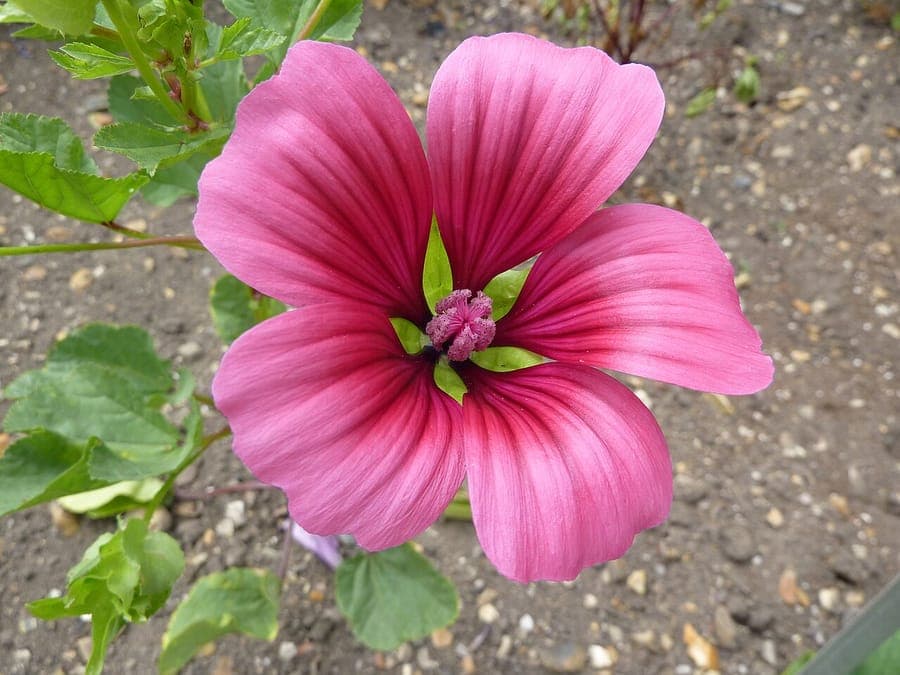
Magnus Manske / CC BY-SA 2.5, via Wikimedia Commons
Malope trifida: complete guide
Malope trifida
¿Quieres ver Malope trifida: complete guide en tu jardín?
1 minuto, sin tarjeta de crédito
Overview
Malope trifida, commonly referred to as mallow-wort, three-lobed mallow, or Spanish summer mallow, is a spectacular annual plant originating from the Mediterranean region, particularly native to Portugal, Spain, Malta, and northwestern Africa including Algeria and Morocco. This elegant member of the Malvaceae family is celebrated for its magnificent large flowers in shades of rose to deep purple, each bearing distinctive funnel shapes that catch the light beautifully throughout the extended growing season. First described botanically in 1786 by Spanish botanist Cavanilles, the species received its name 'trifida' referring to the three-lobed leaf structure at the base of each leaf. With funnel-shaped flowers reaching 4-5 cm in diameter and a prolific flowering habit producing literally hundreds of successive blooms across the season, Malope trifida creates a spectacular centerpiece in summer borders and cottage gardens. The species performs exceptionally well in continental European gardens, thriving from direct sowing, requiring no special winter hardiness measures, and demanding minimal maintenance once established, making it an ideal choice for gardenworld.app users seeking hassle-free Mediterranean flair.
Appearance and Bloom Period
Malope trifida develops into a compact, upright shrub reaching approximately 60-90 cm in height and 45-60 cm in width with a naturally full and well-branched habit. The foliage consists of deeply three-lobed leaves - the botanical name 'trifida' references this characteristic three-partite structure - displaying vibrant green coloration with prominent venation, creating attractive textural backdrop for the flowers. The plant is renowned for its extraordinarily generous flowering display, with literally hundreds of funnel-shaped blossoms emerging continuously from July through September in most temperate climates. Individual flowers measure 4-5 cm across and showcase a captivating interplay of colors: typically deep rose to purple at the outer margins transitioning to a lighter cream or pale pink center, frequently approaching white at the petal base. The petals display delicate veining in darker shades creating intricate linear patterns. While each individual bloom persists for only a single day - a characteristic of many Malvaceae species - continuous new flower opening ensures the plant maintains spectacular coverage throughout the extended July-October bloom window. The flowers demonstrate exceptional attractiveness to pollinators, serving as vital nectar and pollen sources for honeybees, bumblebees, and numerous butterfly species throughout this extended period.
Light and Location Requirements
Malope trifida demands full sun - minimum 6-8 hours direct solar radiation daily - to achieve optimal flowering potential. Plants cultivated in inadequate light conditions become leggy with reduced flower production. The species thrives in warm positions where Mediterranean climate conditions can be approximated. In the Netherlands, Belgium, and northern France, south- or southwest-facing terraces and borders prove ideal. The plant exhibits no winter hardiness and requires annual resowing from seed unless cultivated as an indoor annual. USDA hardiness zones 10-11 support permanent cultivation; elsewhere it functions as an obligate annual.
Diseño gratis
¿Quieres ver Malope trifida: complete guide en tu jardín? Crea un diseño gratis ahora.
Soil Requirements
Malope trifida develops successfully in virtually any well-drained soil medium. The plant demonstrates remarkable indifference to soil quality and accepts even impoverished substrates, though regular compost incorporation stimulates vigorous growth. Soil pH tolerance ranges from neutral to slightly acidic (pH 6.0-7.5). Because it functions as a rapid-growing summer bloomer, established plants exhibit notable drought tolerance. For container cultivation, employ standard potting compost enriched with supplemental coarse sand ensuring drainage. Ensure drainage holes in all container bottoms preventing waterlogging.
Sowing and Planting
Malope trifida seeds germinate readily direct-sown into garden soil after all frost danger passes, typically mid-May in temperate zones. Seeds are small but do not require light for germination; sow directly on soil surface without covering. Maintain moisture until seedlings emerge (7-14 days). Thin seedlings to 30-45 cm spacing for optimal plant size. Alternatively, sow seeds under protection in March-April indoors and transplant after final frost dates. For container cultivation, sow seeds directly into individual containers.
Watering and Fertilization
Regular watering remains essential until plants establish - approximately 3-4 weeks post-germination - after which the plant demonstrates worthwhile drought tolerance. However, for sustained optimal flowering, maintain consistent moisture especially during heat waves. Water early morning rather than late afternoon preventing foliar diseases. Fertilize monthly with balanced formula or bloom-promoting fertilizer throughout the growing season (June-September) enhancing flowering. Excessive nitrogen promotes excessive foliage at the expense of flowers - avoid nitrogen-rich formulations.
Maintenance Calendar
May: Direct sowing or transplant established seedlings after frost risk June-July: Provide regular watering and fertilization, initial flowers emerge Augustus-September: Peak flowering, deadhead spent flowers regularly, maintain fertilization schedule October: Growth slows naturally as temperatures cool, discontinue fertilizing November-April: Plants succumb to frost; alternatively pot up for next season
Pest and Disease Management
Malope trifida exhibits relative pest and disease resilience. Spider mites may occasionally appear during intensely dry conditions - irrigate foliage with water spray to deter. Botrytis (gray mold) may develop during extended humid conditions with poor air circulation - improve ventilation through strategic plant spacing. Certain caterpillars may consume foliage - remove manually or employ biological pest controls. Overall, this species demands minimal intervention.
Companion Planting
Malope trifida combines effectively with:
- Salvia species - blue flowers provide striking color contrast
- Heliotropium arborescens - purple flowers, matching culture
- Nemesia - diverse color palette, simultaneous blooming
- Echinacea - extended flowering season, pollinator-friendly
- Lavandula - textural foliage and fragrance, Mediterranean theme
Conclusion
Malope trifida offers straightforward, reliable Mediterranean warmth and color injection into northern gardens. For gardenworld.app users seeking effortless exotic appeal, this proves an ideal selection. Direct sow in May and enjoy continuous blooming throughout summer and into autumn.
¿Quieres ver Malope trifida: complete guide en tu jardín? Crea un diseño gratis ahora.
Sube una foto, elige un estilo y obtén un diseño fotorrealista con lista de plantas en menos de un minuto.
Sin tarjeta de crédito


Plantas similares
Crimean linden: complete guide
Tilia × euchlora
Crimean linden is an elegant, fast-growing shade tree ideal for large gardens. Discover cultivars, spacing, maintenance tips and winter hardiness.
California flannelbush: complete guide
Fremontodendron californicum
Everything about California flannelbush (Fremontodendron californicum): sunny placement, drainage, pruning and care for this spectacular yellow-flowering shrub.
Hairy rose mallow: complete guide
Hibiscus moscheutos subsp. lasiocarpos
Full growing guide for hairy rose mallow (Hibiscus moscheutos subsp. lasiocarpos): location, soil, watering, winter hardiness and garden design tips.