
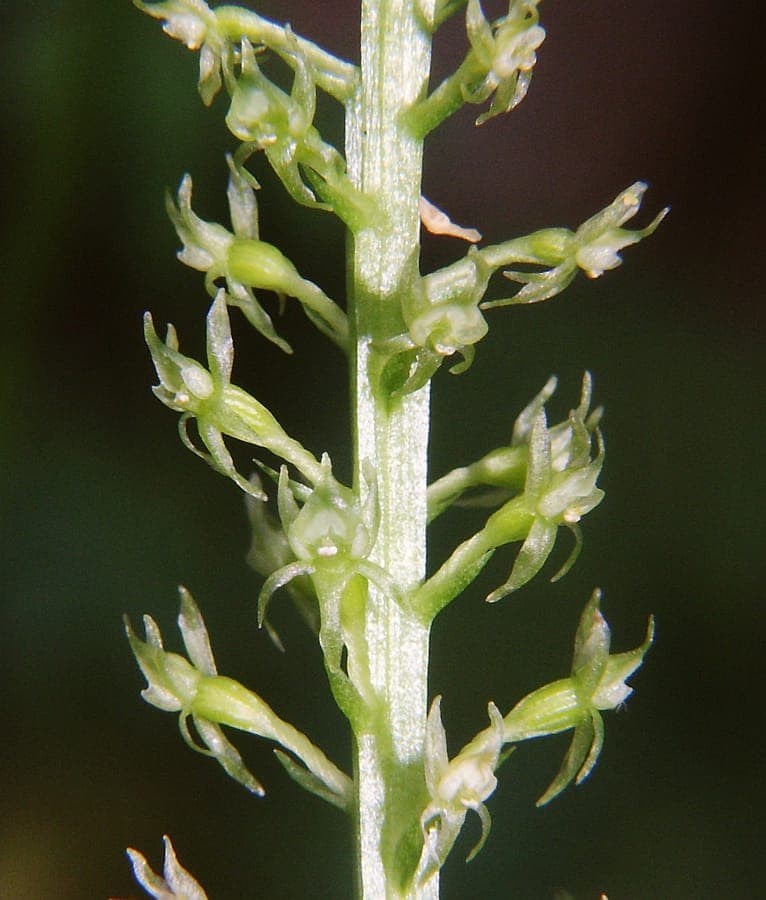
Bernd Haynold / CC BY 2.5, via Wikimedia Commons
Malaxis monophyllos: complete guide
Malaxis monophyllos
¿Quieres ver Malaxis monophyllos: complete guide en tu jardín?
1 minuto, sin tarjeta de crédito
Overview
Malaxis monophyllos, commonly known as the white adder's mouth orchid or one-leaved malaxis, is a remarkable dwarf orchid species native to temperate regions across the northern hemisphere extending through Russia and Scandinavia to the Philippines. Belonging to the family Orchidaceae, this plant captivates enthusiasts with its minute greenish flowers, each measuring only a few millimeters across. Despite its tiny scale, Malaxis monophyllos represents a sophisticated example of botanical adaptation and ecological niche-filling. The species has gradually gained recognition among orchid cultivators who appreciate plants that reward close observation and specialized care. While challenging to grow outside its native habitat, gardeners with controlled environments and commitment to orchid horticulture increasingly succeed with this remarkable plant. Its presence in a collection signals dedicated plantsman's expertise and patience for species-level cultivation. For gardeners exploring gardenworld.app seeking exceptional plants for woodland shadowy corners, Malaxis monophyllos proves an outstanding choice.
Appearance and Bloom Period
Malaxis monophyllos is a terrestrial orchid of diminutive stature, typically reaching only 10-20 cm in height when in bloom. The plant characteristically produces a single linear leaf per growing season - hence the scientific name monophyllos meaning 'one-leaved' - measuring 8-15 cm long with a subtle blue-green coloration. The thin, arching leaves serve as elegant foliage even when the plant is not in flower, creating textural interest year-round. The inflorescence is a delicate raceme bearing dozens of minute, greenish flowers that open sequentially from June through July in the temperate climate zones typical of USDA zones 5-9. Each individual flower, measuring approximately 3-4 mm in diameter, displays remarkable structural complexity when examined under magnification, featuring distinctive column structures, petals, and labellum modifications characteristic of the Orchidaceae family. The flowering process is gradual and protracted, sometimes extending over 6-8 weeks, providing extended observation opportunities for keen cultivators. At gardenworld.app, we recognize that Malaxis monophyllos appeals to enthusiasts seeking botanical rarities that exemplify orchid family diversity and demonstrate that spectacular gardening need not always mean large, showy blooms.
Ideal Location
Malaxis monophyllos thrives best in locations receiving dappled, indirect shade, such as beneath established trees or against north-facing walls where diffuse filtered light penetrates. The plant requires a minimum of 40-50% shade and cannot tolerate direct sunlight, particularly intense afternoon sun which causes rapid dehydration of the delicate leaf tissues. In temperate climates such as those throughout the Netherlands, Belgium, and northern France, the plant succeeds in protected positions receiving gentle, northern exposure. The ideal USDA hardiness zone for Malaxis monophyllos ranges from 5-9, indicating suitability throughout most of the Benelux region and central Europe when appropriately sheltered against severe frost.
Diseño gratis
¿Quieres ver Malaxis monophyllos: complete guide en tu jardín? Crea un diseño gratis ahora.
Soil Requirements
The soil for Malaxis monophyllos must balance excellent drainage with adequate moisture retention - a challenging equilibrium. The ideal composition consists of approximately 40% orchid bark, 30% sphagnum moss, 20% leaf mold or compost, and 10% general orchid potting mix. Soil pH should range between 5.5 and 6.5, slightly acidic, matching conditions the plant encounters wild beneath senescent trees in woodland ecosystems. The plant functions as a semi-epiphytic or terrestrial orchid preferring highly aerobic substrate. Excessive water retention inevitably leads to root rot, which proves fatal to this delicate species. Never use dense potting composts or garden soil.
Watering Schedule
Watering requires careful attention. During the growing season from May through September, the plant needs regular misting to maintain relative humidity of 60-80% while keeping soil from becoming waterlogged. Watering approximately every ten to fourteen days during peak growth suffices. Throughout winter months from October through April, dramatically reduce watering to approximately once every 3-4 weeks as the plant enters dormancy. Always employ rainwater or distilled water, as this species proves sensitive to calcium deposits and mineral accumulation from tap water sources.
Maintenance Calendar
January-March: Minimal watering, dormant period, maintain temperatures 5-10°C April-May: Gradually increase water, new growth emerges, maintain 10-15°C June-July: Full growth and blooming, regular misting, maintain 15-20°C August-September: Continue growth cycle, discontinue fertilizing, maintain 15-18°C October-December: Progressively reduce watering, prepare for dormancy, maintain 8-12°C
Winter Hardiness
Malaxis monophyllos exhibits hardiness down to USDA zone 5, tolerating temperatures as low as -29°C when fully dormant. In the Netherlands and Belgium, outdoor overwintering within unheated frames sans additional protection can succeed if kept completely dry. However, in many gardens, indoor overwintering maintaining cool conditions of 5-10°C proves more practical and reliable. In milder maritime regions, protection with specialized plant fleece or conifer branches may suffice for outdoor cultivation.
Companion Planting
Companion plants combining successfully with Malaxis monophyllos in woodland gardens include:
- Lamprocapnos spectabilis (Dicentra) - elegant leaf form, matching shade requirements
- Helleborus niger - dark persistent foliage, winter interest
- Anemone nemorosa - delicate spring flowering
- Polystichum setiferum - finely textured fern fronds
- Liriope muscari - textural and seasonal contrast
Conclusion
Malaxis monophyllos represents a specialized plant demanding particular environmental conditions, yet for gardeners devoted to expanding their knowledge toward more esoteric species, it delivers rewarding cultivation experiences. Its subtle beauty reflects the incredible diversity and refinement existing within the plant kingdom. At gardenworld.app, we encourage gardeners to discover and cultivate such botanical jewels, enriching their personal garden ecology and deepening their appreciation for nature's remarkable variety.
¿Quieres ver Malaxis monophyllos: complete guide en tu jardín? Crea un diseño gratis ahora.
Sube una foto, elige un estilo y obtén un diseño fotorrealista con lista de plantas en menos de un minuto.
Más de 10.000 jardines diseñados
Sin tarjeta de crédito


Plantas similares
Ram's-head lady's slipper: complete guide
Cypripedium arietinum
Everything you need to know about growing Cypripedium arietinum, a rare woodland orchid for cool, moist garden settings. Soil, care and planting tips.
Sparrow's-egg lady's slipper: complete guide
Cypripedium passerinum
Everything about growing Cypripedium passerinum, a cold-hardy subarctic orchid suited to cool, moist, shaded garden spots. Soil, care and companion plants.
Algerian Butterfly-orchid: complete guide
Platanthera algeriensis
Everything about Platanthera algeriensis, the rare Mediterranean orchid with greenish flowers native to Algeria, Morocco, Corsica and Spain.