
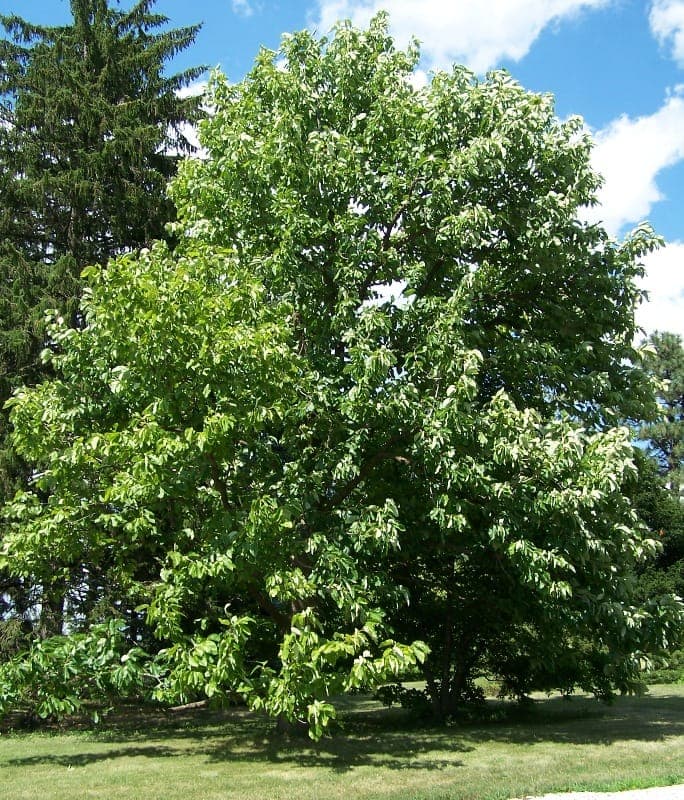
Bruce Marlin / CC BY 3.0, via Wikimedia Commons
Magnolia acuminata: complete guide
Magnolia acuminata
¿Quieres ver Magnolia acuminata: complete guide en tu jardín?
1 minuto, sin tarjeta de crédito
Overview
Magnolia acuminata, commonly called cucumber-tree or mountain magnolia, is a native American tree from the Magnoliaceae family. This impressive tree grows throughout eastern and central United States and Canada and is celebrated for its large, pointed leaves and subtle yellow flowers. The cucumber magnolia is one of the hardiest magnolia species and renowned for its rapid growth and impressive height.
The cucumber-tree is an excellent choice for large gardens and parks where a majestic, native specimen is desired.
Appearance and blooming
Magnolia acuminata grows to an impressive height of 18 to 30 meters, making it one of the largest magnolia species. The tree has a straight, columnar form when young, gradually becoming wider as it matures.
The leaves are large, elliptical, and pointed (where the name "acuminata" originates), reaching 15 to 25 centimeters in length. They are green and provide summer shade. Fall color ranges from golden yellow to olive green.
The flowers are subtle yet charming, appearing in early spring (March to April) before leaves fully expand. They are yellowish to grayish-green and several centimeters across. Though not showy, their delicate appearance against bare branches is remarkably elegant.
After flowering, characteristic, cucumber-like fruits develop, turning red at maturity.
Ideal location
Magnolia acuminata thrives best in full sun to light shade, with minimum 4 to 6 hours daily sunlight. The tree is flexible and accepts shade well, though full sun promotes flowering.
Plant the tree where its impressive height won't overshade neighboring properties. The tree grows rapidly, potentially reaching full size within 20 to 30 years.
Diseño gratis
¿Quieres ver Magnolia acuminata: complete guide en tu jardín? Crea un diseño gratis ahora.
Soil
Magnolia acuminata prefers well-drained soil with pH between 5.2 and 7.0. The tree accepts heavy clay to light sandy soils but grows optimally in nutrient-rich, humus-laden soil.
Add compost or organic matter when planting to improve soil and increase retention.
Watering
Once established, Magnolia acuminata is extremely drought-tolerant. Regular watering in the first years after planting aids root development.
Even during dry periods, the tree accepts limited water. Mulching around the tree helps moisture retention.
Pruning
Minimal pruning needed for mature trees. Remove dead or damaged branches each spring. Form can be slightly adjusted in youth by removing select branches.
Avoid heavy pruning, as magnolias don't heal large wounds well.
Maintenance calendar
Spring: Check for winter damage. Enjoy blooms. Replenish mulch. Summer: Enjoy leaf shade. Minimal care. Fall: Enjoy fall color. Clear leaves (optional). Winter: Tree rests. Structure provides winter interest.
Winter hardiness
Magnolia acuminata is extremely hardy and tolerates temperatures down to -35 degrees Celsius. The tree grows from Ontario to Florida and adapts to diverse climates.
It's one of the hardiest magnolia species and suitable for northern gardens.
Companion plants
Magnolia acuminata grows well alongside other native trees and shrubs:
Quercus alba (white oak) - Large native tree Cornus florida (flowering dogwood) - Understory with contrasting blooms Viburnum opulus - Shrub with fall color
Combinations create native, naturalistic tree collections.
Closing thoughts
Magnolia acuminata is an excellent choice for large gardens and landscapes. Its impressive growth, native status, and drought-tolerance make it a valued centerpiece for any project. With minimal care, this tree will provide generations of beauty.
Available at tree nurseries. Visit gardenworld.app/en for landscape designs!
¿Quieres ver Magnolia acuminata: complete guide en tu jardín? Crea un diseño gratis ahora.
Sube una foto, elige un estilo y obtén un diseño fotorrealista con lista de plantas en menos de un minuto.
Más de 10.000 jardines diseñados
Sin tarjeta de crédito


Plantas similares
Saucer magnolia: complete growing guide
Magnolia × soulangeana Soul.-Bod.
Saucer magnolia is a hybrid featuring spectacular pink-white flowers appearing before leaf emergence. Ideal as specimen plant. Winter-resistant to -15°C.
Magnolia delavayi: complete guide
Magnolia delavayi
Delavay magnolia is an imposing shrub from southern China with large glossy leaves and fragrant creamy-white flowers. Learn about cultivation, hardiness, and care for this rare species.
Sweet michelia: complete guide
Magnolia doltsopa
Discover the sweet michelia, a majestic tree from the Himalayas. Learn everything about this impressive specimen, blooming, and perfect growing conditions.