
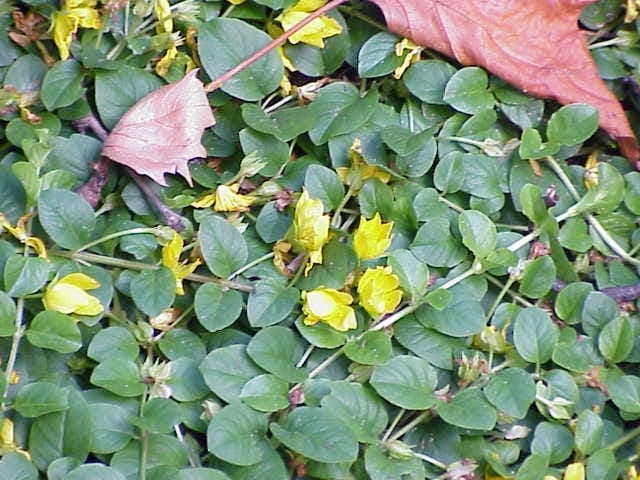
Kurt Stüber [1] / CC BY-SA 3.0, via Wikimedia Commons
Creeping Jenny: complete guide
Lysimachia nummularia
¿Quieres ver Creeping Jenny: complete guide en tu jardín?
1 minuto, sin tarjeta de crédito
Overview
Creeping Jenny, scientifically known as Lysimachia nummularia, is a versatile and highly decorative perennial naturally occurring in moist areas of Europe. This member of the Primulaceae family is remarkable for its unique round leaves resembling small coins, creating its common name 'creeping Jenny.' The plant is an excellent ground cover, spreading rapidly as an extensive mat approximately 5-10 centimeters height, producing bright yellow flowers from May to July.
Creeping Jenny is highly suitable planting material for garden designers interested in fast-growing ground covers, water features, and bog gardens. For more complex garden designs using creeping Jenny, gardenworld.app offers professional assistance. The plant is also frequently used as an aquatic plant in aquaria and ponds, where it provides food for aquarium fish and promotes water biodiversity. With appropriate placement and care, this plant rapidly expands to form attractive green carpeting.
Appearance & Bloom Cycle
Creeping Jenny is a trailing perennial displaying characteristic morphology. The stems are slender, creeping, and spreading, reaching approximately 30-60 centimeters length when unshorn, though they easily prune to desired height. The leaves are the most characteristic feature - they are small, round to oval, approximately 1-2 centimeters diameter, bright green, glossy, growing oppositely along the stems.
The flowers are small yet striking, approximately 0.5-1.5 centimeters diameter, bright yellow in color, appearing singly or in pairs from leaf axils. They are five-petaled, with soft glossy petals attracting insects. Flowering extends from May to July, with peak typically in June. The blooming period provides beautiful yellow accents in green foliage.
Following bloom, small seed capsules develop, ripening in August-September. The foliage remains green throughout the growing season, though autumn color sometimes becomes slightly bronze-tinged.
Ideal Location: Sun, Shade, or Partial Shade
Creeping Jenny grows best in partial shade to full sun, demonstrating great tolerance for varying light conditions. The plant accepts locations from full sun to partial shade (minimum 3-4 hours direct sunlight daily). In full sun, flowering is more abundant and growth faster and more extensive. In full shade, growth occurs only slowly, but it can still survive forming green carpet.
For water feature applications in ponds, creeping Jenny can be grown both at margins (full sun) and underwater. For ground cover use in gardens, a semi-sunny location is ideal - adequate light for good growth and blooming while providing protection from intense afternoon sun in hot regions.
Soil & Underground Requirements
Creeping Jenny is a moisture-loving plant thriving in moist to wet soils. The plant accepts soils ranging from acidic to alkaline (pH 5.0-8.0), thus very pH tolerant. The plant grows best in soils enriched with organic matter, but can even grow in bare, nutrient-poor soils - though more slowly.
For pond plantings, aquatic planting baskets with aquatic potting soil can be used. For ground cover applications in gardens, soils can be improved with leaf mold, compost, and mineral sand to achieve good moisture retention while maintaining adequate drainage. The plant has no special nutritional requirements and will thrive even without fertilization.
Diseño gratis
¿Quieres ver Creeping Jenny: complete guide en tu jardín? Crea un diseño gratis ahora.
Watering: When and How Much
Water is essential for creeping Jenny, particularly given its natural occurrence in moist environments. In gardens, soil must remain consistently moist, requiring regular watering 2-3 times weekly during the growing season. The plant thickens rapidly under constant moist conditions.
In ponds, creeping Jenny can grow both at margins (where moisture is crucial) and underwater, where it can remain fully submerged. For container plants, regular watering is necessary, as dry periods can retard growth and cause leaf loss.
Pruning: When and How
Creeping Jenny grows rapidly and can become aggressive, making regular pruning advisable. The plant can be trimmed during the growing season to desired shape and size. For ground cover use, pruning several times during summer maintains compactness. In late autumn, October-November, the plant can be cut back to ground level or just below water line for neater appearance.
The plant is extremely cut-resistant and will rapidly regrow from cut points, so radical pruning presents no problem.
Maintenance Calendar
- April - May: Growth begins actively. Regular watering. Start light pruning if plant grows too wild. No fertilizer needed, but can be given if faster growth is desired.
- June - July: Bloom and growth peak. Regular watering. Prune as needed. Spent flowers can be removed, though not necessary.
- August - September: Growth slows as temperatures drop. Watering can be slightly reduced, but soil must remain moist. Pruning can continue.
- October - November: Plant prepares for winter. Can be cut back to ground level. Watering reduced, but soil must not dry.
- December - March: Winter dormancy. Minimal watering. Plant can die back completely, especially in very cold areas.
Winter Hardiness & Protection
Creeping Jenny is exceptionally winter hardy, tolerating temperatures to approximately -20°C, making it suitable for USDA zones 4-9. In the Netherlands, Belgium, and other Northern European regions, no special winter protection is necessary. The plant may completely die back in very cold winters but will re-emerge in spring from underground roots.
In very cold areas, optionally a 5-10 centimeter layer of leaf mold can be applied for extra protection. For pond plants growing underwater, winter protection is unnecessary since water beneath ice provides far better insulation than air.
Companion Plants & Combinations
Creeping Jenny combines beautifully with other moisture-loving and ground cover plants:
- Soleirolia soleirolii (Baby tears): This fine, airy plant forms interesting textural contrast with creeping Jenny's round leaves.
- Sagina procumbens (Pearlwort): Another fine-leaved ground cover growing well alongside creeping Jenny.
- Veronica (Speedwell): The blue or pink flowers of certain Veronica species contrast beautifully with yellow creeping Jenny.
- Ajuga reptans (Bugle): This fast-growing ground cover combines well and can be used together.
- Mentha aquatica (Water mint): For wetter conditions, combines well with creeping Jenny in pond settings.
Materials are available at local garden centres.
Conclusion
Creeping Jenny is a versatile, fast-growing plant perfect for ground cover, pond margins, and water gardens. With its round leaves, yellow flowers, and moisture-loving nature, it forms a valuable addition to many garden scenarios. For professional garden designs integrating fast-growing ground covers and water plants, gardenworld.app provides essential support. With appropriate placement and minimal care, this versatile plant rapidly expands to provide years of interest.
¿Quieres ver Creeping Jenny: complete guide en tu jardín? Crea un diseño gratis ahora.
Sube una foto, elige un estilo y obtén un diseño fotorrealista con lista de plantas en menos de un minuto.
Más de 10.000 jardines diseñados
Sin tarjeta de crédito


Plantas similares
Primula incana: complete guide to silvery alpine primrose
Primula incana
Silvery primrose (Primula incana), a delicate alpine flower with white blooms and powdered grey-green leaves. Growing, care, and cultivation guide.
Mealy cowslip: complete guide
Primula pulverulenta
Grow the Mealy cowslip (Primula pulverulenta): striking candelabra flowers in red and purple tones, moisture-loving and ideal for shady, damp garden corners.
Cliff dwarf-primrose: complete guide
Androsace laevigata
Full guide to growing Androsace laevigata, a rare Pacific Northwest alpine cushion plant. Planting, care, and garden design tips explained.