
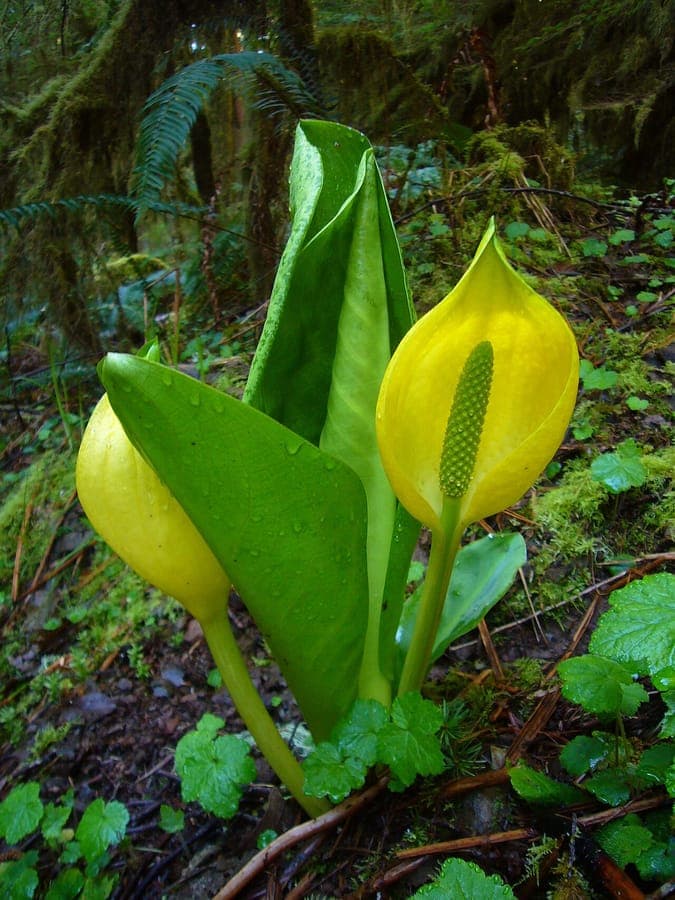
Martin Bravenboer / Public domain, via Wikimedia Commons
Lysichiton americanus: complete guide
Lysichiton americanus
¿Quieres ver Lysichiton americanus: complete guide en tu jardín?
1 minuto, sin tarjeta de crédito
Overview
Lysichiton americanus, commonly known as Yellow skunk cabbage or Western skunk cabbage, is a spectacular wetland plant from the Araceae family (arum family) naturally occurring in rainforests of the Pacific Northwest in North America, from Alaska to Northern California. This imposing plant reaches heights of 30-100 centimeters and grows in extremely wet, marshy soils alongside rivers and pools where water tables remain high and constant. The plant is especially known for its striking yellow spathae (flower-enveloping bracts) appearing in early spring, often before meltwater completely disappears. With its large green leaves and spectacular yellow inflorescence, this is a perfect choice for garden owners wishing to create a tropical-looking water-plant garden via gardenworld.app, even in temperate climates.
Lysichiton americanus is undoubtedly one of the most remarkable wetland plants you can grow in a temperate garden. The plant develops large, heart-shaped leaves that can reach 1 meter in length and are particularly striking. These leaves are uniformly green with distinct veining and possess a very succulent, thick texture. As leaves grow, they emerge in large hastate-like formations slowly unfurling in spring. The plant forms thick, underground rootstocks that return year after year.
The most spectacular feature, however, is the inflorescence appearing in March-April before leaves fully expand. The flower structure consists of an extremely large, bright yellow spathe (flower-enveloping sheath) that can reach 10-15 centimeters long and folds around a yellow, dense spadix (flower column). This distinctive "yellow lantern"-like appearance makes the plant recognizable for kilometers in marshes where it occurs. The plant emits a strong, characteristic scent - hence the name "skunk cabbage" - although many people find this scent pleasant rather than unpleasant. After flowering, red, fleshy fruits develop that provide bird food.
Ideal Location
Lysichiton americanus thrives exclusively in extremely wet, marshy conditions with permanently high groundwater tables. The plant grows best along waterfronts, in shallow pools, marshland, or in artificial water zones with constantly wet soil. Water depths of 0-30 centimeters are ideal. The plant loves full sun to partial shade (40-60% sunlight) and flowers more profusely in sunny locations. However, very warm, dry summer sun can prove problematic in very hot climates, so light afternoon shade may prove beneficial.
The plant is not tolerant of dry conditions and will quickly perish if water drains. Plant it therefore in very protected water zones regularly monitored for water levels. The plant does not grow in normal garden soils and requires true marsh conditions to thrive.
Soil Type & Nutrition
Lysichiton americanus grows in extremely wet, nutrient-rich, humic soils with pH between 5.5 and 7.0, leaning neutral to slightly acidic. The ideal soil is silt and clay-like with high organic matter content, comparable to natural marsh sediments. If you wish to grow this plant in your garden, add generous organic waste material - peat moss, dead plant matter, leaf mold, and compost - giving the soil the richness and structure this plant requires.
Nutrition is abundantly available in natural marshes where organic waste constantly accumulates. Synthetic fertilizers are not essential, but you can subtly add organic nutrients by regularly introducing organic waste into the water/soil system.
Diseño gratis
¿Quieres ver Lysichiton americanus: complete guide en tu jardín? Crea un diseño gratis ahora.
Watering & Moisture Management
Watering is irrelevant for this plant since it grows permanently in water or requires extremely wet soil. Instead, ensure water levels remain constant at 0-30 centimeters deep, depending on your planting location. In natural habitats, the plant grows very deeply in marshes with both open water and silt-like banks. If creating an artificial wetland zone, best install a water-level management system delivering water constantly.
In rainy seasons (autumn-winter-spring) the plant automatically receives adequate water. In dry summers you must actively add water. Stagnant water is fine; strong flow is unnecessary.
Maintenance & Pruning
Lysichiton americanus requires minimal maintenance. Pruning is not essential because the plant naturally maintains form. In spring (May-June), after flowering and initial leaf formation, you can carefully remove wilted flower clusters. Large leaves may turn brownish in late summer/early autumn (September-October); you can carefully trim these or let them naturally wither and disappear.
Ensure weeds, especially invasive aquatic plants, don't overgrow. Regular water-level inspection is essential. If the plant becomes too dense with thick leaf clusters, you can carefully remove some leaf clusters to promote better air circulation.
Maintenance Calendar
January-February: Preparation for blooming, water level check March-April: Flowering period, yellow spathe observation May-June: Leaf-forming period, remove dead flower clusters July-August: Full leaf formation period, summer drought management September-October: Leaf aging, possible removal of dead material November-December: Winter dormancy, maintain water, minimal maintenance
Winter Hardiness & Frost Sensitivity
Lysichiton americanus is reasonably winter-hardy and thrives in very cold climates. The plant is frost-tolerant to USDA zone 5 (minimum temperature -29°C). The plant grows in very cold, snowy regions of North America, enabling it to withstand severe winters. In extremely cold climates, ice can damage leaf stalks, but the root system survives deep freezing without issue as long as it remains beneath freezing water.
In very mild regions, the plant may be nearly evergreen; in cold areas leaves die back and the plant regrows from roots in spring.
Companion Plants & Installation
When planning to establish Lysichiton americanus, begin by creating suitable, extremely wet growing conditions. This requires true wetland-zone construction with shallow waters or permanently wet soil. Purchase young plant material from specialized wetland-plant nurseries. Plant young specimens in prepared zones with nutritious, wet soil in spring (April-May), spacing 50-80 centimeters apart because the plant grows large.
Companion plants include other marsh species and aquatic plants such as Iris laevigata, other Araceae species, Osmunda regalis (Royal fern), and moisture-loving large-leaved plants. This creates a rich, tropical-appearing water-zone ecosystem. Via gardenworld.app you can design complete spectacular marsh gardens with Lysichiton americanus as impressive centerpiece.
Plant multiple specimens in clusters for maximum visual impact, or position one large specimen as a sculptural element in the center of a water zone.
Conclusion
Lysichiton americanus is a spectacular, drama-filled plant that completely transforms any water zone or marsh garden. The enormous yellow inflorescences in early spring are truly impressive, and the subsequent large green leaves provide structure and interest throughout summer. This is absolutely not a subtle plant; it is a statement plant for garden owners wishing to clearly indicate they have created a natural, biologically valuable marsh ecosystem. Via gardenworld.app you can realize this spectacle in your own garden.
¿Quieres ver Lysichiton americanus: complete guide en tu jardín? Crea un diseño gratis ahora.
Sube una foto, elige un estilo y obtén un diseño fotorrealista con lista de plantas en menos de un minuto.
Más de 10.000 jardines diseñados
Sin tarjeta de crédito


Plantas similares
Arrowhead vine: complete guide
Syngonium auritum
Everything about Syngonium auritum, the tropical five-fingers houseplant. Care, location, watering, and pruning explained clearly for beginners and enthusiasts.
Minute duckweed: complete guide to Lemna perpusilla
Lemna perpusilla
Everything about Lemna perpusilla, the minute duckweed: ecology, pond management, water quality and care in garden water features.
Dead horse arum lily: complete guide
Helicodiceros muscivorus
Everything about the dead horse arum lily (Helicodiceros muscivorus): growing conditions, spectacular bloom, thermogenesis, and care for this Mediterranean aroid.