
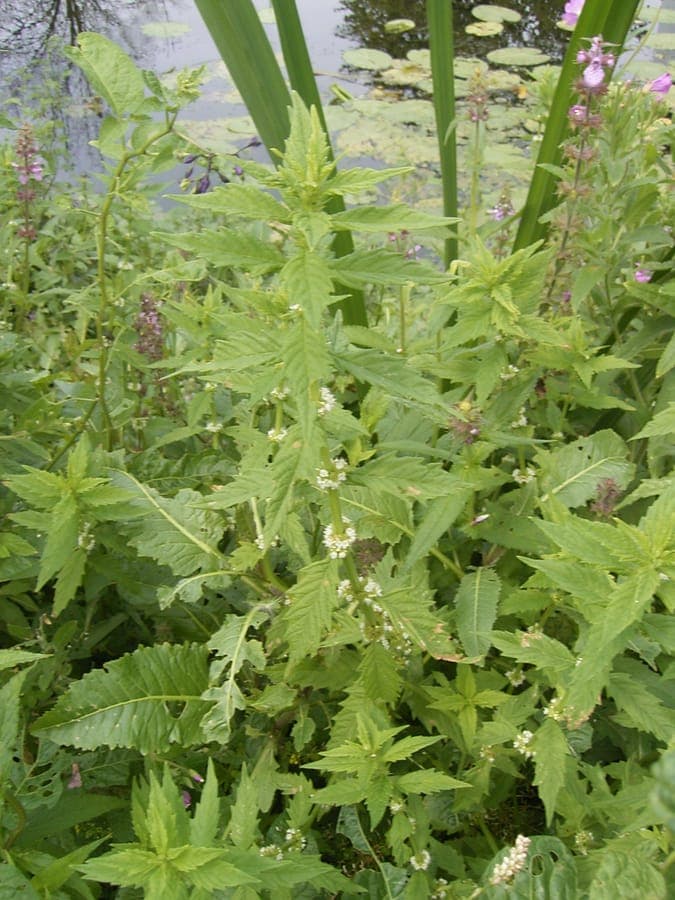
No machine-readable author provided. TeunSpaans assumed (based on copyright claims). / CC BY-SA 3.0, via Wikimedia Commons
Lycopus europaeus: complete guide
Lycopus europaeus
¿Quieres ver Lycopus europaeus: complete guide en tu jardín?
1 minuto, sin tarjeta de crédito
Overview
Lycopus europaeus, commonly known as Water-bugleweed or European bugleweed, is a valuable aquatic plant from the mint family (Lamiaceae) naturally occurring alongside waters and in marshes throughout Europe, Asia, and North Africa. This perennial herb reaches heights of 30-100 centimeters and grows upright in wet soils and shallow waters, forming dense clusters with characteristic square stems and small, delicate white to pink flowers. The plant has been known for centuries for its medicinal properties and was used in traditional medicine for various purposes. With its compact growth habit and attractive flowers, this is a perfect choice for garden owners wishing to create an educational, functional water-plant garden via gardenworld.app.
Lycopus europaeus is an herbaceous plant with very characteristic square stems - a hallmark trait all Lamiaceae species share. This square form is not only botanically interesting but helps with identification. The stems are greenish to purplish with fine whitish hairs, giving it a very refined appearance. The leaves are linear to oval, coarsely toothed, and arranged opposite each other along the stem. They contain aromatic oils that release a characteristic, somewhat bitter scent when rubbed.
The flowers are the most striking feature, appearing from July to October in dense, tiered whorls around stems. They are very small, merely 2-3 millimeters long, white with purple spots or entirely white, and contrast beautifully against green stems. The plant attracts many bees, bumblebees, and other pollinators, making it biologically valuable. After flowering, very small, hard seeds develop and self-disperse, enabling the plant to self-seed in favorable conditions. Via gardenworld.app you can create water-garden designs where this plant thrives optimally.
Ideal Location
Lycopus europaeus grows best in extremely wet conditions, so along waterbanks, in shallow pools, marshes, or boggy areas. The plant loves full sun to partial shade and grows well in both situations. Ideal locations are along waterfronts, in pond-bank areas that regularly flood, or in marsh-like areas with constant water excess. The plant also grows well in very wet, groundwater-rich areas where water levels rise close to the surface.
The plant tolerates both full sun (which stimulates flowering) and light shade beneath overhanging trees. However, very full darkness is unsuitable. Wind exposure is not problematic because the plant grows upright and is rigid enough to withstand wind. Place it rather in protected water zones if your garden is windy.
Soil Type & Nutrition
Lycopus europaeus grows in very wet, nutrient-rich soils with pH between 5.5 and 7.5, leaning neutral. The plant is flexible and accepts both acidic and alkaline soils as long as they contain sufficient nutrition. The ideal soil is silt or clay-like with high organic matter content, typical of water-bank soils. If planting outside natural water boundaries, add organic material via compost or leaf mold.
Nutrition: this is a nutrient-loving water plant thriving in rich, nutrient-heavy waters. Synthetic fertilizers are not essential since the plant absorbs nutrients from water and soil. However, if your water is very clean (such as rainwater storage), you can subtly add nutrition or ensure organic debris accumulates in the water.
Diseño gratis
¿Quieres ver Lycopus europaeus: complete guide en tu jardín? Crea un diseño gratis ahora.
Watering & Moisture Management
Watering is irrelevant for this plant since it grows permanently in water. Instead, ensure water remains permanently present with water depths of 0-20 centimeters, depending on where you plant it. Along water-banks where water levels fluctuate, plant Water-bugleweed in zones regularly experiencing inundation but also occasional drying. This mimics its natural habitat.
Water quality is less critical than for many aquatic plants. The plant grows well in lightly polluted water, making it useful for water-purification purposes in water garden designs. Stagnant water is fine as long as it doesn't become completely anaerobic (oxygen-free). Water flow is not strictly necessary but can be beneficial.
Maintenance & Pruning
Lycopus europaeus requires minimal maintenance. In spring (March-April) you can carefully remove dead previous-season material. Shaping pruning is not essential because the plant naturally grows upright. If the plant becomes too dense and you see fewer flowers, in early summer you can carefully remove some stems to create better air circulation.
Self-seeding can occur extensively in water gardens, so if you want to limit seed dispersal, you can remove wilted flower clusters before they form seed pods. However, this self-seeding phenomenon is also valuable, allowing the plant to spread naturally. In closed water systems this can be beneficial; in open water features it might become weedy.
Maintenance Calendar
March-April: Carefully remove dead material, check water levels May-June: Growth season, ensure constant water July-August: Full bloom, possible pruning for form September-October: Seed formation, optional pruning for seed control November-February: Winter dormancy, maintain water, minimal maintenance
Winter Hardiness & Frost Sensitivity
Lycopus europaeus is extremely winter-hardy and grows wild throughout Europe including very cold regions. The plant is fully frost-tolerant to USDA zone 4 (minimum temperature -30°C). The plant ranges from Arctic margins to southern Europe, enabling it to withstand extreme cold. In winter the above-ground portion dies, but the root system survives beneath freezing groundwater.
In frozen waters the ice can provide protection. In very long, severe frost periods without snow cover, roots may experience damage, but usually they survive. If your garden experiences temperatures lower than -30°C, you can provide some extra protection with plant debris.
Companion Plants & Installation
When planning to establish Water-bugleweed, best plant it along water-banks or in shallow waters where it remains permanently or semi-permanently wet. Purchase young plant material from aquatic plant nurseries. Plant in spring (April-May) directly into water-bed or wet zones with spacing of 30-45 centimeters.
Companion plants include other water plants such as Iris species, Mentha aquatica (Water-mint), Veronica beccabunga, and other moisture-loving flowering plants. This creates a rich, biologically diverse water zone. Via gardenworld.app you can realize complete water-ecosystem designs with Lycopus as a valuable component.
Conclusion
Lycopus europaeus is a valuable, medically-interesting water plant that alongside its aesthetic value is also functional. The white flowers attract pollinators, contributing to ecosystem biodiversity. For garden owners with water zones wanting more structure and recognizable flowering, Water-bugleweed is a perfect choice you can integrate into an educational water-plant design via gardenworld.app.
¿Quieres ver Lycopus europaeus: complete guide en tu jardín? Crea un diseño gratis ahora.
Sube una foto, elige un estilo y obtén un diseño fotorrealista con lista de plantas en menos de un minuto.
Más de 10.000 jardines diseñados
Sin tarjeta de crédito


Plantas similares
Apple mint (Mentha x villosa): complete guide
Mentha x villosa
Meet apple mint (Mentha x villosa): a fruity-scented kitchen herb with woolly leaves, perfect for tea and mojitos.
Salvia peyronii: complete guide
Salvia peyronii
Discover Salvia peyronii, a rare Lebanese mountain sage. Growing tips, hardiness, and companion planting for a Mediterranean gravel garden.
Bigleaf mint (Mentha x rotundifolia): complete guide
Mentha x rotundifolia
Discover bigleaf mint: cultivation, care tips, and garden uses. Learn how to grow this aromatic herb with soft, hairy leaves.