
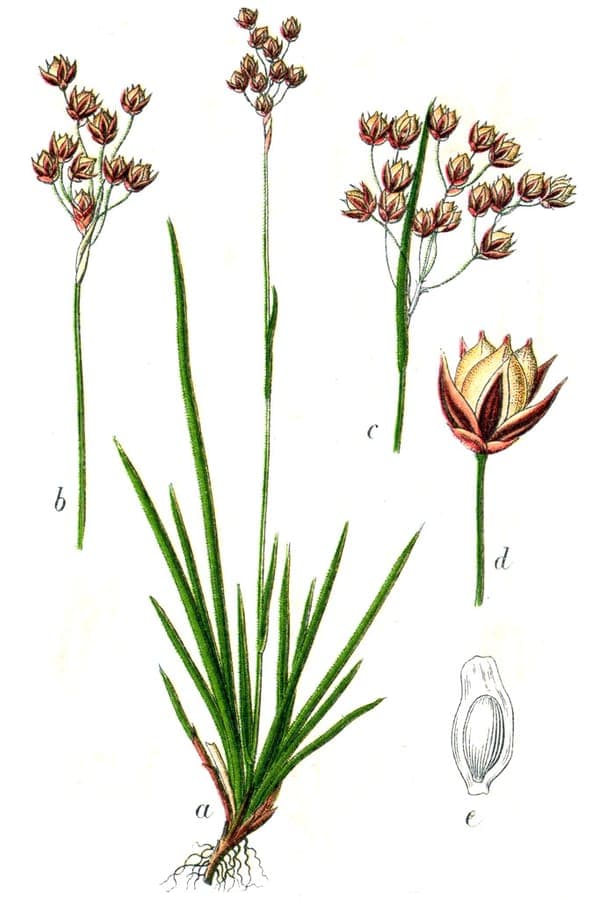
Johann Georg Sturm (Painter: Jacob Sturm) / Public domain, via Wikimedia Commons
Southern wood-rush: complete guide
Luzula forsteri
¿Quieres ver Southern wood-rush: complete guide en tu jardín?
1 minuto, sin tarjeta de crédito
Overview
Southern wood-rush (Luzula forsteri) is a slender, elegantly grass-like plant native to southern Europe, North Africa, and Iran. This plant belongs to the Juncaceae family and is primarily found in drier habitats than its northern relatives. For gardeners seeking ideas on gardenworld.app for dry, sunny locations, Luzula forsteri is an excellent, characterful choice.
Southern wood-rush distinguishes itself through very fine, light foliage and a graceful inflorescence. The plant grows taller and more delicately than Luzula campestris, giving it airier presence in the garden. This grass-like plant is drought-tolerant once established, making it ideal for water-conscious gardening in warmer regions. The plant prefers full sun and turns its long stems toward light, creating a moving, graceful effect.
Historical distribution throughout the Mediterranean region and extending to Iran demonstrates Luzula forsteri's broad tolerance range. In its natural habitat, the plant grows on rocky slopes, dry grasslands, and light woodland margins where moisture is limited.
Appearance & bloom cycle
Southern wood-rush forms fine rosettes of extremely thin, linear leaves. The blades measure only 1-2 millimeters wide, much more slender than other Luzula species, giving the plant an elegant, refined character. The foliage is dark green colored and reaches total heights of 25-50 centimeters in flowering conditions.
The blooming period extends from April through June, peaking in May. Flowers appear in small, brownish-red to red colored spherules at stem tips on long, fine stalks. The inflorescence is much looser and finer than Luzula campestris, showing more individual flower character. The plant grows rapidly toward the blooming period and reaches full height only for 4-8 weeks.
Following bloom, small seeds form and disperse by wind. Seeds ripen in July-August. The plant partially dies back in summer heat and regrows in autumn when temperatures decline. This characteristic makes Luzula forsteri particularly interesting for warm climates.
Ideal location
Southern wood-rush grows optimally in full sun, requiring minimum 6-8 hours direct sunlight daily. The plant weakens in shade and prefers open, exposed locations where wind flows freely. Because the plant derives from dry Mediterranean habitats, it tolerates full heat without problem, unlike many other grass plants.
Good drainage is crucial. Planting on raised beds, in stone gardens or rock gardens is ideal. The plant also grows well on steep slopes where water rapidly drains away. In low-lying, wet places, Luzula forsteri will not thrive.
Wind protection is not necessary; the plant actually performs better in somewhat windier conditions. Wind exposure helps keep the plant compact.
Soil requirements
Southern wood-rush grows on very poor, sometimes even sandy or gravel-like soils. The pH can vary very broadly, from very acidic (pH 4.5) to nearly neutral (pH 7.0). The plant tolerates calcareous material well. Fertilization is generally undesirable; the plant thrives better on poor soils.
Drainage is far more important than soil richness. A mixture of coarser sand, gravel, and some decomposed leaf material creates ideal conditions. In very nutrient-rich garden soils, Luzula forsteri can become unnaturally coarse.
The plant appears to grow least vigorously on nutrient-rich soils with abundant nitrogen. This contrasts with many other garden plants that appreciate fertilization.
Diseño gratis
¿Quieres ver Southern wood-rush: complete guide en tu jardín? Crea un diseño gratis ahora.
Watering
Southern wood-rush is very drought-tolerant once established. In the first year following planting, young material deserves some regular moisture attention until deeply rooted, but thereafter supplemental water is usually unnecessary except in exceptionally dry years.
Indeed, too much water in summer can be harmful. The plant prefers dryness in summer. Only in very exceptional droughts, when the plant clearly wilts, should extra water be provided.
In container-grown material, water should be given until the plant is outplanted. Once the plant grows in open ground, supplemental water is rarely needed.
Pruning
Southern wood-rush requires very little pruning. In early spring, aged, brown-colored stems can be carefully pulled from the plant. This helps the plant reshoot.
The plant naturally maintains its shape well. Only in exceptional circumstances, when lower foliage becomes very messy, can careful pruning be performed. Generally, minimal intervention is best.
Avoid heavy form-pruning. This plant benefits from being left in its natural, slender form.
Maintenance calendar
Spring (March-May): Plant in early spring when temperatures rise. Prevent excessive moisture in early weeks. Observe growth and bloom preparation. Minimize watering.
Summer (June-August): Plant will be less active; give minimal watering. Observe bloom and seed formation. Accept some die-back in extreme heat.
Autumn (September-October): Rainfall will increase; remain cautious with excessive moisture. Plant will reshoot as temperatures decline. Remove any very dead stems.
Winter (November-February): Plant grows slowly; minimal attention. In very cold winters, protect against extreme frost damage.
Winter hardiness
Southern wood-rush is hardy in temperate zones (USDA zones 6-9), with limit to zone 6 in more continental climates. The plant tolerates temperatures to approximately -10 degrees Celsius, but prefers winters that are mild to moderate.
In very cold zones (USDA zone 5 and colder), the plant may be damaged in exceptionally severe winters. Drainage is important: in very wet, frozen soils, root rot can occur.
In warm zones (USDA zone 9+), the plant may not overwinter well without adequate drainage. The combination of wet soil and frost is particularly harmful to this species.
Companion plants
Southern wood-rush combines well with other drought-tolerant and sun-loving plants. Lavender (Lavandula species) grows beautifully alongside it, creating purple-brown color contrast. Flax (Linum species) and other Mediterranean stalwarts complement it well.
In rock gardens, small evergreen shrubs such as Thymus and Sedum grow next to Luzula forsteri. These compositions create natural, xeriscaped-like effects.
Globular plants such as Ferula communis and other umbels harmonize well with the slender Luzula forsteri silhouette. Together they create light, airy architecture.
Closing remarks
Southern wood-rush is an elegant, refined plant for gardeners seeking drought-tolerant, low-maintenance additions. For gardenworld.app visitors in warm, drier regions, Luzula forsteri is the perfect full-sun option. With proper drainage and minimal watering, this plant will largely maintain itself, creating fine texture and graceful movement in the landscape. The plant offers low-maintenance requirements paired with genuine Mediterranean charm.
¿Quieres ver Southern wood-rush: complete guide en tu jardín? Crea un diseño gratis ahora.
Sube una foto, elige un estilo y obtén un diseño fotorrealista con lista de plantas en menos de un minuto.
Sin tarjeta de crédito


Plantas similares
Short-fruited Rush (Juncus brachycarpus): complete guide
Juncus brachycarpus
Complete guide to Juncus brachycarpus: wet soil, pond margins, bloom season, division and winter care for this North American rush in garden ponds.
Smallhead rush: complete guide
Juncus brachycephalus
Smallhead rush (Juncus brachycephalus) - a slender North American wetland plant for pond margins and boggy garden zones. Full care guide.
Mertens' rush: complete guide
Juncus mertensianus
Mertens' rush (Juncus mertensianus) - a compact alpine wetland plant with purple-brown flower heads for cool pond margins. Full growing guide.