
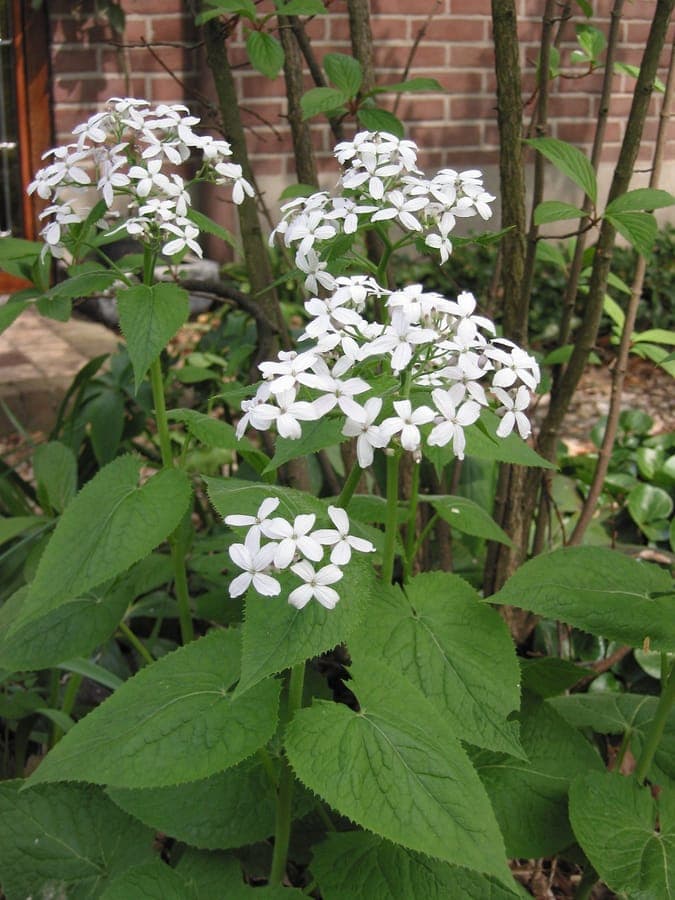
Rasbak / CC BY-SA 3.0, via Wikimedia Commons
Lunaria rediviva: complete guide to perennial honesty
Lunaria rediviva
¿Quieres ver Lunaria rediviva: complete guide to perennial honesty en tu jardín?
1 minuto, sin tarjeta de crédito
Overview of Lunaria Rediviva
Lunaria rediviva, commonly known as perennial honesty or wild honesty, is a long-lived perennial distinguished by its elegant blue flowers and strong vanillaesque fragrance. This plant belongs to the Brassicaceae family and originates from Europe, naturally growing in woodlands, woodland edges, and ravines from the Netherlands through Southern Europe. Unlike its biennial relative (Lunaria annua), Lunaria rediviva is a true perennial that can occupy the same location for many years. This makes it particularly valuable for gardeners preferring sustainable, low-maintenance garden designs.
The plant typically reaches 50 to 100 centimeters in height, with variation depending on growing conditions. The stems are green, sometimes reddish especially lower down. The leaves are heart-shaped, much larger than Lunaria annua (10-20 cm), roughly hairy, with serrated margins. Especially in spring, the leaves have an attractive fragrant character - the plant smells strongly of vanilla and other subtle aromatic compounds when you touch the leaves.
Appearance and Flowering
The flowers of Lunaria rediviva are the main attraction. They measure approximately 12-20 millimeters in diameter, usually blue to lilac (sometimes with purple tints), distinctly different from the purple or white flowers of Lunaria annua. The flowers are highly fragrant, especially in the evening (hence the English name 'perennial honesty'). The flowers appear in dense, long spikes and the flowering period runs from May through July, lasting approximately 6-8 weeks depending on climate.
After flowering, silvery seed discs also form here, similar to Lunaria annua but usually somewhat larger (3-5 cm diameter). These seed discs are equally attractive and can be dried in the same way for arrangements. The plant is however stronger and can endure longer than the biennial variant, so the seed discs can remain on the plant longer (until deep into November or December).
Ideal Location and Light Requirements
The main distinction of Lunaria rediviva is that it grows much better in shade than Lunaria annua. The plant is suitable for woodland, shady locations and can produce flowers with just 2-3 hours of direct sunlight daily, or even in dappled shade. This makes it an ideal choice for gardens with abundant shading from trees or large shrubs.
The plant also grows in full sun, though this in hotter climates leads to fewer flowers and leaves may wilt. For optimal growth in warm regions, place Lunaria rediviva in light shade.
Soil Requirements and Ground Preparation
Lunaria rediviva thrives best in rich, humus-rich soils such as found in woodland environments. Add generous amounts of well-rotted compost or leaf mold to the soil - at least 30-40 percent of the planting medium. Calcareous to neutral terrain (pH 6.5-7.5) is ideal, though the plant also grows in slightly acidic soils (pH 6.0).
Good drainage is important: waterlogging can lead to root rot. In clayey soils add sand and grit to improve drainage. If your soil is very moist, plant Lunaria rediviva in slightly raised beds or slopes.
Diseño gratis
¿Quieres ver Lunaria rediviva: complete guide to perennial honesty en tu jardín? Crea un diseño gratis ahora.
Watering and Moisture Management
Once established, Lunaria rediviva is fairly drought-tolerant, though regular moisture promotes growth and flowering. In the first growing season water regularly to promote root establishment. After establishment water regularly during the growing season (April-September), especially during dry periods. In winter, watering can be greatly reduced.
The plant tolerates more moisture fluctuations than Lunaria annua and also grows in somewhat moister situations (for example in woodland zones with regularly moist soil).
Pruning and Maintenance
Pruning is rarely needed for this perennial plant. However, if you prefer more compact forms, you can in March cut off dead stems from the previous season just above new growth. This encourages more side-branching and a denser pattern.
Particularly important: cut off spent flower spikes after flowering (July-August) to keep the plant neat and encourage second blooming (though this is rare in cooler climates). Harvest silvery seed discs in October-November before they completely fall.
Maintenance Calendar
March: Cleanup: remove dead stems from previous season. April-May: Active growth, water regularly. May-July: Flowering, check weekly for flowers, water. August-September: Seed formation, reduce watering. October-November: Harvest and dry seed discs. December-February: Dormancy, minimal maintenance.
Winter Hardiness and Frost Protection
Lunaria rediviva is fully hardy in Northern and Central Europe and tolerates temperatures to -20°C. The plant dies back to ground level in winter, which is normal for this perennial. No special protection is needed. In spring (March-April), new shoots emerge from the roots.
Companion Plants and Combinations
Lunaria rediviva combines beautifully with other shade-loving plants:
Helleborus (Lenten rose) - for winter flowering when Lunaria is still dormant. Aquilegia (columbine) - purple-yellow flowers create nice contrast. Smilacina (Solomon's seal) - white flowers form contrast. Pulmonaria (lungwort) - red and blue flowers create nice mixture. Primula elatior (cowslip) - yellow flowers against blue Lunaria. Osmunda/Dryopteris (ferns) - for textural layer.
In woodland, shady gardens, use Lunaria rediviva as an elegant mid-height accent plant. The blue, fragrant flowers form a striking element in late-spring woodlands. On gardenworld.app, design complete shade garden systems with Lunaria rediviva as core component.
Conclusion
Lunaria rediviva is a refined, long-lasting plant that adds elegance and fragrance to shade gardens and woodland settings. With its blue, fragrant flowers in May-June and attractive silvery seed discs in autumn, this plant offers months of visual and olfactory pleasure. This is a plant for those seeking permanence and who don't want to reseed annually. For more inspiration and garden designs featuring Lunaria rediviva in woodland and shade gardens, visit gardenworld.app and discover how this classic woodland plant can transform your garden.
¿Quieres ver Lunaria rediviva: complete guide to perennial honesty en tu jardín? Crea un diseño gratis ahora.
Sube una foto, elige un estilo y obtén un diseño fotorrealista con lista de plantas en menos de un minuto.
Más de 10.000 jardines diseñados
Sin tarjeta de crédito


Plantas similares
Brassica cretica: complete guide
Brassica cretica
Brassica cretica, the Cretan cabbage, grows wild on Aegean cliffs. Discover how to grow this drought-tolerant, yellow-flowered Mediterranean perennial.
Corsican cabbage: complete guide
Brassica insularis
Corsican cabbage is a rare Mediterranean rock cabbage with white flowers and blue-green leaves. Location, soil and winter protection.
Prostrate cabbage: complete guide
Brassica procumbens
Prostrate cabbage is a creeping North African cliff plant with yellow flowers. Discover location, soil type and winter protection.