
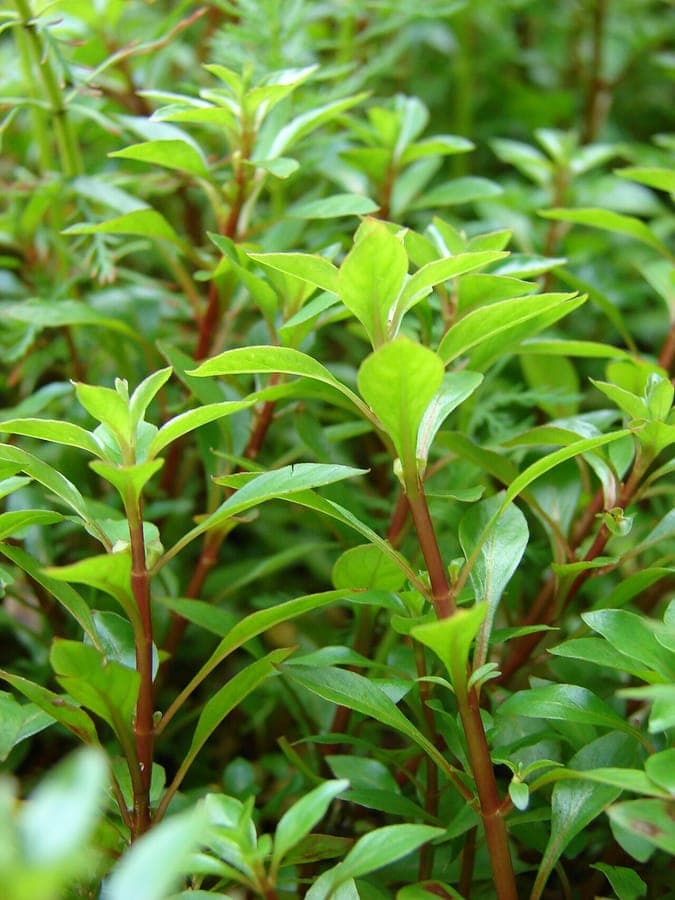
Forest & Kim Starr / CC BY 3.0, via Wikimedia Commons
Ludwigia palustris: complete guide to Hampshire-purslane
Ludwigia palustris
¿Quieres ver Ludwigia palustris: complete guide to Hampshire-purslane en tu jardín?
1 minuto, sin tarjeta de crédito
Overview of Ludwigia Palustris
Ludwigia palustris, commonly known as Hampshire-purslane or marsh seedbox, is a fascinating aquatic plant growing in wetlands, water channels, and shallow waters from Europe through the Mediterranean region. This plant belongs to the Onagraceae family (evening primroses) and distinguishes itself through its remarkable adaptability: it can grow both submerged and semi-aquatically. Ludwigia palustris proves valuable for water garden designs, particularly in natural swimming ponds, water gardens, and biotope aquariums where it serves as a rapid grower providing crucial nutrients for aquatic organisms.
The plant typically reaches 20 to 30 centimeters in height when aquatic, though terrestrial forms can grow taller (to 50 cm). The stems are reddish to brown in color, especially under aquatic conditions, and branch well when regularly trimmed. The leaves are remarkably polymorphic: underwater they are small and oppositely arranged (1-2 cm), while above water they become larger and more rounded (2-4 cm). This morphological plasticity makes Ludwigia palustris exceptionally adaptive to varying growing conditions.
Appearance and Flowering
The flowers of Ludwigia palustris are small, approximately 4-6 millimeters in diameter, and yellow in color. They appear in leaf axils and are usually inconspicuous. The flowering period extends from June through October, particularly in warm summers. The fruits are small, rectangular seed capsules approximately 3-4 millimeters long. For water garden application, however, flowering is less important than vegetative growth and the red coloration that occurs under good conditions.
The red color of stems and young leaves is particularly intense under strong light and when nutrition is optimal. This red color morph makes Ludwigia palustris highly ornamentally attractive in water garden designs. In darker conditions, plants remain predominantly green in color.
Ideal Location and Light Requirements
Ludwigia palustris grows best in full sun to partial shade, with a minimum of 5 hours of direct sunlight daily for good growth. At 8+ hours of sun per day, stems and leaves will become significantly redder. The plant can grow in complete shade but will be thinner and less colored. For aquariums, cultivate the plant under full-spectrum growth lamps (12-14 hours daily).
In water garden context, ensure the plant isn't overshadowed by large aquatic plants, as this significantly reduces growth and coloration.
Soil Requirements and Ground Preparation
Ludwigia palustris grows both rooted in substrate and fully submerged. For optimal growth in water gardens, add nutrient-rich substrate (aquasoil or loam-gravel mix of at least 5 centimeters thickness). The plant grows more slowly in pure gravel or sand lacking nutrients. The plant is not particularly demanding regarding pH, growing well between 5.5 and 7.5.
In aquariums: use nutrient-rich aquasoil with a layer of fine gravel over it. The plant will grow reasonably quickly if nutrients are available.
Diseño gratis
¿Quieres ver Ludwigia palustris: complete guide to Hampshire-purslane en tu jardín? Crea un diseño gratis ahora.
Watering and Moisture (Aquatic Context)
In aquatic context, water changes prove important. For water garden systems, perform 25-50 percent water changes weekly, depending on fish and plant load. For aquariums: 30-50 percent weekly. Excessive water changes can remove nutrients from water, hindering growth. Insufficient changes lead to waste accumulation.
Water quality: Ludwigia palustris thrives at water temperatures of 16-28°C, preferably around 22-24°C. Harder water (>200 ppm total hardness) may somewhat hinder growth, but the plant isn't highly sensitive.
Pruning and Maintenance
Regular pruning promotes bushier growth and fuller appearance. Trim growing tips at approximately 5-10 centimeters height, allowing the plant to form more side branches. These trimmed stems can be replanted in substrate for propagation. For a denser plant, cut back regularly and plant cuttings close together.
Regularly remove dead leaves from the plant's base. Algae on leaves can be gently hand-rubbed off.
Maintenance Calendar
May through October: Regular pruning (every 2-3 weeks), water changes, monitor for nutrient depletion. May: Raise water temperature as season begins. October: Extend pruning cycles as temperature drops. November through April: Minimal growth, maintain existing plant.
Winter Hardiness and Frost Protection
Ludwigia palustris is partially hardy in northern regions: it can survive short frost periods (to -5°C for a few hours), but prolonged frost kills the plant. For permanent water garden applications: allow the plant to grow robustly in autumn, and when frost threatens, remove stems and store in unfrozen water indoors (aquarium or container). Replant these stems in spring.
Alternatively: cultivate in pots that can be moved indoors for winter, then return in May.
Companion Plants and Combinations
Ludwigia palustris combines beautifully with:
Hygrophila difformis (square stem) - similar growth characteristics. Echinodorus species (swordplants) - form background mass. Cryptocoryne - provide mid-ground coverage. Bolbitis heudelotii (Java fern) - textural layer. Azolla (mosquito fern) - floating surface plant for contrast.
In natural water garden designs, use Ludwigia palustris as mid-height accent, especially along edges where it colors red against other green plants. On gardenworld.app, design complete aquatic ecosystems with Ludwigia as a core component.
Conclusion
Ludwigia palustris is a highly versatile aquatic plant, suitable for both aquariums and water gardens and wetland patches. The plant grows quickly, colors beautifully red under optimal conditions, and requires minimal maintenance. Whether creating a sustainable aquatic biotope or a natural wetland patch, Ludwigia palustris certainly deserves a place. For more water garden and aquatic design inspiration, visit gardenworld.app.
¿Quieres ver Ludwigia palustris: complete guide to Hampshire-purslane en tu jardín? Crea un diseño gratis ahora.
Sube una foto, elige un estilo y obtén un diseño fotorrealista con lista de plantas en menos de un minuto.
Más de 10.000 jardines diseñados
Sin tarjeta de crédito


Plantas similares
Shortfruit evening primrose: complete guide
Oenothera brachycarpa
Everything about Oenothera brachycarpa - the shortfruit evening primrose from the American Southwest. Growing tips, placement and care for your garden.
Sundrops (Oenothera tetragona): complete guide
Oenothera tetragona
Everything about Oenothera tetragona - the cheerful daytime-blooming sundrops perennial. Growing tips, placement, pruning and care for a long summer display.
Seabeach evening primrose: complete guide
Oenothera humifusa
Full guide to Oenothera humifusa, the seabeach evening primrose native to the US Atlantic coast. Yellow blooms, silvery foliage, drought-tolerant.