
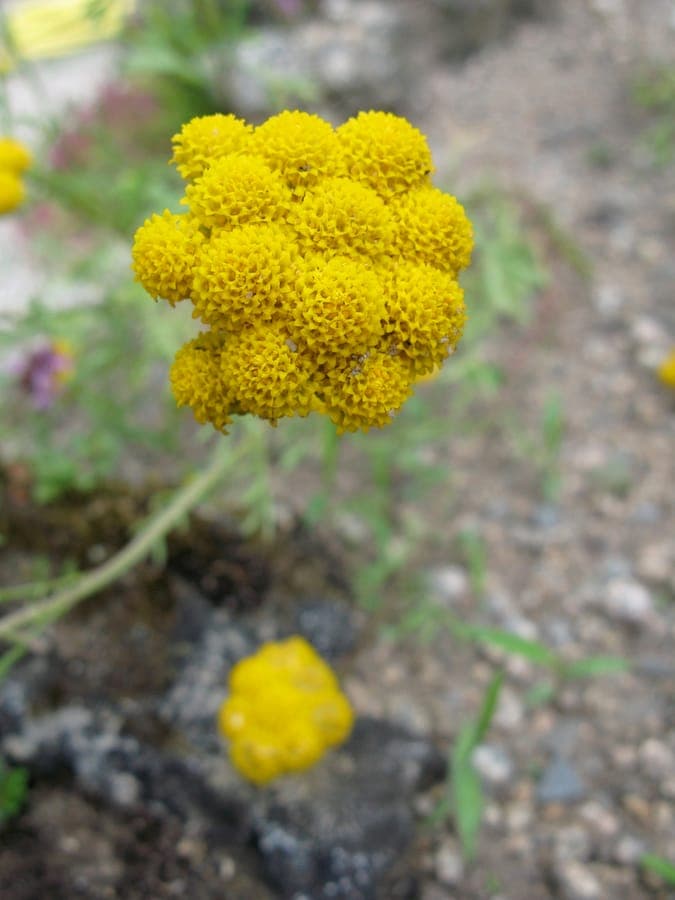
Botanischer Garten TU Darmstadt / CC BY 2.0, via Wikimedia Commons
Lonas annua: complete guide
Lonas annua
¿Quieres ver Lonas annua: complete guide en tu jardín?
1 minuto, sin tarjeta de crédito
Overview
Lonas annua, known as African Daisy, Yellow Ageratum or Lonas, is an attractive annual herb from North Africa. This plant belongs to the Asteraceae family, the same family as daisies and asters. The plant is known for its very fine, green foliage and numerous small yellow flowers that bloom for a long season.
Although annual, plants often reseed themselves and can return in mild climates. The plant grows compact to about 30-45 centimeters height and forms a full, bushy shape. It is widely used as a cut flower and dried flower due to its long shelf life.
Appearance and Bloom
African Daisy has very fine, feathery divided leaves that almost look fern-like. The foliage is dark green and shimmers in sunlight. The entire plant appears very ornamental.
The flowering display consists of numerous small yellow flowers forming in dense clusters above the foliage. Flowers begin in May-June and bloom continuously until the first frost. The color remains bright yellow throughout the entire blooming period.
After drying, the flowers retain their color well, making the plant ideal for dried bouquets and potpourri.
Ideal Location
African Daisy grows best in sunny locations with at least 6-8 hours of direct sunlight. The plant tolerates light shade, but blooms much fuller and richer in full sun.
Plant in windy locations where air circulation is optimal. The plant tolerates strong sun and heat well. For full bloom and form, full sun is absolute preference.
Avoid dense shade and very humid locations.
Soil
African Daisy is very tolerant of various soil types. It grows well on sandy, sandy-loam to slightly clayey soils. A pH between 6.5 and 7.5 is ideal, but the plant tolerates other values.
Good drainage is important. Heavy, waterlogging-prone soils must be improved with sand and gravel. For pot culture, standard potting soil can be used.
The plant is very nutrient-efficient and requires minimal fertilization.
Watering
African Daisy has moderate water requirements during the growing season. Water regularly, but allow the soil to dry superficially between waterings. Avoid waterlogging and long periods of very wet soil.
Once established, the plant tolerates drought reasonably well. Too much water can lead to plant weakening and lower blooms.
In pot culture, watering is needed more frequently than in open ground.
Diseño gratis
¿Quieres ver Lonas annua: complete guide en tu jardín? Crea un diseño gratis ahora.
Pruning
Regular deadheading of spent flowers helps continue blooming. Regularly cut off dead flower clusters, this stimulates further flower production.
In late summer, general pruning can be done to keep the plant more compact and stimulate more branching.
For use as dried flowers, cut flowers when they are about halfway open, for maximum shelf life.
Maintenance Calendar
Spring (March-May): Direct sow in open ground after last frost. Water plants regularly. Thin if needed so plants are 20-30 centimeters apart. Start fertilizing once monthly.
Summer (June-August): Continuous bloom. Regular deadheading of spent flowers. Water during dry periods. Fertilize weekly or bi-weekly.
Fall (September-October): Continuous bloom until frost. Gradually reduce fertilization. Let plants go until frost damages them.
Winter (November-February): Plant dies after frost. For next year, overwinter seedlings or save new seeds.
Winter Hardiness
African Daisy is very sensitive to frost and cannot tolerate temperatures below 0 degrees Celsius. It is an annual plant that dies after the first frost.
In very mild regions (for example French Riviera, Southern Spain) it may sometimes return from previous year seedlings.
In cooler climates it must be grown annually from seed.
Companion Plants
African Daisy works well with:
- Blue flowers like Salvia and Veronica for color combination
- White and red flowers for contrast
- Silver-leaf plants like Senecio as background
- Evergreen shrubs for structure
- Ornamental grasses for texture
Combine for maximum color effect in borders and vases.
Closing
Lonas annua is a versatile plant offering many possibilities. Whether used as a cut flower, dried flower, in pots or in borders, this plant delivers yellow beauty all season. With its easy cultivation and long bloom, it is a standard choice for gardeners wanting to enjoy yellow for a long time.
Seed is easy to find and the plant grows quickly from seed to bloom. Find seeds at seed dealers or via gardenworld.app for your yellow summer garden.
¿Quieres ver Lonas annua: complete guide en tu jardín? Crea un diseño gratis ahora.
Sube una foto, elige un estilo y obtén un diseño fotorrealista con lista de plantas en menos de un minuto.
Más de 10.000 jardines diseñados
Sin tarjeta de crédito


Plantas similares
Calendula stellata: complete guide
Calendula stellata
Complete guide to Calendula stellata, the star-flowered marigold from Sicily: location, soil, watering and companion planting tips.
Korean chrysanthemum: complete guide
Chrysanthemum x rubellum
Chrysanthemum x rubellum is a hardy autumn perennial with single pink to copper flowers from August to November. Care and combinations.
Helianthus divaricatus: complete guide
Helianthus divaricatus
Helianthus divaricatus is a North American woodland sunflower with yellow summer blooms, ideal for naturalistic borders and shady edges.