
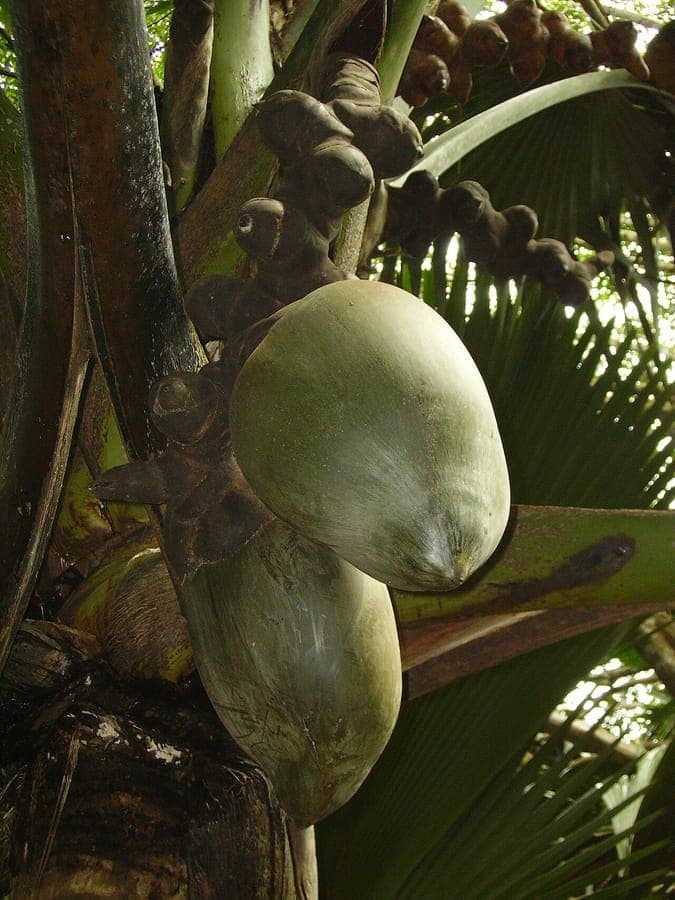
WL~commonswiki / CC BY-SA 3.0, via Wikimedia Commons
Seychelles Nut (Coco de Mer): complete guide
Lodoicea maldivica
¿Quieres ver Seychelles Nut (Coco de Mer): complete guide en tu jardín?
1 minuto, sin tarjeta de crédito
Overview
The Seychelles Nut (Lodoicea maldivica), also called Coco de Mer and Double Coconut, is one of the most fascinating and legendary trees on earth. This unique palm is endemic to the Seychelles and produces the world's largest seeds from any plant. The nuts can weigh up to 20 kilograms and have a distinctive shape that has fascinated botanists and adventurers for generations.
For gardenworld.app readers, the Seychelles Nut is a true botanical curiosity. The tree grows extremely slowly and can take 100 years before producing fruits. This palm is not suitable for temperate climate gardens, but rather a fascinating specimen for collectors and botanists in tropical conditions.
Appearance and Bloom
The Seychelles Nut is a majestic palm reaching 30 to 40 meters tall. Fronds are enormous and can reach 8 to 10 meters long, forming a massive crown atop the trunk. The trunk is massive, gray-green, and smooth.
Flowers are tiny and inconspicuous, appearing in thick, hanging clusters in yellow-green. The fruits, however, are absolutely spectacular: gigantic heart-shaped nuts weighing 10 to 20 kilograms each. Each nut consists of two interlocked halves and requires 12 to 18 years to fully mature.
Ideal Location
The Seychelles Nut requires warm, tropical climate with temperatures between 20 and 30 degrees Celsius year-round. The palm cannot tolerate frost and dies when exposed to temperatures below approximately 15 degrees Celsius. Only in extremely warm locations like subtropical and tropical islands can the palm survive outdoors.
The palm loves full sun with good air movement, though it tolerates some shade. Plant in wind-protected locations, as young plants are quite vulnerable to strong winds.
Soil
The Seychelles Nut grows best in sandy, coral, or calcareous soil with excellent drainage. pH between 6.0 and 7.5 is ideal. The palm is very tolerant of poor soils and grows even on bare coral sand.
Organic matter is not essential but helpful. Soil must not be waterlogged: excellent drainage is critical. In container culture use heavy sand mixture with some organic material.
Diseño gratis
¿Quieres ver Seychelles Nut (Coco de Mer): complete guide en tu jardín? Crea un diseño gratis ahora.
Watering
During the growing season, the Seychelles Nut requires regular watering. The plant grows best when soil dries slightly between waterings. In very dry periods, daily watering may be necessary. In winter, watering can be substantially reduced.
Ensure pots have excellent drainage: waterlogging quickly causes root rot. Young plants in containers need more consistent moisture than mature trees in ground.
Pruning
The Seychelles Nut prunes very minimally. Remove only dead fronds and branches. The tree grows naturally compact without requiring much shaping. Damaged fronds may be carefully removed, but don't cut healthy foliage.
The tree grows extremely slowly and intensive pruning causes only damage. Allow the tree to maintain its natural form.
Maintenance Calendar
Spring: Begin watering as temperatures rise, light feeding. Summer: Regular water, feeding every four weeks. Autumn: Gradually reduce watering. Winter: Minimal water, no feeding, cold exposure is damaging.
Winter Hardiness
The Seychelles Nut absolutely cannot tolerate frost. Temperatures below 15 degrees Celsius are fatal. Outside tropical and subtropical zones, the palm must be cultivated in heat: greenhouse, conservatory, or warm indoor location.
Young plants are especially sensitive. Ensure temperature never drops below 18 degrees Celsius, preferably 20 degrees Celsius or higher.
Companion Plants
In tropical gardens, combine the Seychelles Nut with other tropical palms and trees: coconut, mango, breadfruit. The gigantic nuts form a spectacular sculptural element.
Underplant with tropical species like orchids, bromeliads, and other shade-tolerant plants.
Final Notes
The Seychelles Nut is a fascinating botanical wonder, but not for every garden. The tree requires tropical climate, great patience (young plants grow extremely slowly), and appreciation for its unique nature.
Seed propagation is slow: seeds can take months to germinate. Young seedlings grow extremely slowly. For gardenworld.app readers in warm regions, this can be a spectacular addition, but in temperate climates, greenhouse culture is the only option.
Protected sowing in warm, humid conditions gives best results. Patience is key to success with this legendary palm.
¿Quieres ver Seychelles Nut (Coco de Mer): complete guide en tu jardín? Crea un diseño gratis ahora.
Sube una foto, elige un estilo y obtén un diseño fotorrealista con lista de plantas en menos de un minuto.
Más de 10.000 jardines diseñados
Sin tarjeta de crédito


Plantas similares
Needle palm: complete guide
Rhapidophyllum hystrix
Everything about the needle palm: the world's hardiest palm, suitable for gardens in temperate climates down to USDA zone 7b.
Saw palmetto: complete guide
Serenoa repens
A complete guide to saw palmetto (Serenoa repens), the iconic fan palm from Florida and the southeastern United States, prized for its toughness.
Puerto Rican hat palm: complete guide
Sabal causiarum
Grow Puerto Rican hat palm successfully. A majestic fan palm with tropical presence suited to sheltered Mediterranean-style gardens.