
Kristian Peters -- Fabelfroh 09:04, 21 February 2007 (UTC) / CC BY-SA 3.0, via Wikimedia Commons
Common Gromwell (Lithospermum officinale): complete guide
Lithospermum officinale
¿Quieres ver Common Gromwell (Lithospermum officinale): complete guide en tu jardín?
1 minuto, sin tarjeta de crédito
Overview
Common gromwell (Lithospermum officinale), also called pearl gromwell, European gromwell, or stone seed, is a perennial plant from the family Boraginaceae. Distributed from Europe to Siberia and the Himalayas, this plant has been used in herbal medicine for centuries. The name 'Lithospermum' comes from Greek 'lithos' (stone) and 'sperma' (seed), referring to the hard, stone-like seeds the plant produces.
Appearance & Bloom
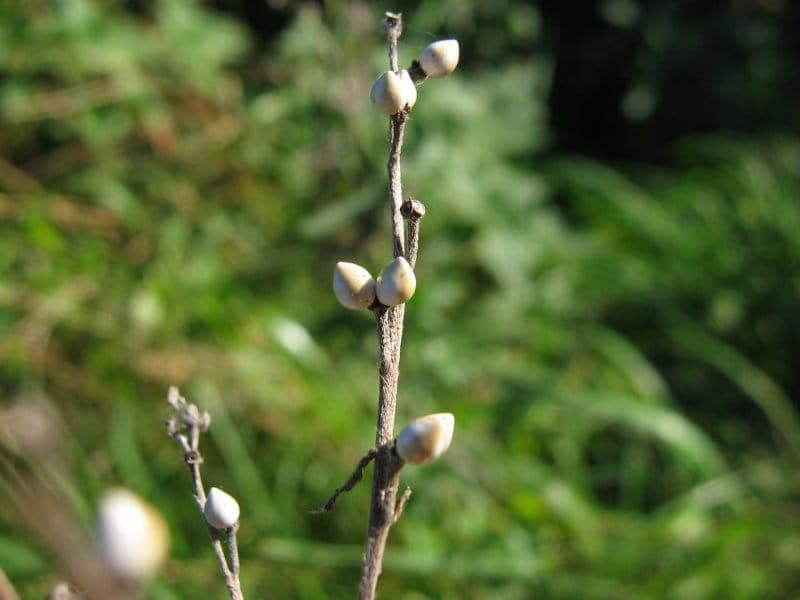
Common gromwell grows as a slender, upright plant of 30-80 cm tall. The plant has narrow, lance-shaped leaves that are green to gray-green. The small flowers - approximately 5-7 mm - are white to cream-colored, sometimes with yellow spots. Flowering period: May to August. After bloom, the characteristic hard, white to gray stone-like seeds of 3-4 mm form, covered with soft brown tissue.
Ideal Location
Common gromwell thrives optimally in full sun to partial shade. Minimum 4-6 hours of direct sunlight daily is ideal. The plant tolerates light shade well, though blooming becomes less prolific. Perfect for dry borders, sloping sites, herb gardens, and naturalistic garden settings. The plant is an excellent bee and pollinator forage plant.
Soil Requirements
Common gromwell is highly drought-tolerant and grows in poor, well-drained soil. Sandy, loamy, and even gravelly soils are suitable. The plant accepts pH between 5.0-7.5. Nutrient-rich soil is not needed and can even be detrimental. Good drainage is essential; waterlogging leads to root rot.
Watering
Once established (after 6-8 weeks), common gromwell requires very little watering. The plant is highly drought-tolerant. Water only during very dry periods of more than 2-3 weeks without rain. In normal seasons, rainwater is usually sufficient. Excessive watering is harmful.
Diseño gratis
¿Quieres ver Common Gromwell (Lithospermum officinale): complete guide en tu jardín? Crea un diseño gratis ahora.
Pruning
Pruning is not necessary, but removal of faded flowers can stimulate further blooming. In spring, the plant can be lightly trimmed to maintain shape. After blooming, you can prune the entire plant back to 15 cm for more compact growth next season.
Maintenance Calendar
March–April: Preparation. Sow seed in pots for transplanting or sow directly. No fertilization needed.
May–June: Peak bloom. Regular deadheading for continued blooming. Water only during drought.
July–August: Blooming continues. Seeds ripen. Usually no watering needed.
September–October: Seeds are ripe. Allow self-sowing or harvest for storage.
November–February: Rest period. Plant can be reset for next season.
Winter Hardiness
Common gromwell is winter-hardy in USDA zones 5–9 (down to -20°C). In Netherlands, Germany, and France, frost periods are normal overwintering season. Protection against extreme cold snaps can be beneficial in areas with temperatures below -25°C. Mulch in fall offers extra protection.
Companion Plants
Common gromwell combines well with:
- Lavender (Lavandula angustifolia)
- Red sage (Salvia × sylvestris)
- Oregano and thyme
- Gray-leaved Artemisia
- Coreopsis (tickseed)
- Achillea (yarrow)
- Phlox in pink/purple tones
- Wild daisy
Closing
Common gromwell is a valuable addition to dry herb gardens and naturalistic borders. The plant requires minimal care, provides bee forage, and has historical herbal medicine value. In potager gardens, it was traditionally used for diuretic and skin applications. Modern research finds various active compounds. Sow common gromwell for both function and beauty. For more inspiration on functional gardens, visit gardenworld.app.
Seed of common gromwell is available from herb seed suppliers in the Netherlands (Intratuin, Gamma) and Germany (OBI, Hornbach).
¿Quieres ver Common Gromwell (Lithospermum officinale): complete guide en tu jardín? Crea un diseño gratis ahora.
Sube una foto, elige un estilo y obtén un diseño fotorrealista con lista de plantas en menos de un minuto.
Más de 10.000 jardines diseñados
Sin tarjeta de crédito


Plantas similares
Western waterleaf: complete guide
Hydrophyllum occidentale
Full growing guide for western waterleaf (Hydrophyllum occidentale): shade tolerance, soil needs, watering, winter hardiness and naturalistic garden use.
Limestone phacelia (Phacelia affinis): complete guide
Phacelia affinis
Full guide to Phacelia affinis, the limestone phacelia: sowing tips, purple-blue bee flowers, drought tolerance and uses in dry or wildlife gardens.
Pyrenean viper's bugloss: complete guide
Echium asperrimum
Echium asperrimum is a striking biennial from the western Mediterranean with rough bristly stems and vivid blue flowers. A magnet for bees and a bold border plant.