
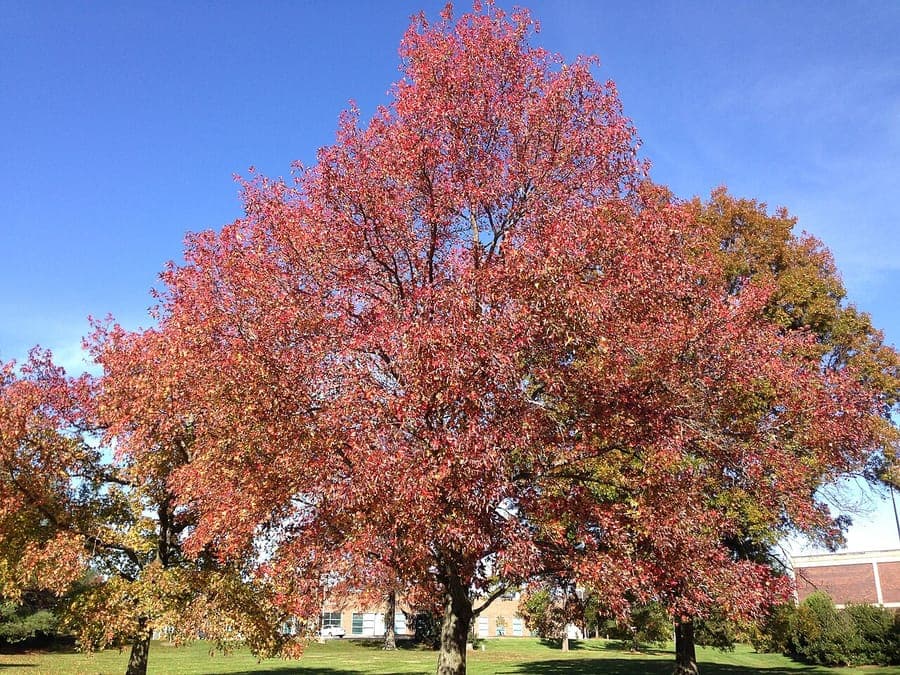
Famartin / CC BY-SA 4.0, via Wikimedia Commons
Sweet gum: complete guide
Liquidambar styraciflua
¿Quieres ver Sweet gum: complete guide en tu jardín?
1 minuto, sin tarjeta de crédito
Overview
Sweet gum (Liquidambar styraciflua) is a North American deciduous tree native from Connecticut to Texas and Central America. In temperate gardens, it remains relatively uncommon but is growing in popularity among gardeners seeking seasonal drama and structural interest.
The tree is celebrated for its spectacular autumn color - burning orange-red in cool years - and for its distinctive persistent seed balls that remain ornamental throughout winter.
Appearance & growth habit
Sweet gum grows 15-20 meters tall (in northern regions often 12-15m). Form is columnar to neat pyramidal, depending on cultivar.
Foliage is distinctive: star-shaped leaves with 5-7 lobes, glossy green in summer. In autumn (October-November), they transform to fiery red or deep burgundy, sometimes with orange tints. Autumn color depends heavily on weather - crisp autumn nights promote anthocyanin formation.
Flowers are inconspicuous - tiny clusters in April-May. After bloom, characteristic ball-shaped seed heads form (approximately 3-4 cm diameter), ripening by September and remaining visible throughout winter.
Ideal location
Sweet gum thrives on sunny sites with good air movement. Ideal conditions are:
- Full sun (minimum 6 hours direct sun daily)
- Good air circulation (prevents fungal disease)
- Protection from very strong westerly winds
- Specimen setting (not shaded by adjacent large trees)
Shade dramatically reduces autumn color intensity.
Soil requirements
Sweet gum thrives on slightly acidic soil (pH 5.5-6.5). In neutral (pH 7.0) or alkaline (pH > 7.5) soils, chlorosis (yellow foliage) can occur.
Moisture requirement: moderate to moist. The tree tolerates wet conditions better than many deciduous trees, though waterlogging is undesirable. Sandy, nutrient-rich soils with good drainage are ideal.
Amend planting holes with acidifying compost - azalea potting soil or heathland compost helps in alkaline gardens.
Watering
Water regularly after planting (first two seasons). The tree must develop deep roots - avoid shallow daily watering.
Established trees have moderate water needs. In dry summers (July-August), provide supplemental water. Drought can cause leaf scorch.
Diseño gratis
¿Quieres ver Sweet gum: complete guide en tu jardín? Crea un diseño gratis ahora.
Pruning
Minimal pruning needed. The tree naturally assumes an attractive pyramidal form. Remove only:
- Dead or diseased branches
- Strongly downward-growing branches
- Crossing branches
Prefer pruning in July-August (not autumn - this stimulates frost-sensitive new growth).
Maintenance calendar
- April-May: Flowering; refresh mulch around base
- June-August: Water management during dry spells
- September-October: Enjoy autumn color; seed balls develop
- November-March: Winter dormancy; minimal maintenance
- January-March: Pruning if needed
Winter hardiness
Sweet gum is hardy to -15 to -20°C (USDA zones 5-9). No winter protection needed in temperate regions.
Young trees (first winter) benefit from careful mulching around the base during extreme cold.
Autumn color & seasonal interest
Autumn color is not guaranteed - it depends on:
- Temperature (warm days, cold nights stimulate anthocyanin production)
- Moisture (adequate water helps)
- Sunlight (full sun promotes color)
- Growing season (variability between years)
In mild autumns, color may remain yellow-orange rather than deep red. This is beautiful in its own way - subtle and refined.
Companion plants
Sweet gum stands beautifully as a specimen but can be combined with:
- Low perennials beneath the canopy: Hostas, Astilbes, Ferns
- Low ground covers: Paxistima, Vinca minor
- Early spring bloomers: Galanthus, Helleborus, Erythronium
Avoid crowding - the tree demands space.
Closing thoughts
Sweet gum is for gardeners seeking seasonality and dramatic autumn transformation. Growth is not rapid, so patience is required. The tree reaches full beauty only after 10-15 years.
The persistent seed balls provide winter interest and wildlife food source. Seek cultivars from regions with reliable autumn coloring (Virginia, Carolina cultivars). 'Worplesdon' is an excellent choice with consistently deep red autumn color.
On gardenworld.app, discover how sweet gum integrates into complete garden designs with year-round visual interest and seasonal drama.
¿Quieres ver Sweet gum: complete guide en tu jardín? Crea un diseño gratis ahora.
Sube una foto, elige un estilo y obtén un diseño fotorrealista con lista de plantas en menos de un minuto.
Más de 10.000 jardines diseñados
Sin tarjeta de crédito


Plantas similares
Acer pycnanthum: complete guide
Acer pycnanthum
Acer pycnanthum, the Japanese swamp maple, is a fast-growing tree with early red flowers and brilliant autumn color, ideal for damp garden settings.
Freeman maple: complete guide
Acer × freemanii
Everything about the Freeman maple (Acer x freemanii): a fast-growing shade tree with spectacular autumn colour for large gardens.
Silver vine: complete guide
Actinidia polygama
Discover silver vine (Actinidia polygama): a hardy climbing plant with silvery foliage, loved by gardeners and cats alike.