
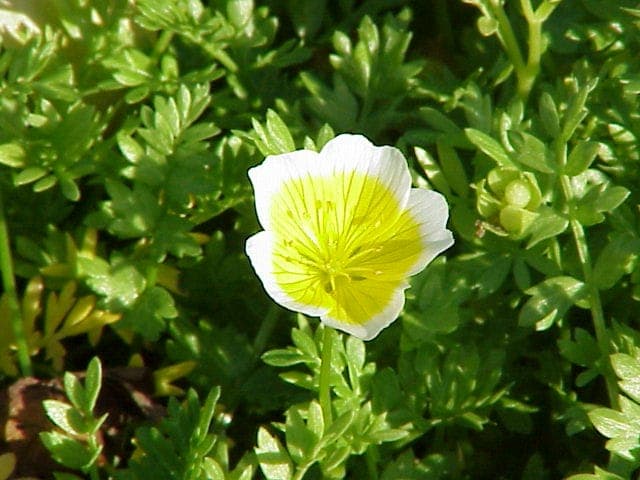
Kurt Stüber [1] / CC BY-SA 3.0, via Wikimedia Commons
Meadowfoam: complete guide
Limnanthes douglasii
¿Quieres ver Meadowfoam: complete guide en tu jardín?
1 minuto, sin tarjeta de crédito
Overview
Limnanthes douglasii, better known as meadowfoam or "poached egg plant," is a charming, compact-growing plant native to California and Oregon. This plant of the Limnanthaceae family is renowned for its adorable white flowers with yellow edges that indeed resemble poached eggs. It is a wonderful filler plant for moisture-loving locations.
Appearance and Bloom
Limnanthes douglasii grows as a compact, spreading plant reaching only 20-40 cm tall. The plant features fine, light-colored foliage and produces abundant small, round flowers approximately 10-15 mm in diameter. The flowers are characteristically white with yellow borders, explaining their popular nickname "poached egg plant." Blooming runs from April to October.
Ideal Location
This plant thrives best in locations with full sun to light shade. It prefers open, sunny spots but can also grow in lightly shaded areas. The plant thrives in moisture-loving soils and along pond edges.
Soil
Limnanthes douglasii loves moist, well-draining soils and is not very fussy. The plant thrives in neutral to acidic soils (pH 6.0-7.0). It tolerates normal garden soils provided they are well-moistured.
Watering
This plant enjoys regular watering and prefers soils that are consistently moist. It is not, however, tolerant of waterlogging. Regular watering during growth and blooming ensures continuous flowering.
Diseño gratis
¿Quieres ver Meadowfoam: complete guide en tu jardín? Crea un diseño gratis ahora.
Pruning
Minimal pruning is needed. You can remove spent flowers for appearance, though this is not strictly necessary. Pinch the tips to encourage bushy growth.
Maintenance Calendar
- Spring (March-May): Direct sow seed or sow in pots. Water regularly. Blooming begins.
- Summer (June-August): Plant blooms continuously if watered regularly. Remove spent flowers.
- Autumn (September-October): Plant continues blooming until first frost. Collect seed for next year.
- Winter (November-February): Plant dies in colder areas. In milder zones, it may overwinter.
Winter Hardiness
Limnanthes douglasii is not winter-hardy in many Northern European regions and is typically grown as an annual. However, it can overwinter in very mild areas.
Companion Plants
Combine Limnanthes douglasii with:
- Forget-me-nots (Myosotis)
- Violas (Viola)
- Alyssum (Lobularia maritima)
- Dianthus
These combinations create a charming, colorful groundcover.
Closing Thoughts
Limnanthes douglasii is a wonderful choice for gardeners wanting to add something unique to moisture-loving areas. Its cute flowers with their "poached egg" appearance are irresistible. This is ideal for borders and container plants. Find seed or seedlings at garden centers. For more inspiration for moisture-loving gardens, visit gardenworld.app for your next project.
More tips for moisture-loving plants can be found on gardenworld.app.
¿Quieres ver Meadowfoam: complete guide en tu jardín? Crea un diseño gratis ahora.
Sube una foto, elige un estilo y obtén un diseño fotorrealista con lista de plantas en menos de un minuto.
Más de 10.000 jardines diseñados
Sin tarjeta de crédito


Plantas similares
Acer pycnanthum: complete guide
Acer pycnanthum
Acer pycnanthum, the Japanese swamp maple, is a fast-growing tree with early red flowers and brilliant autumn color, ideal for damp garden settings.
Freeman maple: complete guide
Acer × freemanii
Everything about the Freeman maple (Acer x freemanii): a fast-growing shade tree with spectacular autumn colour for large gardens.
Silver vine: complete guide
Actinidia polygama
Discover silver vine (Actinidia polygama): a hardy climbing plant with silvery foliage, loved by gardeners and cats alike.