
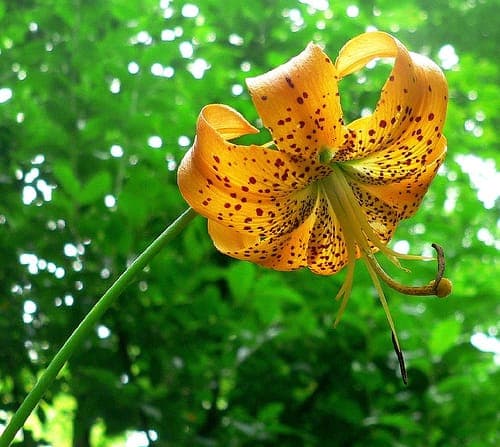
Original uploader was Arx Fortis at en.wikipedia / CC BY-SA 3.0, via Wikimedia Commons
Lilium superbum: complete guide
Lilium superbum
¿Quieres ver Lilium superbum: complete guide en tu jardín?
1 minuto, sin tarjeta de crédito
Overview
Lilium superbum, commonly known as the American Turk's-cap lily, superb lily, or swamp lily, is a majestic wildflower native to the moist forests and meadowswamps of eastern North America. This spectacular plant bears numerous drooping, turban-shaped flowers per stem - up to 20 or more - each perfectly reflexed and spotted. The flowers range from deep yellow to orange-red with brown spots and characteristically recurved petals, creating an exotic, almost voluptuous appearance.
Gardenworld.app recommends this plant for gardeners seeking something truly distinctive. Lilium superbum is a native American species that thrives in moist, humus-rich soils in dappled shade - perfect for woodland gardens and naturalistic plantings.
Appearance and Bloom Cycle
Lilium superbum produces tall, sturdy stems reaching 120-200 cm in well-grown specimens. The leaves are linear to lanceolate, green, and arranged in whorls around the stem in a distinctive pattern. This striking growth habit makes the plant recognizable even before bloom.
Flowering occurs in July-August with blooms spiraling up the upper stem in groups of 3-20. Each flower is turban-shaped, 5-6 cm across, ranging from deep yellow to orange-red with brownish spotting. The reflexed petals and prominent stamens lend an exotic, sensuous quality.
Ideal Location
Lilium superbum thrives in dappled to partial shade, ideally beneath deciduous trees or at woodland edges. Full afternoon sun can bleach the flowers. Provide moisture-retaining, humus-rich soil with excellent drainage around the bulb zone.
Plant these lilies in woodland gardens, shady borders, and naturalistic plantings. They excel in gardens with substantial organic matter and irregular watering patterns. Gardenworld.app designers frequently recommend them for adding height and exotic color to shaded areas.
Soil Requirements
Lilium superbum demands highly porous, acidic to neutral soils (pH 5.5-6.5). The plant is humus-dependent; incorporate liberal amounts of leaf mold, peat moss, or premium compost. Heavy clay soils require substantial amendment with sand, peat, and organic matter.
Beyond drainage, moisture retention is paradoxically essential for this lily. This balance is achieved through organic soil enrichment. Avoid mineral-rich fertilizers; this lily evolved in nutrient-poor forest soils.
Diseño gratis
¿Quieres ver Lilium superbum: complete guide en tu jardín? Crea un diseño gratis ahora.
Watering
Lilium superbum requires consistent moisture, particularly during active growth and flowering (May-August). Keep the soil consistently moist but never waterlogged. Water at the base, never overhead, to prevent fungal diseases.
Drought is more harmful than wet feet for this species. Mulch heavily with leaf litter and woodchips to maintain soil moisture and keep bulb zones cool. Supplementary irrigation during dry periods is essential.
Pruning and Maintenance
Remove faded flowers as they lose appeal unless collecting seed. Cut flowering stems gently for the vase, leaving at least three leaf pairs on the plant for energy recovery. After bloom (September-October), allow foliage to persist until fully senescent. This provides the bulb essential time to recharge. Only then cut dead stems to ground level.
Maintenance Calendar
March: Growth surge; ensure consistent moisture with heavy leaf mulch. April-May: Stem growth accelerates. June: Bud formation. July-August: Peak flowering; provide afternoon shade and water. September-October: Flowering wanes, foliage matures then dies. November-February: Complete dormancy; protect bulbs from winter moisture.
Winter Hardiness
Lilium superbum is extremely hardy in temperate to continental climates, thriving throughout temperate North America and northern Europe. The bulbs survive winter temperatures to -20 degrees Celsius without damage provided dry dormancy. Protect against winter wetness through raised planting or excellent drainage.
Companion Plants
Lilium superbum combines beautifully with woodland natives. Pair with Adiantum (maidenhair fern) for fine foliage texture, Hosta species for shade tolerance, and Polygonatum (Solomon's seal). For height: combine with Aconitum (monk's-hood) or Hemerocallis (daylily). Foreground: Astilbe (false spirea) in red-white. These combinations create authentic woodland environments featured on gardenworld.app.
¿Quieres ver Lilium superbum: complete guide en tu jardín? Crea un diseño gratis ahora.
Sube una foto, elige un estilo y obtén un diseño fotorrealista con lista de plantas en menos de un minuto.
Más de 10.000 jardines diseñados
Sin tarjeta de crédito


Plantas similares
Reverchon's gagea: complete guide
Gagea reverchonii
Full guide to Gagea reverchonii, Reverchon's gagea: rare Pyrenean bulb with bright yellow spring flowers, soil needs and companion planting.
Leafy gagea: complete guide
Gagea foliosa
Gagea foliosa is a rare Mediterranean bulb with bright yellow star-shaped flowers blooming February to March in well-drained rocky settings.
Tubular gagea: complete guide
Gagea fragifera
Gagea fragifera is a mountain bulb with golden-yellow star flowers blooming May to July on subalpine slopes from Europe to the Himalaya.