
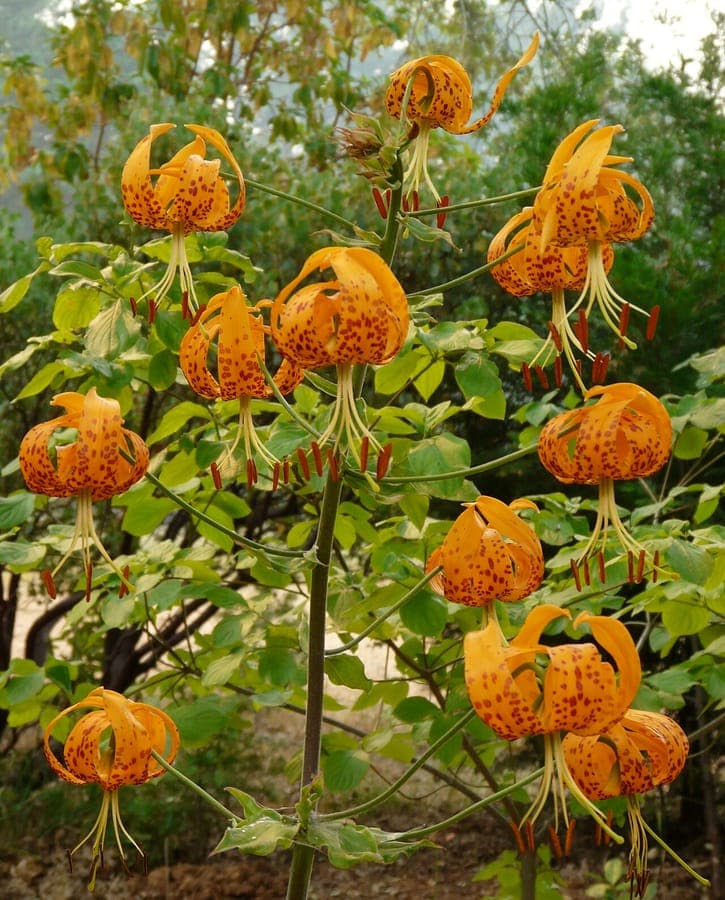
First Light (talk) / CC BY 3.0, via Wikimedia Commons
Humboldt lily: complete guide
Lilium humboldtii
¿Quieres ver Humboldt lily: complete guide en tu jardín?
1 minuto, sin tarjeta de crédito
Overview
The Humboldt lily (Lilium humboldtii) is an impressive lily species native to California through northern Baja California, Mexico. This elegant bloom bears the name of the renowned German naturalist Alexander von Humboldt. The Humboldt lily is celebrated for its spectacular height, sometimes reaching 180 centimetres, and the abundant profusion of flowers appearing throughout summer months.
Appearance and Bloom
The Humboldt lily is an impressive plant with tall, slender stems clothed in linear, green leaves. The plant grows upright and effortlessly reaches 1.5 to 1.8 metres height in ideal growing conditions. The flowers steal the show: orange-yellow, sometimes red-tinged at margins, with red spots on the inner sides of flower petals. Each stem can carry hundreds of blooms, arranged in dense racemes appearing from June through August. These lilies are also fragrant, especially in late afternoon.
Ideal Location
The Humboldt lily thrives in fully sunny locations with minimum eight hours of direct sunlight daily. Good flower production requires abundant light. The plant tolerates some windbreak, especially since it grows extremely tall. Ensure that strong winds cannot snap the tall stems through appropriate support of large specimens.
Soil
The Humboldt lily demands fairly exacting soil conditions. This plant struggles in wet, waterlogged soils. Well-draining, sandy soil with pH 6 to 7 proves ideal. Add abundant gravel, sand and organic matter to the planting hole. Lilies abhor stagnation, so ensure excellent drainage. In regions with heavy rainfall, raised planting proves necessary.
Diseño gratis
¿Quieres ver Humboldt lily: complete guide en tu jardín? Crea un diseño gratis ahora.
Watering
The Humboldt lily is moderately moisture-loving but tolerates dryness once established. Watering should maintain moderation: neither too wet nor completely dry. Regular watering during the growing season proves beneficial, but not excessive. Water deeply but less frequently than shallow and frequent applications. In rainy seasons, supplemental watering may prove unnecessary.
Pruning
Minimal pruning is required. Remove spent flowers carefully to maintain plant neatness, although this remains optional. After flowering and dry foliage, you can carefully cut back the aboveground portions. Healthy, green leaves should remain until they naturally yellow.
Maintenance Calendar
May: Begin growth phase. June-August: Peak flowering period. Protect from strong winds. August-September: Flowering ends. Reduce watering. October-April: Winter dormancy period. May: Growth resumes.
Winter Hardiness
The Humboldt lily is winter-hardy to approximately minus 10-15 degrees Celsius. In Netherlands and Belgium, the plant typically overwinters without protection in temperate coastal zones, but in harsher inland regions, protection with thick leaf mulch proves beneficial. In very cold regions, bulbs should be lifted in autumn and replanted in spring.
Companion Plants
The Humboldt lily combines beautifully with lower-growing plants filling space beneath the stems. Plant low shrubs, grasses or ground covers around lilies. Lavender, sage, sedum and ornamental grasses combine well. Avoid coarse plants that might damage the bulbs.
Closing Thoughts
The Humboldt lily is a spectacular addition to summer gardens, provided well-draining soil and abundant sunlight are available. With its imposing height and orange-yellow flower display, it offers dramatic garden architecture. Provide well-draining soil, full sunlight and moderate watering, and these lilies will reward you with years of continuous blooms. For additional plant advice, visit www.gardenworld.app.
¿Quieres ver Humboldt lily: complete guide en tu jardín? Crea un diseño gratis ahora.
Sube una foto, elige un estilo y obtén un diseño fotorrealista con lista de plantas en menos de un minuto.
Más de 10.000 jardines diseñados
Sin tarjeta de crédito


Plantas similares
Reverchon's gagea: complete guide
Gagea reverchonii
Full guide to Gagea reverchonii, Reverchon's gagea: rare Pyrenean bulb with bright yellow spring flowers, soil needs and companion planting.
Leafy gagea: complete guide
Gagea foliosa
Gagea foliosa is a rare Mediterranean bulb with bright yellow star-shaped flowers blooming February to March in well-drained rocky settings.
Tubular gagea: complete guide
Gagea fragifera
Gagea fragifera is a mountain bulb with golden-yellow star flowers blooming May to July on subalpine slopes from Europe to the Himalaya.