
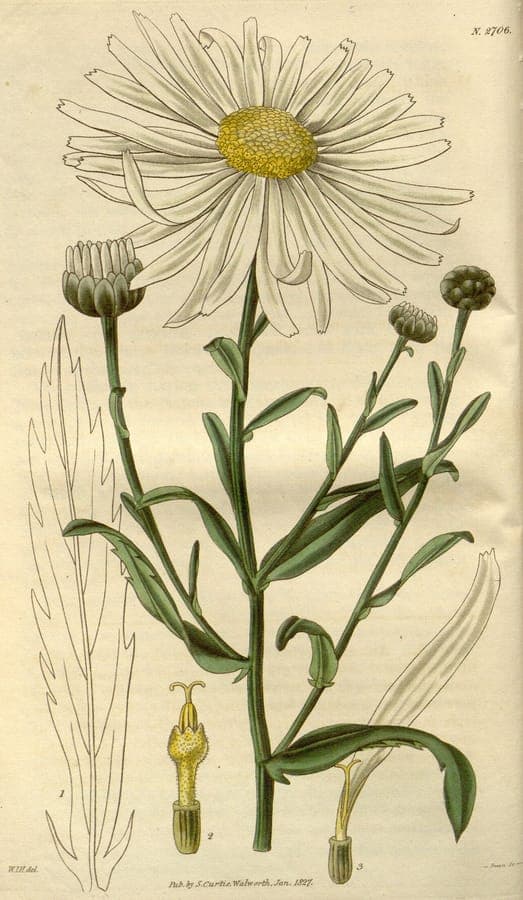
Curtis's Botanical Magazine, vol. 54 [ser. 2, vol. 1]: t. 2706 (1827) [W.J. Hooker] / Public domain, via Wikimedia Commons
Hungarian daisy: complete guide
Leucanthemella serotina
¿Quieres ver Hungarian daisy: complete guide en tu jardín?
1 minuto, sin tarjeta de crédito
Overview
Leucanthemella serotina, also known as Hungarian daisy or autumn oxeye, is an elegant perennial plant of the Asteraceae family native to Central and Southeast Europe. This plant is beloved because it blooms in autumn, when many other flowers have already faded. With its large white flowers and golden centers, it offers a fresh note to autumn gardens.
Appearance and Bloom
Leucanthemella serotina grows as an upright, bushy plant approximately 80-120 cm tall. The plant features dark green, linear foliage and large, daisy-like white flowers with yellow disks appearing from September to November. This late-season flowering makes it a valuable addition to gardens.
Ideal Location
This plant thrives best in a location with full sun to light shade, receiving at least 6 hours of direct sunlight daily. While it tolerates light shade, full sun will promote flowering. Plant it in a location not overshadowed by other plants.
Soil
Leucanthemella serotina is not particularly fussy about soil but prefers well-draining, fertile soil. The plant thrives in neutral to acidic soil (pH 6.5-7.0). It is tolerant of normal garden soil and does not require special preparation.
Watering
Once established, this plant is fairly drought-tolerant and requires minimal watering. During dry periods, you can water, but excessive watering must be avoided. The plant prefers soil with moderate moisture.
Diseño gratis
¿Quieres ver Hungarian daisy: complete guide en tu jardín? Crea un diseño gratis ahora.
Pruning
Pruning is minimal. You can remove dead flowers to improve appearance, though this is not strictly necessary. In spring, you can remove dead stems. A light early summer trim can help the plant become fuller.
Maintenance Calendar
- Spring (March-May): Plant grows out. Water regularly until well established. Remove dead stems from previous year.
- Summer (June-August): Plant develops. Minimal watering needed unless extremely dry. Monitor for weeds.
- Autumn (September-October): Plant flowers profusely. Water regularly to support blooming. Remove spent flowers.
- Winter (November-February): Plant dies back. Dead biomass can remain until spring.
Winter Hardiness
Leucanthemella serotina is extremely winter-hardy and can tolerate temperatures well below freezing. It is ideal for cold climates and grows well in Northern Europe.
Companion Plants
Combine Leucanthemella serotina with:
- Asters (Aster novi-belgii)
- Heathers (Erica/Calluna)
- Astilbe (Astilbe)
- Meadow sage (Salvia x sylvestris)
These combinations create beautiful autumn borders.
Closing Thoughts
Leucanthemella serotina is a valuable plant for gardeners wanting autumn color. Its large white flowers are unmatched when other plants decline. This is ideal for autumn garden design. Find plant material at garden centers specializing in perennials. For more inspiration for autumn garden design, visit gardenworld.app for your next project.
More tips for autumn bloomers can be found on gardenworld.app.
¿Quieres ver Hungarian daisy: complete guide en tu jardín? Crea un diseño gratis ahora.
Sube una foto, elige un estilo y obtén un diseño fotorrealista con lista de plantas en menos de un minuto.
Más de 10.000 jardines diseñados
Sin tarjeta de crédito


Plantas similares
Calendula stellata: complete guide
Calendula stellata
Complete guide to Calendula stellata, the star-flowered marigold from Sicily: location, soil, watering and companion planting tips.
Korean chrysanthemum: complete guide
Chrysanthemum x rubellum
Chrysanthemum x rubellum is a hardy autumn perennial with single pink to copper flowers from August to November. Care and combinations.
Helianthus divaricatus: complete guide
Helianthus divaricatus
Helianthus divaricatus is a North American woodland sunflower with yellow summer blooms, ideal for naturalistic borders and shady edges.