
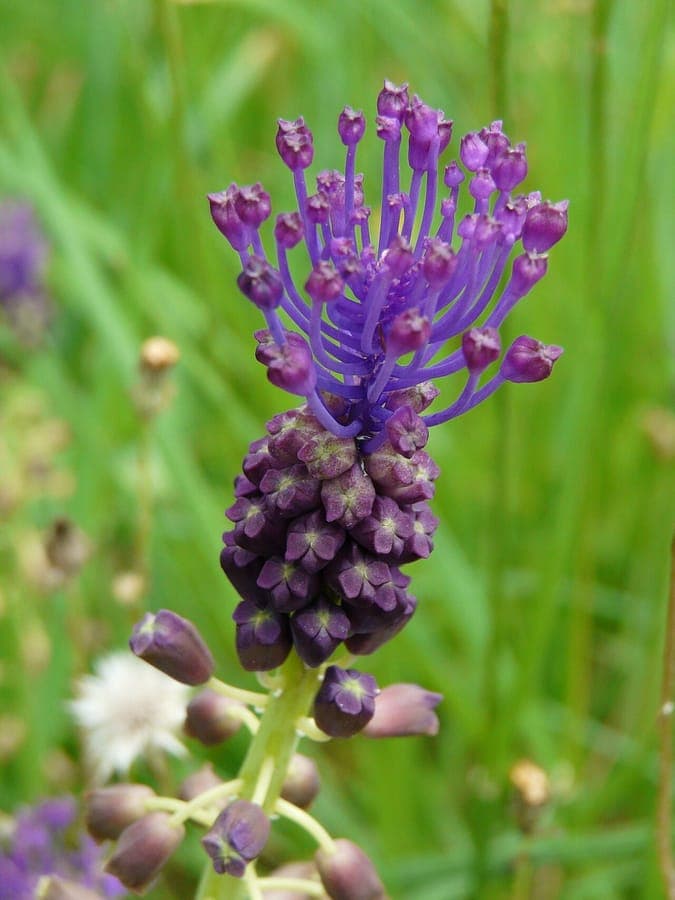
Père Igor / CC BY-SA 3.0, via Wikimedia Commons
Leopoldia comosa: complete guide
Leopoldia comosa
¿Quieres ver Leopoldia comosa: complete guide en tu jardín?
1 minuto, sin tarjeta de crédito
Overview
Leopoldia comosa, better known as the feather hyacinth, tassel grape-hyacinth, or tasselled hyacinth, is a striking bulb plant from the Asparagaceae family. This fascinating plant is known for its unique, fluffy flower heads with feathery tufts emerging from the flower spike. The plant is a true eye-catcher in spring and adds dramatic texture and color to front yard and garden designs.
The feather hyacinth grows naturally in Southern and Central Europe and around the Mediterranean. It is a versatile plant that works well in borders, planters, and even in garden grids. With minimal care, this plant will return year after year.
Appearance & Bloom
Leopoldia comosa grows to approximately 20-30 centimeters tall and forms dense tufts of narrow, gray-green foliage. The flower spike is the most characteristic feature: a compact raceme of small star-shaped flowers in purple to purple-red, topped with a striking tuft or plume of bright purple sterile flowers without stamens.
This unique tuft gives the plant its name and provides a remarkable decorative effect. Flowering appears in April to May, depending on your location and weather conditions. The bloom period lasts 2-3 weeks.
After flowering, seed capsules form that can also be decorative. The foliage typically disappears by summer and the plant enters dormancy.
Ideal Location
The feather hyacinth grows best in full sun to partial shade. At least 4-5 hours of direct sunlight daily is ideal. This promotes healthy growth and full blooming. The plant is flexible regarding light and can also thrive in partially shaded planters.
Plant this bulb in groups for maximum effect. Both direct ground planting and container cultivation work excellently.
Soil
Leopoldia comosa makes few demands on soil. Good drainage is important, especially in moist climates. Standard garden soil mix with some extra sand works fine. The plant can grow in moderately fertile to poor soils.
The pH can be neutral to slightly alkaline. Drainage is more important than soil fertility.
Diseño gratis
¿Quieres ver Leopoldia comosa: complete guide en tu jardín? Crea un diseño gratis ahora.
Watering
Watering requirements are relatively low. After planting and during growth and bloom, keep lightly moist. However, excessive water must be avoided, especially with heavy soils. If natural rainfall is sufficient, extra water is usually not needed.
After blooming and during the rest period, water should be greatly restricted. In containers, allow to dry until next season.
Pruning
Pruning is practically unnecessary. Remove faded flowers to keep the plant looking neat. Remove foliage only when completely withered. Seed capsules can be removed or left, depending on your aesthetic preference.
Maintenance Calendar
September-October: Planting time. Plant bulbs at 8-10 centimeter depth. March-May: Growth and blooming. June-August: Dormancy. Minimal maintenance. August-September: Preparation for next cycle.
After bloom: Let foliage wither. Remove from potting soil or add fertilizer to the soil.
Winter Hardiness
Leopoldia comosa is hardy to approximately -15 degrees Celsius in Europe. The bulbs can overwinter outdoors all winter and will sprout again next spring. In very wet, heavy soils, good drainage is essential to prevent rot problems.
Companion Plants
The feather hyacinth combines beautifully with other spring bloomers such as tulips, daffodils, and small irises. Soft yellow combined with lavender or gray-silver foliage forms a lovely combination. Low-growing groundcovers and sedums around the base prevent soil splashing.
In mixed borders, Leopoldia works well with other bulb plants and evergreen plants that provide texture.
Closing
Leopoldia comosa is an underutilized gem among spring bloomers. Its unique, striking appearance and easy care make it an excellent choice for garden designers wanting something different. The plant is affordable and usually available at garden centers in spring.
Want to use this plant in your front yard? Gardenworld.app can help with complete garden designs featuring this feather hyacinth as a textural addition. Check Intratuin or Gamma in the Netherlands for bulbs. Enjoy these beautiful spring bloomers on gardenworld.app!
¿Quieres ver Leopoldia comosa: complete guide en tu jardín? Crea un diseño gratis ahora.
Sube una foto, elige un estilo y obtén un diseño fotorrealista con lista de plantas en menos de un minuto.
Más de 10.000 jardines diseñados
Sin tarjeta de crédito


Plantas similares
Narrow-leaved dracaena: complete guide
Dracaena angustifolia
Everything about Dracaena angustifolia - the narrow-leaved dracaena: location, care, overwintering and use as a houseplant or patio plant.
Chaparral yucca: complete guide to Hesperoyucca whipplei
Hesperoyucca whipplei
Hesperoyucca whipplei (Our Lord's candle) is a dramatic rosette-forming plant from California that produces a towering flower spike, ideal for dry and gravel gardens.
False lily-of-the-valley: complete guide
Maianthemum dilatatum
Everything about Maianthemum dilatatum, the false lily-of-the-valley. Care, shade location, propagation and garden combinations for this popular shade ground cover.