
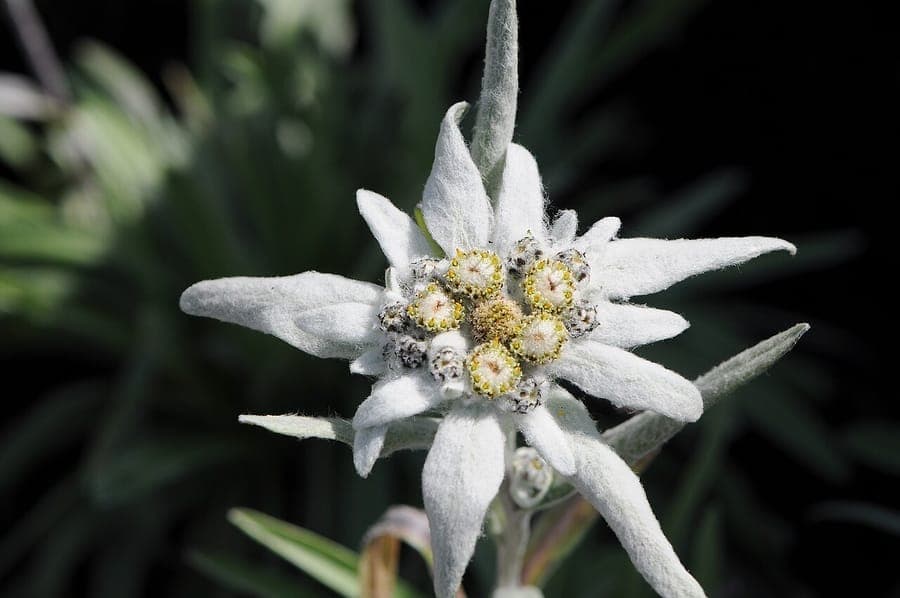
Böhringer Friedrich / CC BY-SA 2.5, via Wikimedia Commons
Edelweiss: complete guide
Leontopodium nivale
¿Quieres ver Edelweiss: complete guide en tu jardín?
1 minuto, sin tarjeta de crédito
Overview
Edelweiss (Leontopodium nivale), the legendary alpine flower, is a cultish favorite perennial from the Asteraceae family. This famous plant grows naturally on rocks and mountain meadows of the Alps and other European mountains at high altitude (1,500-3,500 meters). The plant is known for its characteristic silvery-white, woolly leaves surrounding the flower and yellow flower centers. In gardens, edelweiss is greatly valued for its exotic appearance and symbolic significance.
Want a garden with legendary alpine flowers? On gardenworld.app, you can have a garden plan designed featuring alpine treasures like edelweiss. The site helps you create a dreamlike, mountainous garden.
Appearance & Bloom Cycle
Edelweiss forms compact rosettes of woolly, grayish-white foliage 5-10 cm long. Leaves are linear to lance-shaped and covered with dense white hairs, resulting in a silvery-white appearance. Flower heads appear in May-July on stems 10-25 cm tall. Each flower head is surrounded by distinctive silvery-white, woolly bract-like structures (involucres) much more prominent than the actual flower. The true flower center consists of tiny yellow florets. The plant blooms for several weeks.
Ideal Location
Edelweiss grows best in very sunny, fully sunny locations. The plant cannot thrive in any shade. South or west-facing exposure on a raised bed or rock feature is preferred. The plant is very wind-resistant; windiness is actually favorable in the alpine environment for which this plant is designed.
Soil Requirements
Like many alpine plants, edelweiss demands extremely well-drained soil. Sand, gravel, small stones are ideal. A pH of 6.0 to 8.0 is acceptable. The plant grows very poorly in normal garden soils and nutrient-rich ground. Wet soil is absolutely unsuitable. The plant is very tolerant of nutrient-poor conditions.
Diseño gratis
¿Quieres ver Edelweiss: complete guide en tu jardín? Crea un diseño gratis ahora.
Watering
Once established, edelweiss is very drought-resistant and requires minimal water. Water regularly during the first growing season until established. Afterwards, minimal watering. With wet soils, plants almost always die from root rot. Prevention of water stagnation is absolutely critical.
Pruning & Support
Edelweiss requires no pruning or support. The plant is very compact. Removing spent flowers is not necessary, though it can extend the blooming period. After blooming, the plant can be cut back to ground level the following spring or left as is.
Maintenance Calendar
- March-April: Soil preparation, planting young plants
- April-May: Growth period, very minimal watering
- May-July: Blooming, no watering except in extreme drought
- July-September: Seed formation, no care needed
- September-March: Winter dormancy, keep dry
Winter Hardiness
Edelweiss is very hardy to USDA zone 3 (-40°C). In the Netherlands, Belgium, and Germany, this plant survives winters without difficulty. However, wet winters can be more problematic than cold winters. Many cultivars die from winter wetness rather than frost.
Sowing & Planting
Sow seeds in spring after 4-6 weeks cold stratification. Sowing depth: very shallow, seed needs light. Spacing: 15-20 cm apart. Germination time: 2-4 weeks. Young plants need time to establish; keep out of shade and wet conditions.
Companion Plants
Edelweiss combines well with other alpine plants with similar needs: sempervivums, alpine phlox, saxifrages, alpine sedums, and other very hardy alpine plants. Avoid companions requiring much water.
Seed Production & Propagation
The plant self-seeds in favorable conditions. Seed heads can be collected as they dry and seeds removed. Plant propagation via root cuttings is also possible.
Edelweiss is truly an iconic plant. It is not only a beautiful flower but also a symbol of mountain hiking and alpine romance. Gardenworld.app can help you design an alpine garden with this legendary flower and other spectacular alpine treasures.
¿Quieres ver Edelweiss: complete guide en tu jardín? Crea un diseño gratis ahora.
Sube una foto, elige un estilo y obtén un diseño fotorrealista con lista de plantas en menos de un minuto.
Más de 10.000 jardines diseñados
Sin tarjeta de crédito


Plantas similares
Calendula stellata: complete guide
Calendula stellata
Complete guide to Calendula stellata, the star-flowered marigold from Sicily: location, soil, watering and companion planting tips.
Korean chrysanthemum: complete guide
Chrysanthemum x rubellum
Chrysanthemum x rubellum is a hardy autumn perennial with single pink to copper flowers from August to November. Care and combinations.
Helianthus divaricatus: complete guide
Helianthus divaricatus
Helianthus divaricatus is a North American woodland sunflower with yellow summer blooms, ideal for naturalistic borders and shady edges.