
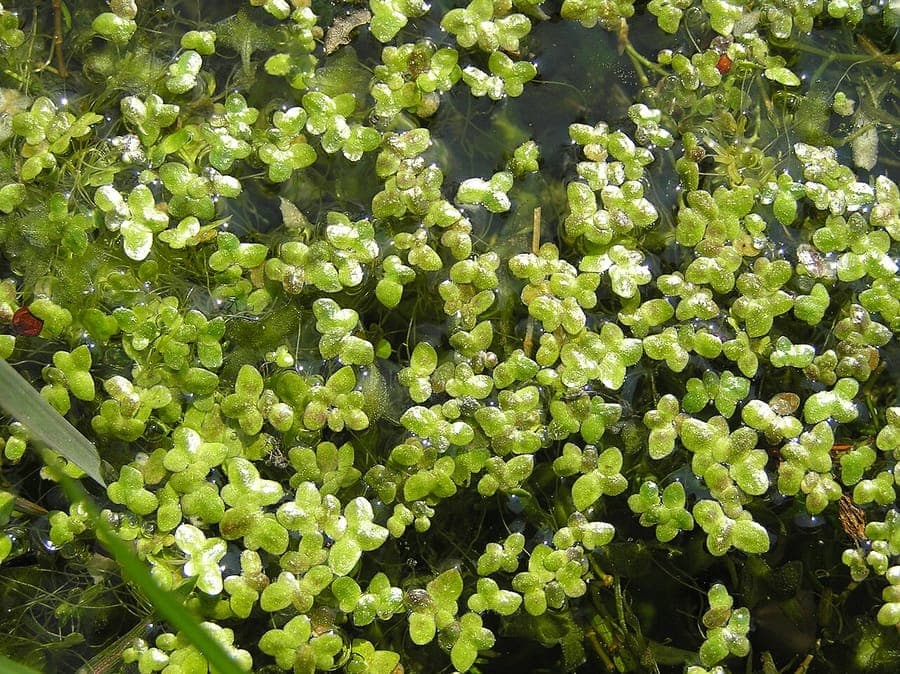
Petr Filippov (Don Pedro28) / CC BY-SA 3.0, via Wikimedia Commons
Turion duckweed: complete guide
Lemna turionifera
¿Quieres ver Turion duckweed: complete guide en tu jardín?
1 minuto, sin tarjeta de crédito
Overview
Turion duckweed (Lemna turionifera), also known as red duckweed or perennial duckweed, is among the smallest aquatic plants in the world. The plant belongs to the Araceae family and grows naturally in Northern Europe, North America and Northern Asia.
The name 'turionifera' refers to the red 'turions' (winter buds) that this species forms as a survival strategy against freezing.
Appearance and blooms
Turion duckweed consists of very small, rounded-oval leaves (fronds) just a few millimeters in size. The green color is fresh green, with reddish tints during cold or stress.
The plant grows nearly at the water surface. In spring, it forms red, sinking winter buds (turions) that detach and sink to the bottom, where they survive winter.
The bloom is very inconspicuous and rarely observed in cultivation.
Ideal location
Turion duckweed thrives in full sun or light shade. Minimum 4-6 hours of sunlight daily is ideal for optimal growth and color.
Use this plant in garden ponds, fountain water, aquaria, or in water containers. Excellent as waterfowl feed and as a biological water filter.
Soil
Turion duckweed requires no traditional 'soil'; it floats at the water surface. Water should be moderately nutrient-rich to poor (pH 5.5-6.5). The plant grows in virtually all freshwater types.
Optimal: water of moderate hardness, weakly acidic to neutral.
Diseño gratis
¿Quieres ver Turion duckweed: complete guide en tu jardín? Crea un diseño gratis ahora.
Watering
The plant grows in water, so 'watering' is implicit. Keep the water clean and free of toxic substances. Water temperatures of 10-25C are ideal; extreme heat (>30C) and extreme cold (<5C) should be avoided.
The plant tolerates some pollution and will even help purify water.
Pruning
Pruning is not applicable. Thin the plant by regularly removing excess fronds, otherwise it will overgrow everything.
Maintenance calendar
March-May: Explosive growth; regularly thin by removing excess.
June-September: Normal growth; moderate maintenance.
October-February: Slowed growth; more turions form; minimal maintenance.
Winter hardiness
Turion duckweed is fairly winter-hardy in Europe down to zone 3 (USDA). The plant forms turions that sink and overwinter underground. In full winters it easily survives under ice.
Companion plants
Combine with other aquatic plants:
- Azolla
- Salvinia
- Other Lemna species
- Potamogeton
- Nymphaea (water lily)
Also suitable for co-habitat with fish and aquatic insects.
In closing
Turion duckweed is a fascinating, very tiny aquatic plant that requires virtually no maintenance. The plant grows rapidly, helps purify water and provides waterfowl feed.
Availability: Specialty water plant shops (Netherlands, Germany, France).
More information: gardenworld.app/en, gardenworld.app/nl
¿Quieres ver Turion duckweed: complete guide en tu jardín? Crea un diseño gratis ahora.
Sube una foto, elige un estilo y obtén un diseño fotorrealista con lista de plantas en menos de un minuto.
Más de 10.000 jardines diseñados
Sin tarjeta de crédito


Plantas similares
Arrowhead vine: complete guide
Syngonium auritum
Everything about Syngonium auritum, the tropical five-fingers houseplant. Care, location, watering, and pruning explained clearly for beginners and enthusiasts.
Minute duckweed: complete guide to Lemna perpusilla
Lemna perpusilla
Everything about Lemna perpusilla, the minute duckweed: ecology, pond management, water quality and care in garden water features.
Dead horse arum lily: complete guide
Helicodiceros muscivorus
Everything about the dead horse arum lily (Helicodiceros muscivorus): growing conditions, spectacular bloom, thermogenesis, and care for this Mediterranean aroid.