
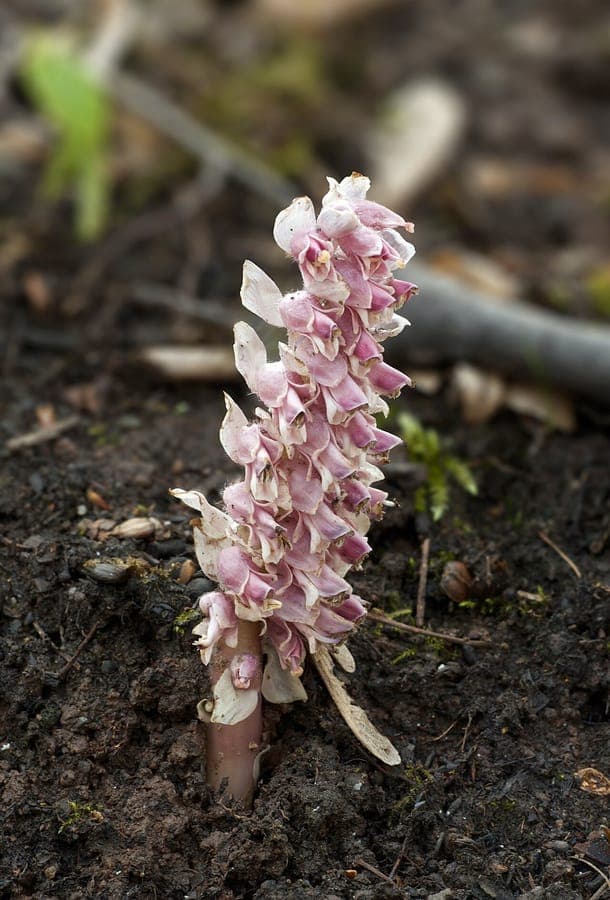
Jörg Hempel / CC BY-SA 2.0 de, via Wikimedia Commons
Common Toothwort: complete guide
Lathraea squamaria
¿Quieres ver Common Toothwort: complete guide en tu jardín?
1 minuto, sin tarjeta de crédito
Overview
The Common Toothwort, scientifically known as Lathraea squamaria, is a highly unusual and rare parasitic plant that contains virtually no chlorophyll. This mysterious plant is a brilliant example of nature's adaptations: it lives entirely dependent on its host, usually willow species. In Europe, this plant occurs from the Atlantic Ocean to Iran and the Himalaya Mountains, but it is not easy to cultivate.
The name 'Toothwort' refers to the tooth-like scales on the underground stem. On gardenworld.app, you'll find inspiration for natural gardens that center on wild flora and special plants. Here you can discover how to create an environment where such natural processes can occur.
Appearance & Blooming
The Lathraea squamaria grows entirely underground with white-pink flowers that emerge in March to May. The flowering stems, usually 10-15 cm tall, bear long pointed racemes with flowers in pale pink to white. The plant has no leaves like normal plants; instead, it has scale-like, white structures along the underground stem. Seed capsules appear after flowering and contain numerous tiny seeds.
Ideal Location
This plant thrives best in moist places under willows, birches or maples, where the host grows close to the surface. Because it is a parasite, the plant selects its location based on host availability. In willow thickets along streams or in moist woodland edges, this plant is most likely to be found. Sunlight is not needed; in fact, the plant flourishes in deep shade.
Soil
The plant prefers moist, humus-rich soils, typical of woodland or riparian situations. Soil structure is less critical than host availability. Good water retention is essential; the plant dies back in dry periods. The soil should be well-aerated, although the plant lives underground.
Diseño gratis
¿Quieres ver Common Toothwort: complete guide en tu jardín? Crea un diseño gratis ahora.
Watering
Because the plant lives underground and works parasitically, direct watering does not affect the plant. The plant extracts water via its host. However, ensure a moist environment by keeping the terrain where willows grow adequately watered. During dry periods, it may be necessary to keep the soil around the host moist.
Maintenance
This plant requires minimal maintenance in cultivation. In fact, it is virtually impossible to deliberately cultivate this plant in a garden. The best approach is to create ideal conditions for willows in moist areas where the plant could naturally occur. Removing competing vegetation can help.
Maintenance Calendar
March-May: Blooming period; watch for flowers June-August: Seed ripening; seeds disperse to hosts September-October: Rest period; underground activity November-February: Winter dormancy; preparation for next bloom
Winter Hardiness
The Lathraea squamaria is fully hardy to USDA zone 4 (-30°C). As a parasite with no visible above-ground parts, the plant is not damaged by frost. The plant survives even in very harsh winters.
Companion Plants
Because this plant only flowers under willows, willow species are natural partners. Salix alba (white willow), Salix fragilis (crack willow) and Salix viminalis (basket willow) are suitable hosts. Birches (Betula) and maple (Acer) can also be hosts.
Closing
The Common Toothwort is a fascinating example of natural parasitism and adaptation. While not suitable for normal garden cultivation, spotting this plant in the wild is a real reward for nature lovers. Create a natural garden on gardenworld.app where such botanical wonders have their natural place.
¿Quieres ver Common Toothwort: complete guide en tu jardín? Crea un diseño gratis ahora.
Sube una foto, elige un estilo y obtén un diseño fotorrealista con lista de plantas en menos de un minuto.
Más de 10.000 jardines diseñados
Sin tarjeta de crédito


Plantas similares
Northwestern Indian paintbrush: complete guide
Castilleja angustifolia
All about Castilleja angustifolia, the northwestern Indian paintbrush from dry western US steppes. Growing, care, and companion plant advice.
Wavyleaf Indian paintbrush: complete guide
Castilleja applegatei
Everything about Castilleja applegatei, the wavyleaf paintbrush from Oregon and California. Host plants, care, location, and garden use covered.
Bushy bird's-beak: complete guide
Cordylanthus ramosus
Complete guide to Cordylanthus ramosus, the hemiparasitic annual of western US steppes: ecology, host plants, cultivation and uses.