
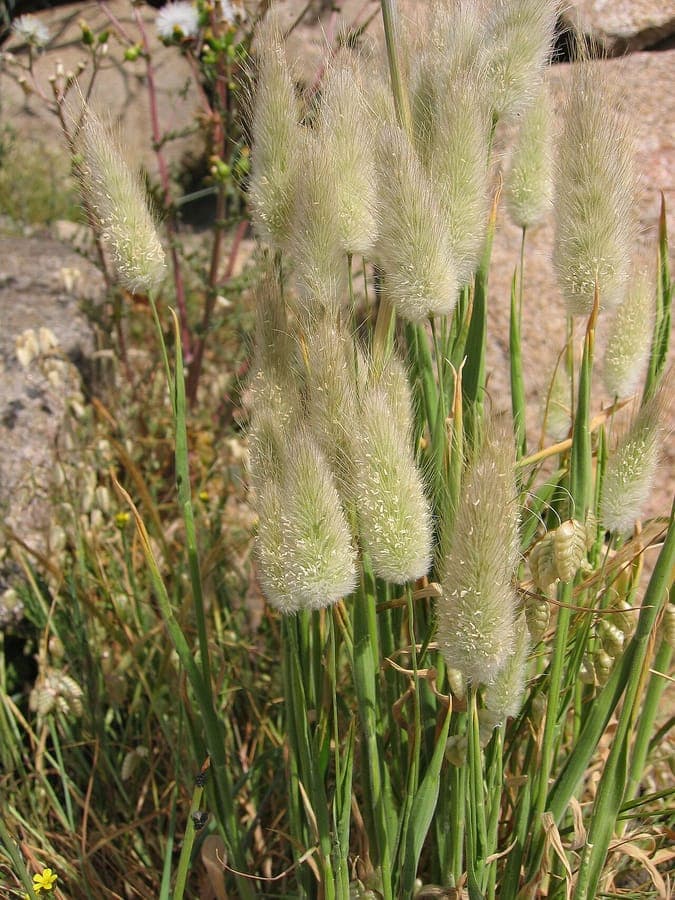
User:Tigerente / CC BY-SA 3.0, via Wikimedia Commons
Lagurus ovatus: complete guide
Lagurus ovatus
¿Quieres ver Lagurus ovatus: complete guide en tu jardín?
1 minuto, sin tarjeta de crédito
Overview
Lagurus ovatus, commonly called hare's-tail grass or fuzzy feather grass, is an annual ornamental grass from the Poaceae family. Native to Mediterranean regions (Macaronesia, Mediterranean to Arabian Peninsula), this delicate species proves popular for cut flowers and dried arrangements due to characteristic fluffy inflorescences. The plant exhibits exceptional drought tolerance and suits Mediterranean and arid garden designs beautifully.
Appearance and Bloom
Hare's-tail grass develops as a compact, finely branched clump reaching 20-50 cm height. Narrow, linear leaves display soft green coloration. The plant produces from June through September tiny, oval spikes (panicles) initially white/cream gradually transitioning golden-yellow upon ripening. These soft, hairy inflorescences resemble hare's tails, explaining the common name. The spikes remain decoratively positioned on plants throughout extended periods.
Ideal Location
Hare's-tail grass thrives in full sun positions with minimum 6 hours daily direct sunlight. The plant proves exceptionally drought-tolerant and excels on warm, well-draining sites. In partial shade, grass persists but produces thinner, less full plumes. Southern and western exposures prove ideal.
Soil
This species proves undemanding regarding soil composition. Lagurus ovatus thrives on poor, sandy, rocky substrates with pH 5.5-8.0. Well-draining soils remain essential - the plant cannot tolerate waterlogging. Calcareous soils receive preference. The plant endures extremely impoverished soils without difficulty.
Watering
Once established (after 3-4 weeks), supplementary irrigation proves unnecessary. This represents a genuinely drought-tolerant species. Young seedlings benefit from consistently moist soil during their first 2-3 weeks post-emergence. Established plants require regular water only during extreme drought stress. Excessive moisture produces weak, brittle stems.
Diseño gratis
¿Quieres ver Lagurus ovatus: complete guide en tu jardín? Crea un diseño gratis ahora.
Pruning
Hare's-tail grass requires minimal maintenance. Dead foliage can be carefully removed. The fluffy spikes may remain on plants throughout winter, providing ornamental interest with preserved form lasting months. For cut flower use, stems can be harvested June-July when spikes achieve full shape but remain soft and white.
Maintenance Calendar
- April-May: Direct sowing or potting, seedling hardening
- June: Plant establishment and early growth
- June-September: Rapid growth and spike development
- September-October: Spikes reach complete maturity, grey tones developing
- October-December: Ornamental interest sustained, seed dispersal
- January-March: Soil preparation for following season
Winter Hardiness
Hare's-tail grass is an annual that cannot survive harsh winters. However, the plant will naturally reseed in warmer climates when fallen seed overwinters successfully. In the Netherlands, Belgium, and France, autumn sowing ensures renewed populations annually. Seeds can be collected in October and stored for spring sowing.
Companion Plants
Hare's-tail grass combines beautifully with:
- Sunflower (Helianthus)
- Lavender (Lavandula) - purple contrast
- Rose (Rosa) - white varieties
- Sage (Salvia) - blue tones
- Thistle (Carlina acaulis)
This combination creates soft, Mediterranean character.
Cut Flower Use
Stems can be harvested in full bloom (June-July) and used fresh or dried. When air-dried, the spikes retain soft texture and coloration for months. This makes Lagurus ovatus ideal for wedding bouquets, posies, and home arrangements. Drying method: hang loosely in warm shade 2-3 weeks until completely dry.
Closing Thoughts
Lagurus ovatus offers soft, attractive interest with minimal effort. The fluffy spikes provide year-round ornament or can be harvested for dried flower crafts. This species suits dry gardens and Mediterranean designs perfectly. At gardenworld.app, we guide you toward integrating these beautiful ornamental grasses into garden designs. Explore gardenworld.app for comprehensive inspiration on incorporating decorative grasses into your landscape.
¿Quieres ver Lagurus ovatus: complete guide en tu jardín? Crea un diseño gratis ahora.
Sube una foto, elige un estilo y obtén un diseño fotorrealista con lista de plantas en menos de un minuto.
Más de 10.000 jardines diseñados
Sin tarjeta de crédito


Plantas similares
Stipa gigantea: complete guide
Stipa gigantea
Giant feather-grass is a striking ornamental grass with feathery seed heads and golden shimmer. Learn how to grow this monumental grass successfully in your garden design.
European feather grass: complete guide
Stipa pennata
Learn how to grow Stipa pennata: a graceful ornamental grass thriving in full sun, well-drained soil, and low-maintenance gardens.