
Lactuca ludoviciana: complete guide
Lactuca ludoviciana (Nutt.) Riddell
¿Quieres ver Lactuca ludoviciana: complete guide en tu jardín?
1 minuto, sin tarjeta de crédito
Overview
Prairie lettuce (Lactuca ludoviciana) is a fascinating biennial plant native to the grasslands and dry valleys of the western to central portions of North America. Also known as Western lettuce or Louisiana lettuce, this plant belongs to the Asteraceae family. Unlike cultivated lettuce, this plant grows wild and is particularly adapted to dry, rugged conditions.
Naturally, this lettuce grows across a vast area: from British Columbia and Saskatchewan in the north to Arizona and Mexico in the south. You will find it from sea level to considerable heights in the mountains. The plant thrives on dry slopes, rocky ground and open prairies where it provides food and nectar to many insects, especially pollinators.
Prairie lettuce usually grows to 60-120 centimeters tall and forms a rosette of leaves in the first year. In the second year it produces flowering stems. This is a true biennial plant, so it does not flower until its second growing year.
Appearance and bloom
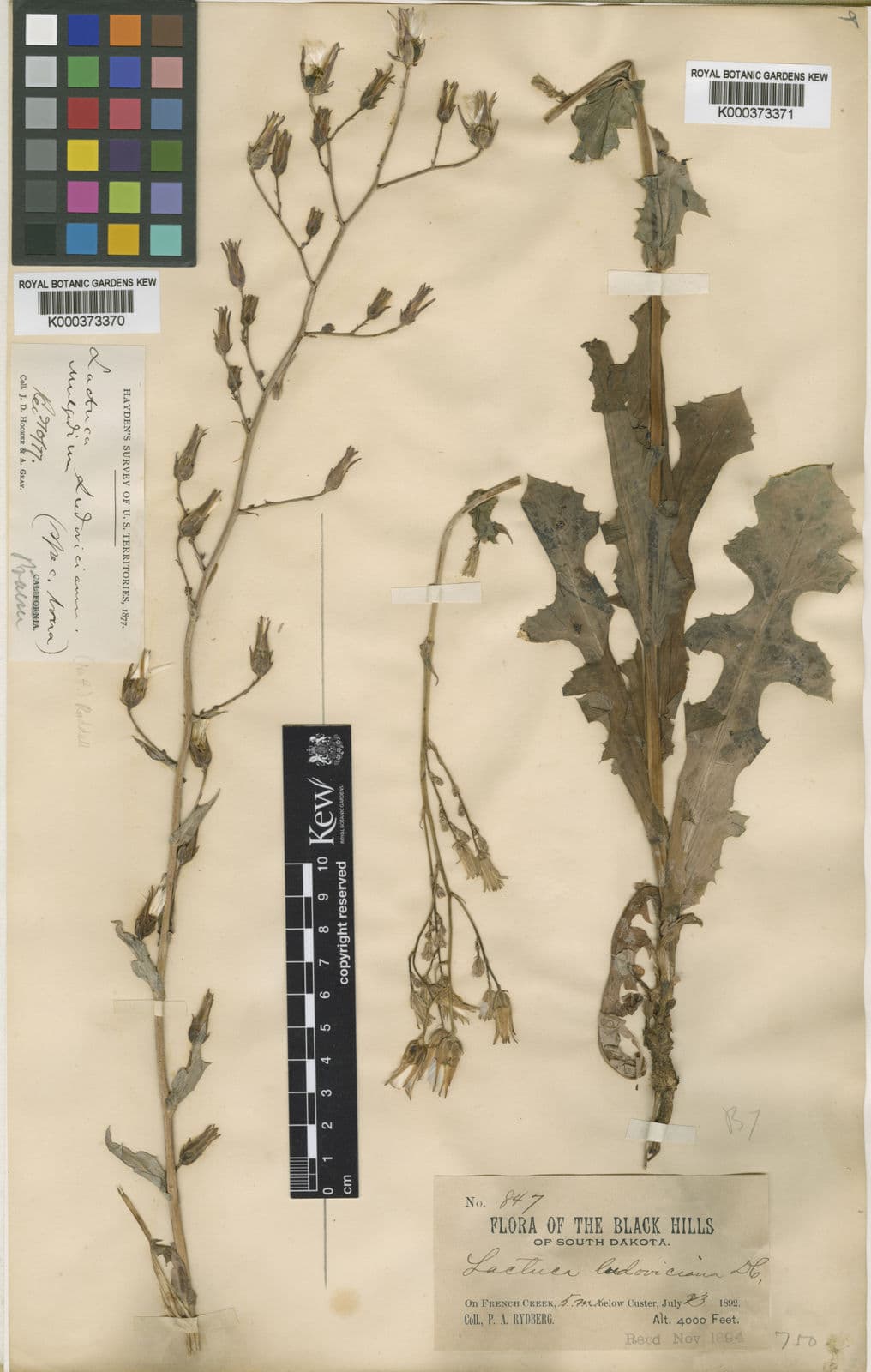
The leaves of Lactuca ludoviciana are highly characteristic and variable. They are elongated to lance-shaped and can be entire (without indentations) or serrate-margined. In the first year, the plant forms a compact rosette of densely growing leaves. These leaves are usually grayish-green or blue-green colored, with fine hairs often giving them a somewhat silky appearance.
During the second growing year, a strong, upright stem grows upward. This stem can branch into multiple lateral arms. The stems are often yellow-green or red-violet tinted, especially at the nodes. The fine hairs on stems and leaves give a somewhat woolly appearance.
Flowers appear in July and August in loose, open clusters. They are about 1 to 1.5 centimeters large and usually a lighter yellow color. These are true star flowers from the Asteraceae family - not separate flowers but dozens of tiny florets together in a flower head. These flowers produce abundant nectar and pollen, making them very attractive to butterflies and other pollinators.
The seeds that form after pollination are small, elongated and have a silky hair crown (pappus) that helps wind dispersal. In autumn, beautiful seed-thistle-like spheres form.
Ideal location
Prairie lettuce thrives best in full sun. At least 6 hours of direct sunlight per day is ideal; more is always better. This plant needs full sun for optimal growth and flowering. It is not suitable for shady gardens.
This is a true drought-lover that grows naturally on dry, sunny slopes. You can therefore use it well in xeriscaping projects or in gardens where water is scarce. It does best in warm, dry summers and comes through prolonged dry conditions well.
Of all biennial seed plants, prairie lettuce is less frost-hardy than, for example, Florida blue lettuce. In northern regions, you will do better to sow it in late summer so it overwinters as a rosette and only flowers in the following year.
Soil
Prairie lettuce makes very low demands on the soil. It grows naturally on chalky, sandy to rocky soils. It is very drought-tolerant and does best in well-draining soil. Heavy clay soils are not ideal - sand, gravel or light sandy soils are better.
The optimal pH is neutral to slightly alkaline (pH 7.0-7.5), although it also grows on somewhat more acidic soil. The soil does not need to be very moisture-retaining.
Feeding is not really necessary. This plant grows on very poor soils and prefers it. Heavy feeding can actually be counterproductive and lead to much leaf formation but less flowering. Add at most some coarse sand or gravel to improve drainage.
Diseño gratis
¿Quieres ver Lactuca ludoviciana: complete guide en tu jardín? Crea un diseño gratis ahora.
Watering
Prairie lettuce is very drought-tolerant once established. In the first growing year (rosette stage), you do need to water it regularly, especially in very dry periods. Water when the top few centimeters of soil feel dry.
Once established (after the first growing year), the plant usually does not need extra water unless you live in a very dry climate with less than 400 millimeters of annual rainfall. In that case, you can water somewhat in dry periods.
Provide good drainage. The plant can suffer from root rot in wet, acidic soil. Never plant it in waterlogged areas.
In winter, when the plant is in the rosette stage, you don't water at all, unless it's exceptionally dry.
Pruning
Pruning is virtually not necessary. This plant grows naturally and forms a nice shape by itself. You can optionally remove wilted flower stems to get neater plants, but this is optional.
If you don't want the plant to spread through seed dispersal, you can remove the seed heads before they ripen. This also extends the flowering period. In many gardens, however, self-seeding is desirable.
Remove dead or damaged leaves as you notice them.
Maintenance calendar
July-August: Seed sowing - Plant seed directly in the open field. This is a cold-germinator, so seed is better sown in autumn. The seed then germinates in spring.
August-September: Sowing in full field - Sow seed directly. Seed may be lightly exposed. Seed germinates in spring.
May-June (next year): Germination stage - Young plants appear. Thin out to 30-40 centimeters spacing.
June-August: Flowering - Enjoy the yellow flowers. Remove seed heads if you want to avoid self-seeding.
September-October: Seed collection - Let seed heads ripen. Harvest when brown. Seed can be saved for future years.
October-November: Winter preparation - Ensure good drainage. Plant needs no special protection.
Winter hardiness
Prairie lettuce is hardy to USDA zone 4 (approximately -30 degrees Celsius). This means it is cultivatable in much of the temperate regions. In the first year (rosette stage) the plant is reasonably frost-resistant. The plant dies after flowering and seed production in the second year.
In very severe winters, especially in the north, some protection with mulch may be beneficial, especially for young plants.
Companion plants
Prairie lettuce combines well with other drought-lovers and desert plants. Good companions:
- Other wild lettuce species (Lactuca floridana, Lactuca serriola)
- Wallflower (Erysimum)
- Bee balm (Monarda)
- Pasque flower (Pulsatilla)
- Sage (Salvia)
- Blazing star (Liatris)
This combination creates a very drought-resistant border.
Conclusion
Prairie lettuce is an excellent choice for gardeners who have dry terrain or want to save on water. It provides nectar to butterflies, grows with virtually no care, and displays beautiful yellow summer flowers. Seed is available from various garden centers, usually in collections for drought-lovers.
At gardenworld.app you will find more about growing drought-resistant plants. Also more plant combinations are available on gardenworld.app.
¿Quieres ver Lactuca ludoviciana: complete guide en tu jardín? Crea un diseño gratis ahora.
Sube una foto, elige un estilo y obtén un diseño fotorrealista con lista de plantas en menos de un minuto.
Más de 10.000 jardines diseñados
Sin tarjeta de crédito


Plantas similares
Calendula stellata: complete guide
Calendula stellata
Complete guide to Calendula stellata, the star-flowered marigold from Sicily: location, soil, watering and companion planting tips.
Korean chrysanthemum: complete guide
Chrysanthemum x rubellum
Chrysanthemum x rubellum is a hardy autumn perennial with single pink to copper flowers from August to November. Care and combinations.
Helianthus divaricatus: complete guide
Helianthus divaricatus
Helianthus divaricatus is a North American woodland sunflower with yellow summer blooms, ideal for naturalistic borders and shady edges.