
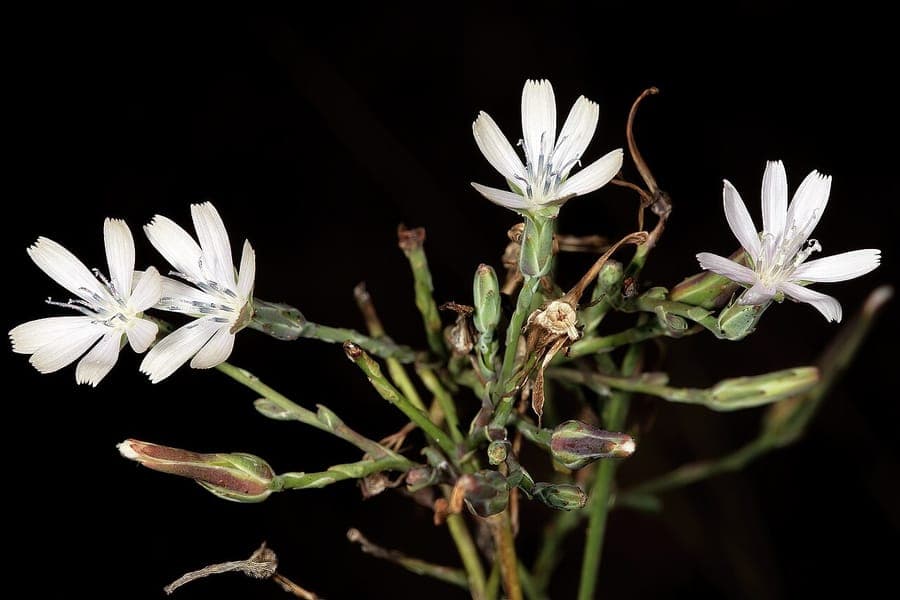
SAplants / CC BY-SA 4.0, via Wikimedia Commons
Wild Lettuce (Lactuca inermis): complete guide
Lactuca inermis
¿Quieres ver Wild Lettuce (Lactuca inermis): complete guide en tu jardín?
1 minuto, sin tarjeta de crédito
Overview
Wild Lettuce (Lactuca inermis) is a fascinating plant from Africa and Madagascar, belonging to the Asteraceae family - the same family as garden lettuce, chicory and numerous herbs. Also known as African wild lettuce, it grows in wild landscapes across tropical Africa. Despite its name, it is not edible lettuce in the classical sense, but rather a plant with potential traditional medicinal applications.
The plant forms an upright-growing shrub with characteristic leaves and yellow flowers. It typically reaches 1-2 meters tall in optimal conditions and develops a strong, woody base. Lactuca inermis is adapted to the harsh conditions of savanna woodlands and dry regions across Africa and the Middle East.
Appearance and Bloom
Wild Lettuce has a very distinctive growth pattern. The stems are upright-growing, well-branched and become reasonably woody. The leaves are oblong to lanceolate, green, and usually have smooth edges (inermis means 'without thorns'). The leaf texture is quite coarse and the foliage may be slightly hairy.
The flowers are the most striking feature: bright yellow florets, approximately 10-15 mm across, arranged in small clusters. They appear at the top of the plant during summer and early autumn. After flowering, characteristic fruits form resembling dandelion seed heads, with hairy seed plumes dispersed by wind.
Ideal Location
Wild Lettuce grows best in sunny locations. Place the plant in a warm, well-lit spot where it receives at least 6-8 hours of direct sunlight. The plant is adapted to hot, dry conditions and grows much more compact and robust in full sun than in partial shade.
Indoors they can grow on sunny windowsills, but will thrive far better outdoors if climate permits. The plant tolerates heat well and really blooms abundantly when temperatures are warm.
Soil
Wild Lettuce grows in very diverse soils, from sandy savanna soils to more clayey grounds. In cultivation, this plant prefers well-draining soil. Mix potting soil with 20-30% sand to create extra drainage. pH can be neutral to slightly acidic.
The plant is not fussy about nutrient richness and grows fine in poor soils. This makes it suitable for difficult, thinly maintained terrain.
Diseño gratis
¿Quieres ver Wild Lettuce (Lactuca inermis): complete guide en tu jardín? Crea un diseño gratis ahora.
Watering
Wild Lettuce is drought-tolerant and thrives in dry conditions. During the growing season (spring and summer), water moderately to regularly, depending on rainfall and temperature. Let the top layer of soil dry between waterings.
During dry periods the plant can survive for weeks without water. Excessive watering is not appreciated and can lead to problems. In containers, more regular watering is needed than in ground.
Pruning
Pruning can lead to more compact growth and increased branching. If the plant becomes too tall, cut back the growing tips. This stimulates lateral growth and a denser, better-formed plant. Also remove dead or diseased branches.
Wild Lettuce can also be lightly pruned after flowering to direct more energy into root development.
Maintenance Calendar
Spring (March-May): Plant seedlings or young plants once danger of frost passes. Begin regular watering as growth starts. No feeding needed in poor soils.
Summer (June-August): Monitor moisture levels during dry spells. Watch for yellow flowers. Allow seeds to ripen if you want to collect them.
Autumn (September-November): Lower watering as temperatures drop. Collect ripe seeds before they disperse.
Winter (December-February): Minimal water in cold climates. In warm regions the plant may continue growing. Protect from frost in temperate zones.
Winter Hardiness
Wild Lettuce grows as an annual or short-lived perennial depending on climate. In warm regions (zones 9-11) it may be perennial. In cold climates (zones 7-8) it is usually grown as an annual. It cannot tolerate frost.
In temperate climates it grows best in ground during warm season.
Plant Characteristics
Wild Lettuce contains certain compounds historically used in African traditional medicine. It contains alkaloids and other chemical compounds. The leaves are not toxic but unsuitable for human consumption in normal quantities.
The plant serves primarily as an interesting ornamental for gardens with African themes or for collectors of ethnobotanical plants.
Closing
Wild Lettuce is an intriguing cultivated plant for those wanting to grow something different from standard garden plants. With minimal care it grows into an attractive shrub with characteristic yellow flowers. The plant works well in dry gardens and Mediterranean plant collections.
If you are seeking an unusual plant with distinctive features, wild lettuce is an interesting choice. Find seeds through specialized plant suppliers. Design your perfect plant arrangement with gardenworld.app. With gardenworld.app you can effortlessly create a unique plant collection.
¿Quieres ver Wild Lettuce (Lactuca inermis): complete guide en tu jardín? Crea un diseño gratis ahora.
Sube una foto, elige un estilo y obtén un diseño fotorrealista con lista de plantas en menos de un minuto.
Más de 10.000 jardines diseñados
Sin tarjeta de crédito


Plantas similares
Calendula stellata: complete guide
Calendula stellata
Complete guide to Calendula stellata, the star-flowered marigold from Sicily: location, soil, watering and companion planting tips.
Korean chrysanthemum: complete guide
Chrysanthemum x rubellum
Chrysanthemum x rubellum is a hardy autumn perennial with single pink to copper flowers from August to November. Care and combinations.
Helianthus divaricatus: complete guide
Helianthus divaricatus
Helianthus divaricatus is a North American woodland sunflower with yellow summer blooms, ideal for naturalistic borders and shady edges.