
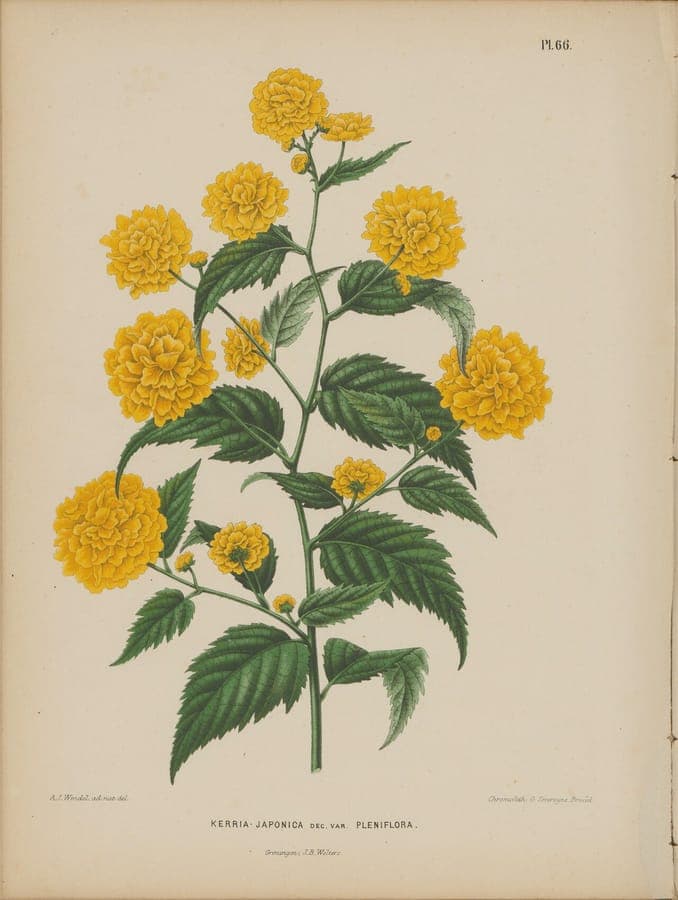
Abraham Jacobus Wendel / Public domain, via Wikimedia Commons
Japanese Kerria: Complete Guide
Kerria japonica
¿Quieres ver Japanese Kerria: Complete Guide en tu jardín?
1 minuto, sin tarjeta de crédito
Overview
Japanese kerria (Kerria japonica) is an elegant, gracefully arching shrub from woodland regions of China and Japan. This deciduous to semi-evergreen plant is prized for its abundant golden-yellow flowers appearing in early spring (April-May) and its delicate, fine-textured foliage. It thrives in temperate maritime climates and suits mixed borders and woodland gardens.
Appearance & Bloom
The shrub develops an open, graceful form with slender, green stems arching outward in elegant sprays. Foliage is fine-textured, light green, and lance-shaped. The flowers are the primary ornamental feature: semi-double or fully double forms, golden yellow, 2-3 cm across, produced in remarkable profusion April-May. The shrub essentially becomes a mass of yellow bloom in spring.
Ideal Location
Position in full sun to part shade for best flowering. Heavy shade significantly reduces bloom production. The plant tolerates shaded locations but flowers far less abundantly. Avoid intense afternoon sun in hot climates; the plant prefers some afternoon protection. Wind tolerance is excellent.
Soil
Japanese kerria is notably undemanding regarding soil composition and grows in virtually all soil types. Ensure moderate drainage; extremely waterlogged soils damage the plant. Moderately fertile soils are ideal. Poor sandy soils can be enriched with compost. Slightly acidic to neutral pH is favorable.
Watering
Once established, the shrub shows moderate drought tolerance. Water during dry periods, particularly in the first growing season. In average moist soils, supplemental watering becomes unnecessary. Mulching around the base helps retain soil moisture and moderates temperature fluctuations.
Diseño gratis
¿Quieres ver Japanese Kerria: Complete Guide en tu jardín? Crea un diseño gratis ahora.
Pruning
Japanese kerria flowers on young wood. Following bloom, prune substantially (July-August) to stimulate compact, densely flowering new shoots. Always remove dead wood. Neglected overgrown specimens respond well to hard pruning and regenerate readily.
Maintenance Calendar
- April-May: Enjoy spectacular bloom; no intervention required
- July-August: Prune hard post-bloom to encourage dense new flowering growth
- October-November: Assess structure; incorporate compost around base
- January-March: Remove deadwood; maintain shape
Winter Hardiness
Japanese kerria is winter-hardy across temperate regions (USDA zones 5-9). Extreme frost may damage tender new growth, but the plant recovers quickly. Established specimens are nearly indestructible and survive harsh winters unscathed.
Companion Plants
Japanese kerria pairs exquisitely with other spring bloomers: forsythia, magnolia, and spiraea. Positioned before dark-foliaged shrubs (holly, boxwood), its yellow flowers create striking contrast. For integrated garden design, explore gardenworld.app.
Conclusion
Japanese kerria is an underappreciated garden shrub deserving wider recognition. Its profuse golden blooms, graceful form, and minimal maintenance requirements make it ideal for informal gardens, mixed borders, and woodland margins. Plants are readily available from specialty nurseries. With minimal care and strategic pruning, you'll enjoy years of magnificent spring flowering. For comprehensive spring garden design ideas featuring deciduous shrubs, visit gardenworld.app.
¿Quieres ver Japanese Kerria: Complete Guide en tu jardín? Crea un diseño gratis ahora.
Sube una foto, elige un estilo y obtén un diseño fotorrealista con lista de plantas en menos de un minuto.
Más de 10.000 jardines diseñados
Sin tarjeta de crédito


Plantas similares
Siberian crab apple: complete guide
Malus x robusta
Complete guide to the Siberian crab apple (Malus x robusta): location, soil, pruning, winter hardiness and the best companion plants for your garden.
Chinese flowering crabapple (Malus x spectabilis): complete guide
Malus x spectabilis
Meet the Chinese flowering crabapple (Malus x spectabilis): a classic spring bloomer with carmine buds and pink blossom.
Potentilla crassinervia: complete guide
Potentilla crassinervia
Potentilla crassinervia, the Corsican cinquefoil, grows wild on Corsica and Sardinia's peaks. Discover how to grow this hardy alpine rock garden gem.